
Deadly Hong Kong Fire Raises Critical Safety Concerns About Traditional Bamboo Scaffolding
- Date & Time:
- |
- Views: 56
- |
- From: India News Bull
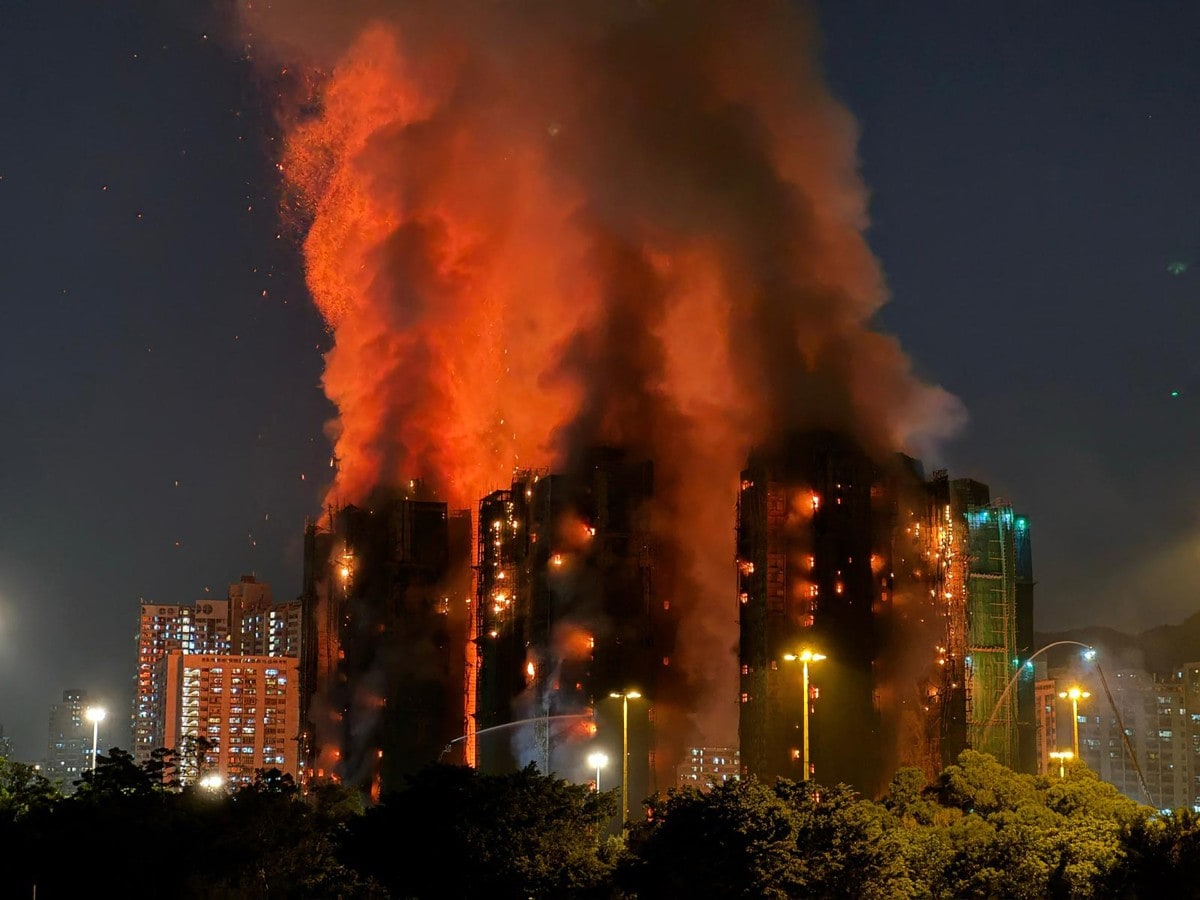
Officials reported that the fire originated on the external scaffolding of a 32-story tower located in the Tai Po suburb.
While authorities have yet to determine the exact cause of the devastating inferno that engulfed a Hong Kong apartment complex, significant concerns have emerged regarding the bamboo scaffolding that surrounded the buildings during the fire incident.
The catastrophic blaze, claiming at least 75 lives, has drawn attention to this ancient construction technique that dates back more than 1,000 years.
Throughout Southeast Asia, construction sites commonly feature bamboo poles secured together with wire and other robust materials. Hong Kong remains one of the few major metropolitan areas where this traditional scaffolding method is still prevalent.
According to officials, Wednesday's fire initiated on the external bamboo scaffolding of a 32-story tower in Tai Po, subsequently penetrating the building's interior before spreading to six additional towers, likely accelerated by windy conditions.
Investigators are currently examining why the scaffolding and other renovation materials on the buildings' exteriors ignited.
Bamboo, characterized by its rapid growth, forms tall, hollow stems with dense, strong fibers. Harvested from 3-year-old plants, these lightweight, cost-effective poles are easily transportable. They're considered more suitable for installation and removal in Hong Kong's densely populated urban environment with limited space.
In accident scenarios such as structural collapses, bamboo poles are perceived as less hazardous than heavier metal alternatives. This traditional scaffolding is also utilized for temporary structures, including outdoor theatrical venues.
The bamboo materials typically originate from Zhaoxing in neighboring Guangdong province, or from the southern provinces of Guangxi and Guilin.
However, even Hong Kong has begun transitioning away from bamboo usage.
A March memorandum from Hong Kong's development secretary indicated plans to "drive a wider adoption of metal scaffolding in public building works progressively."
The Construction Industry Council reports approximately 2,500 registered bamboo scaffolders in Hong Kong. Since 2018, accidents related to bamboo scaffolding have resulted in 23 fatalities.
On Thursday, city leader John Lee announced plans for officials to consult with industry representatives regarding a transition to metal scaffolding systems.
Eric Chan, Chief Secretary for Administration, acknowledged that traditional bamboo scaffolding exhibits inferior fire safety compared to metal alternatives. "For safety reasons, the government believes that a complete switch to metal scaffolding should be implemented in suitable working environments," he stated.
Ehsan Noroozinejad, a professor at Western Sydney University's Urban Transformations Research Centre, explained that steel or aluminum scaffolding offers non-combustible properties, greater strength, and longer durability, despite being heavier, slower to assemble, and more expensive.
"For high-risk, occupied towers, metal is the safer baseline," Noroozinejad emphasized. "If bamboo is used, it must come with strict fire and inspection controls."
Regarding Wednesday's high-rise residential complex fire in Tai Po district, officials have identified flammable construction materials like plastic netting and Styrofoam window coverings as potential factors contributing to the fire's rapid propagation.
Police have arrested three individuals—two directors and an engineering consultant from a construction company—on suspicion of manslaughter. Authorities suspect that certain materials on the buildings' exterior walls failed to meet fire resistance standards, enabling the unusually swift fire spread.
Evidence indicates that a substantial portion, though not all, of the bamboo scaffolding surrounding the buildings undergoing renovations was consumed by the fire.
"This incident is full of lessons," stated Devansh Gulati, founder of fire safety firm Greenberg Engineering, in comments to The Associated Press. He noted that "just by chance, the wrong conditions combined" in Hong Kong, transforming the bamboo scaffolding into fuel for the devastating fire.
Regardless of the investigation's outcome regarding the fire's cause, it appears the era of bamboo scaffolding in Hong Kong may be drawing to a close.
Source: https://www.ndtv.com/world-news/hong-kong-fire-puts-its-iconic-bamboo-scaffolding-under-scrutiny-9712866