
Survivors Recount Devastating Hong Kong Apartment Fire That Killed 65 and Left 250 Missing
- Date & Time:
- |
- Views: 79
- |
- From: India News Bull
China:
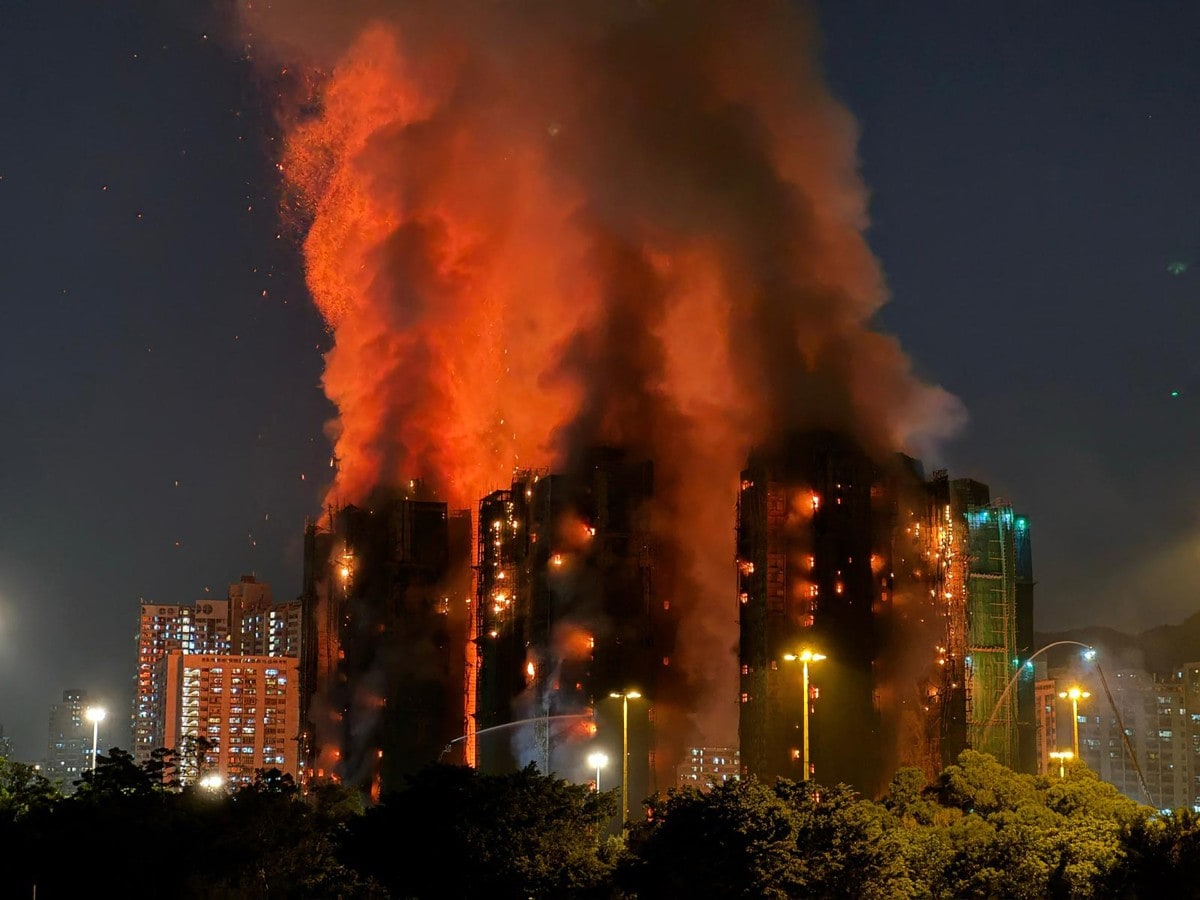
In Hong Kong's most devastating fire in nearly eight decades, at least 65 people lost their lives within an eight-building apartment complex, with more than 250 individuals still unaccounted for.
Authorities established a community center where police displayed photographs of the deceased for identification by family members and friends.
On Thursday, survivors and relatives at the center shared their harrowing experiences with AFP:
Wong Sik-Kam explained that his son, a firefighter, was battling the blaze that consumed his home of four decades.
The inferno originated in mesh-covered bamboo scaffolding and quickly spread from one block to another, propelled by strong winds.
"The fire began at the sixth block. Then it progressed to the fifth and fourth blocks and continued spreading," Wong recounted.
"Since the third block connects to the first and second, once the third block ignited, the other two were inevitably affected."
Only the eighth block remained untouched.
"Those residents are considered fortunate," remarked Wong, whose apartment in the third block was completely destroyed.
Firefighters were already responding when his son alerted him to flee.
"My son called to inform me, 'Dad, there's a fire'. When I looked out the window, I observed firefighters rescuing people from the fourth and fifth blocks," he said.
"I initially thought it was just a routine fire... a minor disturbance that would be quickly extinguished," he continued.
"But it grew so enormous that the entire estate was engulfed in flames."
Witnessing firefighters evacuating residents from other blocks made him realize the true magnitude of the disaster.
"I went door to door, knocking and shouting, 'Fire! Fire! Let's get out! Let's get out!'"
"We descended via the stairs, not the elevator, of course. That's just common sense. Upon reaching ground level, we discovered many others had already gathered outside."
A shuttle bus transported residents to a nearby shelter while police secured the area.
"We avoided getting too close, fearing danger. We worried the scaffolding might collapse on us."
Wong mentioned his son was checking units on higher floors, where "potentially over 100 people perished."
"The elderly and those who couldn't escape likely suffocated from the extreme heat. The temperature killed them," Wong explained.
"He informed me they'll be retrieving the bodies, possibly exceeding 100... we're still uncertain."
"I cautioned him to be careful since the fire burned overnight, raising concerns about structural stability," he added.
Wong spent the night at a community center.
"Sleep was nearly impossible. The lights remained on, blindingly bright. I managed only about two to three hours of rest all night," he said.
"I feel absolutely devastated," he said, breaking into tears.
Kwong Pui-Lun, another resident who has lived in the estate for 41 years, described his daily routine of walking downstairs around 2 pm.
"The moment I stepped outside, I noticed the smoke," Kwong recalled.
He immediately rushed back to his home, alerting neighbors by knocking on their doors.
"I instructed them to use the stairs. We descended together, which helped alleviate their fear," he said.
Most possessions had to be abandoned in the rush to safety.
"Fortunately, I grabbed my wallet and bag. My wife and I live together, so we evacuated together," he mentioned.
Outside, emergency services had not yet arrived.
"Their response wasn't particularly swift. We evacuated faster than they responded," Kwong noted.
"We crossed to the community center, after which emergency vehicles began arriving urgently."
"Many people were terrified," he continued. "I assisted with pushing wheelchairs. I also helped those with mobility challenges."
He described how the center became increasingly chaotic within two to three hours.
"Perhaps they lacked experience handling such disasters. It might have been their first such incident," Kwong suggested.
Social workers distributed medications from hospitals to elderly residents at the center.
"The social workers performed admirably," Kwong acknowledged.
"They even woke people to remind them about taking medications."
"I still feel distressed," he told AFP the next morning after barely sleeping.
"I returned for another look—it was still smoldering. Why does it continue burning? There were only a few water streams."
"This situation is unacceptable."
He mentioned that "quite a number" of his friends remain unaccounted for.
"We've notified police... We hope those missing will communicate their safety," he said.
Friends and relatives offered shelter so Kwong and his wife wouldn't need to stay at the community center.
"They've shown tremendous concern for us," Kwong said tearfully. "They offered, 'come stay at my house.'"
Cheung, who provided only her surname, revealed her sister and brother-in-law are missing.
She viewed the photographs of victims displayed by police at the community center, hoping to identify her loved ones.
"If faces weren't recognizable, personal items were available for identification," Cheung explained.
"The faces in the photos were visible. Images were organized by gender. Most photos were clear, though some appeared darker."
"I couldn't find my family members in those photos," she said, adding she would return if additional photos were displayed.
"My feelings are indescribable. There were children... I cannot articulate it," she said, her voice breaking.
Cheung mentioned repeatedly calling her relatives, but calls went to voicemail.
"It's because they resided in the first building that caught fire," explained Cheung, noting her sister's apartment was on the 23rd floor.
Source: https://www.ndtv.com/world-news/couldnt-sleep-all-night-survivors-recall-deadly-hong-kong-fire-9711200