
Hong Kong's Deadly Fire: How Flammable Styrofoam Accelerated the Tragic Blaze
- Date & Time:
- |
- Views: 78
- |
- From: India News Bull
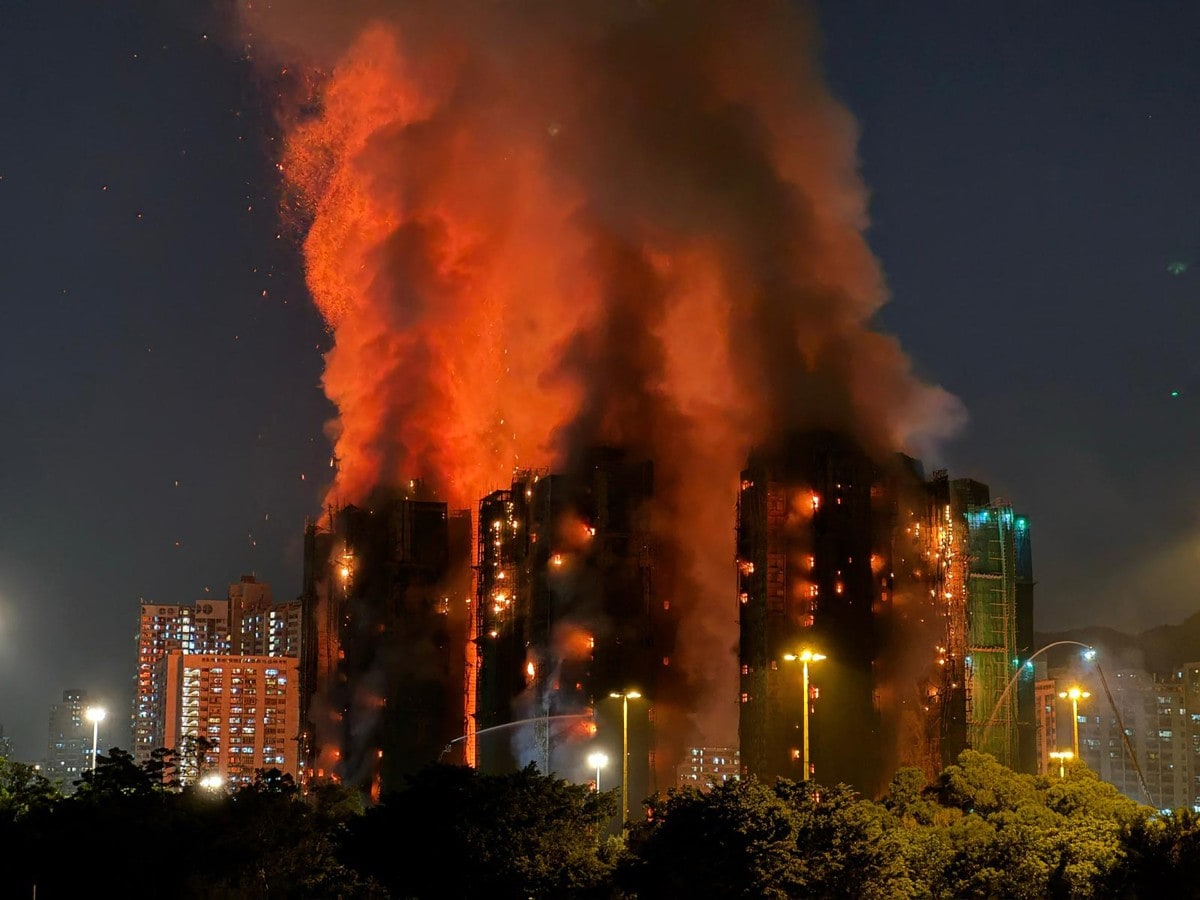
The devastating fire in Hong Kong has resulted in 55 fatalities and more than 70 injuries, prompting a thorough investigation into the incident.
As investigators delve deeper into the Hong Kong building fire tragedy, attention has turned to construction materials potentially responsible for the rapid flame spread. Authorities have arrested three senior officials from the engineering company handling the tower complex renovation on suspicion of manslaughter. According to Associated Press reporting, highly combustible Styrofoam was discovered attached to windows on every floor of an unaffected tower, indicating its likely use throughout the renovation project.
Styrofoam, composed of polystyrene (a petroleum-derived plastic), is commonly utilized in construction, insulation, and food packaging industries. Several regions worldwide, including the European Union, have prohibited its use in food packaging due to its non-biodegradable nature and potential carcinogenic properties.
A critical characteristic of Styrofoam is its ability to ignite at comparatively low temperatures while burning quickly. When combusting, it generates thick black smoke and toxic gases including carbon monoxide. The material contains air pockets—estimates suggest air comprises 95-98 percent of its composition. While this feature makes Styrofoam lightweight and buoyant, it simultaneously facilitates rapid fire progression.
According to The Standard, a Hong Kong news publication, a notice from the building's owners' association published last year by Prestige Construction and Engineering Company Limited detailed materials intended for use during renovation work. The notice explicitly mentioned "foam board" would cover windows to shield glass from sand and rock fragment damage during construction. Canvas and wood panels were also listed as materials to be used.
These flammable materials have become central to the investigation as authorities seek to determine the fire's cause and its swift spread.
Senior police officer Eileen Chung stated investigators have reason to believe the construction company's management demonstrated "gross negligence," according to Associated Press reporting.
The Standard quoted Security Secretary Chris Tang explaining that firefighters observed protective netting, film, waterproof canvas, and plastic sheeting on the building's exterior burned more intensely than standard-compliant materials would.
Tang revealed that police and fire services have established a task force to investigate two "unusual" circumstances involving exterior materials and foam boards. This group will pursue criminal liability questions, including whether the materials met fire and building safety standards.
Fire Services Director Andy Yeung noted that firefighters discovered ventilation windows in an unaffected building sealed with foam boards. Given such foam's high flammability, it could enable rapid fire spread once heated.
The tragedy has claimed 55 lives and injured over 70 people in the residential estate. The housing complex consists of eight buildings containing 2,000 apartments and houses approximately 4,800 residents, many elderly. Built during the 1980s, the complex was undergoing substantial renovation work.
Resident Lawrence Lee told Associated Press he awaits news about his wife. "When the fire started, I told her on the phone to escape. But once she left the flat, the corridor and stairs were all filled with smoke and it was all dark, so she had no choice but to go back to the flat," he explained while waiting at a shelter.
This incident ranks among Hong Kong's deadliest fires in recent decades. In November 1996, 41 people perished in a commercial building fire that lasted approximately 20 hours.
Source: https://www.ndtv.com/world-news/hong-kong-fire-wang-fuk-court-why-hong-kongs-deadly-fire-spread-swiftly-focus-on-fast-burning-foam-9710035