
Trump's 28-Point Ukraine Peace Plan Challenges Zelensky: Accept Moscow's Terms or "Fight His Little Heart Out"
- Date & Time:
- |
- Views: 55
- |
- From: India News Bull
Zelensky Can "Fight His Little Heart Out" If He Rejects Peace Plan: Trump
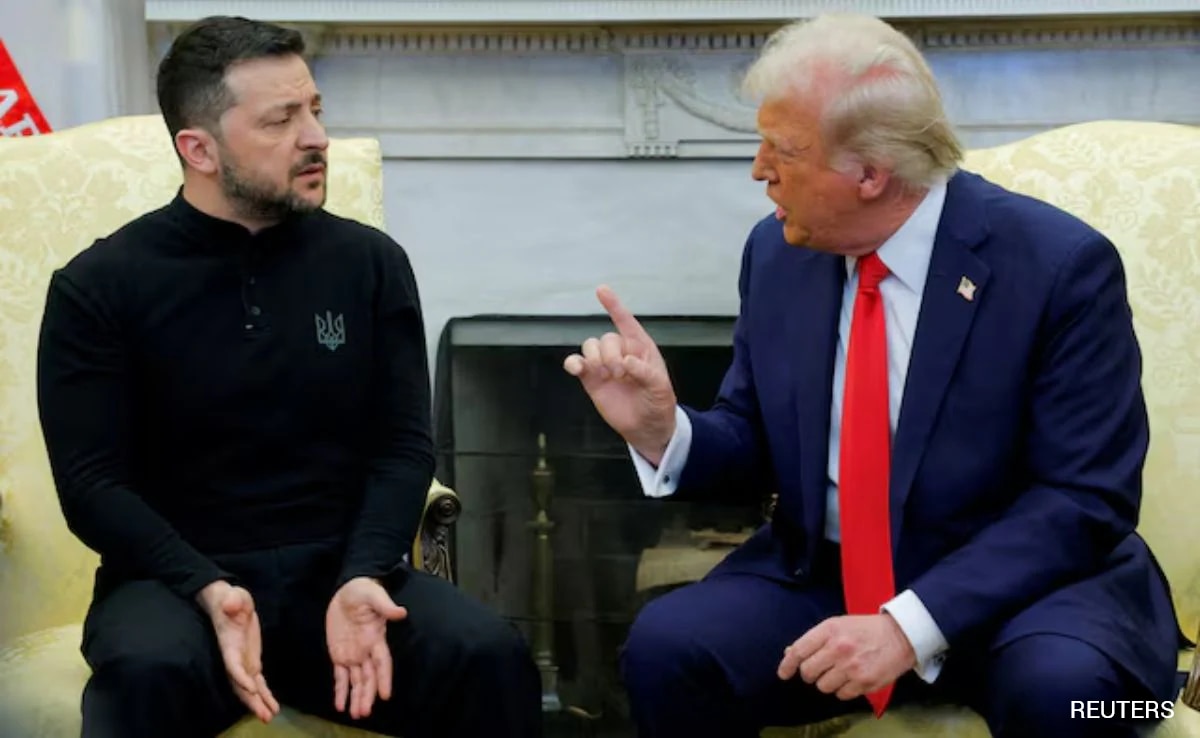
Zelensky has not communicated with Trump since the controversial 28-point peace plan was revealed this week.
Washington:
President Donald Trump's newly unveiled 28-point plan to end the Russia-Ukraine conflict reiterates his position that Ukrainian President Volodymyr Zelensky lacks sufficient leverage to continue military resistance and must accept terms that heavily favor Moscow.
Trump, whose relationship with Zelensky has been strained since his first administration, has set a deadline for the Ukrainian leader to respond to the peace proposal by next Thursday.
"He's going to have to approve it," Trump declared on Friday, though he adopted a more conciliatory tone the following day, stating, "I would like to get to peace."
"We're trying to get it ended. One way or the other, we have to get it ended," Trump told reporters outside the White House on Saturday.
Zelensky faces mounting challenges, including a corruption scandal within his government, battlefield difficulties, and the prospect of another harsh winter as Russia continues targeting Ukraine's energy infrastructure. The Ukrainian president acknowledged his country now confronts perhaps the most consequential decision in its history.
While Zelensky has not spoken with Trump since the plan became public, he anticipates discussions with the Republican president soon. Their relationship has been consistently difficult, beginning with their infamous 2019 phone call when Trump pressured Zelensky to investigate Joe Biden ahead of the 2020 election – an incident that triggered Trump's first impeachment.
During his successful 2024 campaign, Trump criticized Biden's Ukraine support, arguing it placed excessive financial burden on American taxpayers and promising to swiftly resolve the conflict.
Earlier this year, a contentious Oval Office meeting saw Trump and Vice President JD Vance criticize Zelensky for supposedly insufficient gratitude regarding the more than $180 billion in U.S. aid provided to Ukraine since the war's beginning. This confrontation led to a temporary suspension of American assistance.
Trump's current proposal demands significant Ukrainian concessions, including territorial cessions to Russia, dramatic reduction of Ukraine's military forces, and European confirmation that Ukraine will never join NATO.
"Now Ukraine may find itself facing a very difficult choice: either loss of dignity, or the risk of losing a key partner," Zelensky stated in a Friday video address.
Central to Trump's plan is Ukraine surrendering the entire eastern Donbas region, despite substantial portions remaining under Ukrainian control. The Institute for the Study of War estimates complete Russian conquest of this territory would take several years at current advancement rates.
Nevertheless, Trump insists the loss of this strategically vital region is inevitable. "They will lose in a short period of time. You know so," Trump asserted during a Fox News Radio interview. "They're losing land. They're losing land."
The proposal was formally presented to Zelensky in Kyiv by U.S. Army Secretary Dan Driscoll on Thursday. Driscoll's staff were reportedly unaware of their boss's Ukraine mission until shortly before departure.
Army officials left the meeting believing Ukrainians viewed the proposal as a negotiation starting point, according to an anonymous U.S. official familiar with the sensitive discussions.
Trump's willingness for extended negotiations remains unclear. White House Press Secretary Karoline Leavitt characterized the plan as reflecting "the realities of the situation" and offering a "best win-win scenario, where both parties gain more than they must give."
When questioned about Zelensky's hesitant initial response, Trump referenced their February Oval Office confrontation: "You remember, right in the Oval Office, not so long ago, I said, 'You don't have the cards.'"
On Saturday, Trump indicated the proposal wasn't necessarily his final offer, suggesting potential negotiation flexibility. However, when asked about Ukraine potentially rejecting the plan, the president responded dismissively: "Then he can continue to fight his little heart out."
The mounting pressure coincides with Zelensky managing fallout from a $100 million kickback scandal involving the state-owned nuclear energy company, which has forced top Cabinet ministers' resignations and implicated presidential associates.
Konstantin Sonin, a University of Chicago political economist and Russia expert, observed, "What Donald Trump is certainly extremely good at is spotting weak spots of people."
One element of Trump's 28-point plan requires elections within 100 days of agreement implementation.
"I think it's a rationalistic assessment that there is more leverage over Zelensky than over Putin," Sonin noted. "Zelensky's back is against the wall" and "his government could collapse if he agrees" to the American proposal.
Meanwhile, Ukraine shows increasing battlefield strain after years fighting Russia's larger, better-equipped military. The country desperately defends against relentless Russian aerial attacks causing widespread power outages as winter approaches.
Kyiv also faces uncertainty regarding financial support, with a European plan to finance Ukraine's next annual budget through loans linked to frozen Russian assets now in question.
According to David Silbey, Cornell University military historian, several provisions in Trump's proposal deeply challenge Ukrainian national pride.
One provision requires Russia and Ukraine to eliminate "all discriminatory measures and guarantee the rights of Ukrainian and Russian media and education," while stipulating "all Nazi ideology and activities must be rejected and prohibited." Ukrainians may perceive this as validating Putin's distorted historical narratives justifying the 2022 invasion.
Putin has claimed the war partly aims to "denazify" Ukraine and characterized the country as having a "neo-Nazi regime." In reality, Ukraine's 2019 parliamentary election showed far-right candidates received only 2% support, significantly lower than many European nations.
"Very clearly an attempt to build up Putin's claim to Russian cultural identity within Ukraine," Silbey said of this provision. He added, "From territory loss to the substantial reduction of the Ukrainian military to cultural concessions that have been demanded, I just don't think Zelensky could do this deal and look his public in the eye again."
Source: https://www.ndtv.com/world-news/zelensky-can-fight-his-little-heart-out-if-he-rejects-peace-plan-trump-9685030