
Trump's Golden Dome Missile Shield Faces Significant Delays Following Government Shutdown and Budget Challenges
- Date & Time:
- |
- Views: 67
- |
- From: India News Bull
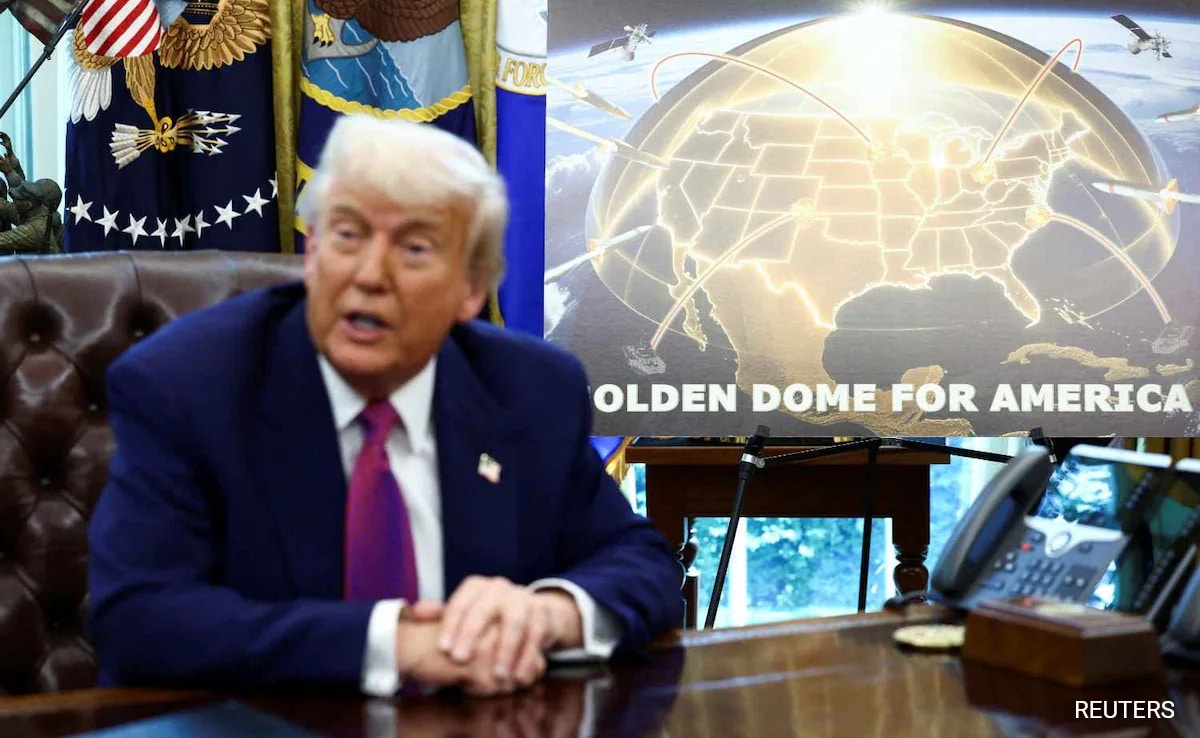
A comprehensive spending plan for the Golden Dome missile defense initiative was scheduled for submission to Congress by late August but has faced significant delays.
Washington:
President Donald Trump's ambitious Golden Dome missile defense program is experiencing considerable setbacks, primarily due to the recent 43-day government shutdown and the absence of a detailed spending strategy for the initial $25 billion allocated for the project this summer, according to eight sources familiar with the situation who spoke to Reuters.
The government shutdown has significantly impeded progress by delaying critical hiring processes and diverting essential personnel from their regular responsibilities of approving and executing contracts, as confirmed by three industry executives and a U.S. official. These sources, along with others, provided information on condition of anonymity due to concerns about potential repercussions for discussing aspects of a highly classified program.
More fundamentally, the nearly $25 billion designated for Golden Dome in the summer budget reconciliation package lacks a comprehensive spending blueprint detailing precise fund allocation. This information was corroborated by two administration sources, a Capitol Hill insider, and two industry executives who spoke with Reuters.
These impediments potentially jeopardize Trump's commitment that the $175 billion defense system, announced just seven days into his new administration, will be operational and protecting the continental United States by 2028.
"While progress hasn't been substantial, I wouldn't characterize the situation as disastrous," remarked one U.S. official who requested anonymity.
Reuters conducted interviews with more than twelve sources across the administration, Pentagon, Capitol Hill, and defense industry to compile a comprehensive assessment of the challenges confronting Golden Dome, Trump's signature national security priority.
The spending framework outlined in the Golden Dome funding legislation was due for congressional submission in late August. This plan is now anticipated to be delivered by Deputy Secretary of Defense Steve Feinberg in December, according to two Capitol Hill sources.
Though delays in defense contracting are commonplace, they have assumed greater importance for Golden Dome given Trump's accelerated timeline. These setbacks have prompted concerns within the defense industry that crucial Golden Dome contracts may not be issued before the Pentagon's internal December 31 deadline. Such delays could potentially increase costs, according to four defense industry executives planning to bid on various components of the program.
"The Golden Dome represents a visionary initiative led by a visionary President," stated a White House spokesperson. "The complexity involved in developing such a system naturally requires significant effort, and all stakeholders are collaborating effectively to formalize plans and deliver this next-generation technology."
A Pentagon representative indicated that details regarding Golden Dome's progress are being carefully safeguarded. "Recognizing adversaries' intentions to exploit Golden Dome's technological breakthroughs, we are rigorously protecting America's strategic advantages inherent in this program."
Both Feinberg and Golden Dome program manager General Michael Guetlein declined to provide comments.
Golden Dome Faces Challenges Meeting Aggressive Schedule
Guetlein successfully met a mid-November deadline for presenting an implementation plan, which is currently under review, according to Pentagon information provided to Reuters. Based on this blueprint, the Pentagon intends to begin awarding contracts for satellite testing and production, interceptor systems, ground stations, and networking infrastructure.
However, administration sources revealed to Reuters that the architectural framework proposed in September remains in flux and won't be finalized for several more weeks. A Pentagon spokesperson told Reuters that "the baseline architecture has been established" but provided no additional details.
Without finalized architecture, implementation plan, or approved spending strategy, Guetlein has been unable to initiate contract solicitations, effectively stalling the initiative's transition from planning to execution, according to one U.S. official and three industry executives.
These delays have intensified industry concerns that Golden Dome will require substantially greater funding and a more extended timeline. Todd Harrison, senior fellow at the American Enterprise Institute, a conservative think tank, estimated in September that a "robust, all-threat" missile defense system could cost approximately $3.6 trillion over two decades.
Guetlein is working urgently to staff the Pentagon's Golden Dome office but has yet to reach the internal target of 30 personnel. The program has also experienced the departure of a key technical director from U.S. Space Command who was working on the project's architecture, according to one administration official and three industry executives familiar with the program.
A replacement for this position has been identified, according to two sources.
Despite challenges, Guetlein has successfully mobilized contractor support, established internal systems, assembled a small team within the Pentagon, and borrowed missile defense specialists from various facilities including the rocket development center at Redstone Arsenal near Huntsville, Alabama, as confirmed by an administration official and three industry executives.
Tom Karako, weapons security expert at the Washington-based Center for Strategic and International Studies, noted that appointing a four-star general like Guetlein to lead the initiative means "he can overcome obstacles and achieve results."
"However, if higher-level indecision continues to affect every aspect of the program, progress will remain stalled," Karako added.
Contractors Express Concerns About Development Expenses
Beyond bureaucratic delays, Golden Dome faces additional challenges as potential contractors have expressed reservations about the substantial upfront investments required to develop Space-Based Interceptors—satellites designed to carry missiles capable of neutralizing threats from launch to just before impact—according to multiple defense industry sources.
An executive from a major defense contractor told Reuters they would likely not compete for interceptor development due to the costly multi-year competition process and concerns that a future administration might abandon the program.
According to documents reviewed by Reuters, companies are expected to bear the development costs for the interceptors. This represents a departure from typical practice where the federal government partially funds such high-risk research initiatives.
The documents indicate contractors are being asked to develop four distinct interceptor variants: two versions capable of intercepting missiles at different boost phase altitudes, one for mid-flight interception, and another designed to counter faster hypersonic missiles.
The government envisions competition groups of up to five companies for different interceptor types, with "prize pools" established for each group. The largest pool of $340 million would be distributed among companies that successfully complete "on orbit" testing, with first place receiving $125 million and fifth place awarded $40 million, according to a Pentagon industry presentation viewed by Reuters.
Ultimately, companies could secure lucrative production contracts valued between $1.8 billion and $3.4 billion annually, as outlined in the Pentagon presentation. However, industry executives estimate that building and testing a space-based interceptor could cost between $200 million and $2 billion.
Major defense contractors including Lockheed Martin, Northrop Grumman, RTX, and Boeing are expected to compete for various Golden Dome components once blanket contracts become available.
Some aspects of the program are progressing satisfactorily. The Department of Defense is making headway in centralizing early-warning systems currently maintained by various government intelligence agencies intended to defend against ballistic, hypersonic, and advanced cruise missiles, according to two industry sources and two U.S. officials.
These integrated systems involve penetrating adversary networks, gathering satellite intelligence and ground-based information, and feeding this data simultaneously to Golden Dome, significantly enhancing missile interception capabilities.
Source: https://www.ndtv.com/world-news/after-us-shutdown-trumps-golden-dome-missile-shield-plagued-by-delays-9676642