
Navy Musician Creates Antarctic Symphony: French Horn Player Performs at Earth's Coldest Stage
- Date & Time:
- |
- Views: 43
- |
- From: India News Bull
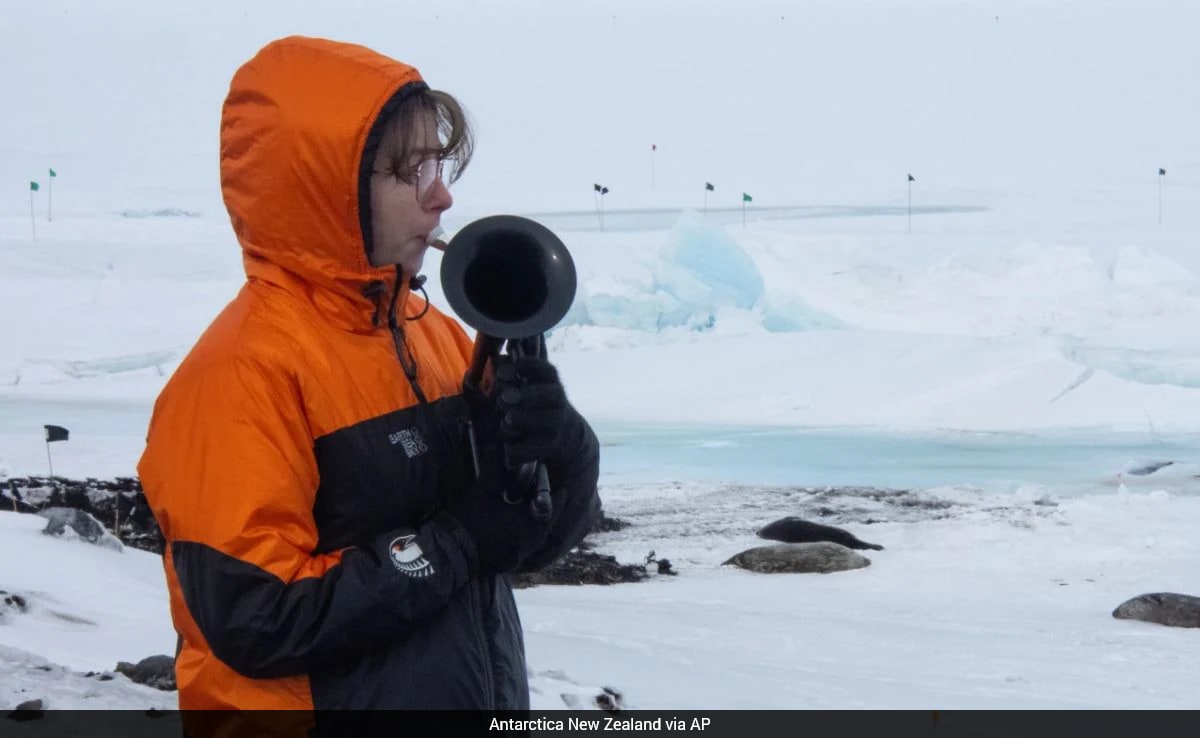
Natalie Paine, a French horn player serving in New Zealand's navy, has been stationed in Antarctica since October, creating a unique musical outpost in one of Earth's most extreme environments.
Wellington:
At the southernmost edge of our planet, maintaining a musical practice requires creativity, determination, and specialized equipment that won't adhere to skin in sub-zero temperatures.
Natalie Paine, currently one of 21 military personnel deployed to Antarctica from New Zealand's navy, has established perhaps the world's most isolated practice space. There, her musical compositions float across the frozen expanse of the Ross Sea.
"The environment is incredibly beautiful and inspires creativity," Paine explained to the Associated Press. "During my limited free time, I sit by the window performing my practice routines and playing music."
Paine's journey to Antarctica follows an unexpected path. Growing up in Adelaide, Australia's hot, arid climate, she originally aspired to visit Antarctica as a scientist.
Instead, she pursued music studies at university, temporarily abandoning her Antarctic ambitions. Years later, after joining New Zealand's navy as a musician, Paine discovered that military personnel were regularly stationed in Antarctica to provide support for scientific research.
Upon inquiring, her supervisor confirmed that any military member could potentially secure one of these sought-after assignments.
"I became instantly excited and asked, 'Even someone like me, a musician?'" Paine recalled. "He responded enthusiastically, 'Absolutely, why not?'"
Though her dream was rekindled, the path wasn't straightforward. Paine submitted applications unsuccessfully for four years before finally securing a position as a communications operator.
This demanding role requires six-day work cycles that leave minimal time for musical pursuits. Paine's responsibilities include monitoring radio transmissions, telephone calls, emails, and other communications at New Zealand's Scott Base facility, sometimes providing a human connection for isolated field researchers who haven't heard another voice for weeks.
In her rare free moments, Paine practices scales and embouchure exercises, taking care not to disturb colleagues working round-the-clock shifts. This often means retreating to a historic hut constructed in 1957 under Sir Edmund Hillary's leadership during New Zealand's establishment of its Antarctic presence.
While practicing beside the window, observing seals on the ice, Paine finds new musical ideas emerging naturally.
"The landscape offers overwhelming beauty that isn't domesticated—it's wild, untamed magnificence in both the terrain and wildlife," she explained. "The experience is profoundly moving spiritually, emotionally, and sometimes physically as well."
Her practical challenges included finding an Antarctica-appropriate instrument—something durable, lighter than a traditional brass French horn, and less susceptible to freezing against skin. Her solution, a plastic instrument called a jHorn, may lack elegance but offers practicality.
"It was originally developed as an introductory brass instrument for children," Paine noted. "It's exceptionally compact, lightweight plastic, highly durable, and requires significantly less maintenance."
According to New Zealand's navy records, Paine—scheduled to remain until March—may be the first military musician ever posted to Antarctica. Her presence has been warmly received at Scott Base, where she has provided live musical performances for ceremonies like flag changes, replacing the usual recorded music.
"Despite wearing ski gloves with double insulation and hand warmers inside while holding the trumpet, my fingers were still freezing," she recounted. Nevertheless, Paine has joined the elite group of musicians who have performed solo concerts in temperatures reaching minus 21 degrees Celsius (minus 6 Fahrenheit).
She observed that the multinational collaborative efforts in Antarctica reminded her of musical collaboration.
"Music functions as a universal language that reminds us of our interconnectedness," she reflected. "It reestablishes connections to home, to the land, and to those around you."
Source: https://www.ndtv.com/world-news/with-plastic-horn-ski-gloves-musician-performs-on-worlds-coldest-stage-9667726