
Trump Says He And Xi Jinping Will Meet In South Korea In Coming Weeks
- Date & Time:
- |
- Views: 69
- |
- From: India News Bull
Trump Says He And Xi Jinping Will Meet In South Korea In Coming Weeks
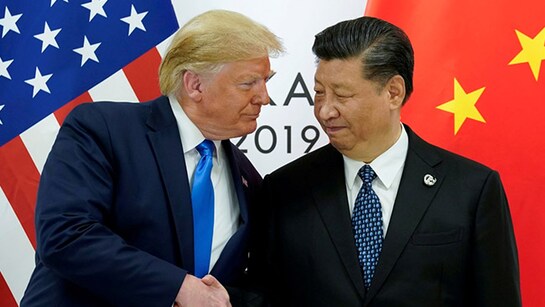
Trump also announced plans for a China visit in the "early part of next year".
Washington:
Following a telephone conversation on Friday, President Donald Trump revealed he would meet with Chinese President Xi Jinping at a regional summit scheduled for late October in South Korea. Trump also shared his intention to visit China in "early next year."
In a post on Truth Social, Trump mentioned that Xi would visit the United States "at an appropriate time" and claimed progress regarding "the approval of the TikTok Deal," which would allow the popular app to continue operating in America, though specific details were not provided.
The Chinese government's statement did not reference these planned visits nor clarify what Xi had agreed to regarding the potential sale of TikTok's controlling stake by its Chinese parent company to avoid a U.S. ban. However, Xi did urge Trump to avoid implementing trade restrictions to prevent deterioration of trade relations, according to the statement.
While the much-anticipated call indicated a cordial relationship between the leaders of the world's two largest economies, their respective statements highlighted ongoing challenges. A fundamental indication of cooperation was their willingness to meet in person to prevent relations from deteriorating further, given how economically intertwined the two countries with conflicting worldviews remain.
"The call was a very good one, we will be speaking again by phone, appreciate the TikTok approval, and both look forward to meeting at APEC!" Trump wrote, referring to the Asia-Pacific Economic Cooperation forum comprising 21 Pacific Rim economies.
ByteDance, TikTok's Chinese parent company, expressed interest in continuing negotiations to ensure the app's services remain available for American users, without providing substantial information about how ownership issues would be resolved.
Earlier this week, the Trump administration announced that a framework deal regarding the app's ownership had been reached with Chinese officials during trade discussions in Madrid.
Trump, who has credited TikTok with helping secure his re-election, has extended the deadline for ByteDance to divest multiple times. This divestment is required under legislation passed last year addressing data privacy and national security concerns.
U.S. officials have expressed concerns about ByteDance's origins and ownership structure, citing Chinese laws that require domestic companies to provide data when requested by the government. Additional concerns focus on the proprietary algorithm determining what content users see on TikTok.
Chinese officials stated Monday that consensus was reached regarding authorization of "intellectual property rights" use, including the algorithm, and that both parties agreed to entrust a partner with managing U.S. user data and content security.
During their conversation, Xi told Trump that Beijing "would be happy to see productive commercial negotiations in keeping with market rules," which would "lead to a solution that complies with China's laws and regulations and takes into account the interests of both sides," according to the Chinese statement.
"The U.S. side needs to provide an open, fair and non-discriminatory environment for Chinese investors," it added.
Craig Singleton, senior China fellow at the Foundation for Defense of Democracies, a Washington think tank, observed that a finalized TikTok deal does not appear to exist yet.
"Beijing frames market-based talks under Chinese law, keeping a de facto veto, while Trump casts himself as the final approver," he explained.
In Friday's post, Trump stated they also made progress on "many very important issues including Trade, Fentanyl, the need to bring the War between Russia and Ukraine to an end."
A day earlier, Trump suggested that Russia's war in Ukraine could be resolved if European countries imposed higher tariffs on China. He did not specify whether he planned to increase tariffs on Beijing over its purchase of Russian oil, as he has done with India.
The Chinese statement emphasized Xi's stress on the importance of bilateral relations and his urging that the U.S. avoid implementing any trade restrictions.
Senior U.S. and Chinese officials have conducted four rounds of trade talks between May and September, with another round likely in the coming weeks. Both sides have temporarily suspended high tariffs and pulled back from severe export controls.
However, they have yet to reach agreements on tech export restrictions, Chinese purchases of U.S. agricultural products, or fentanyl. The Trump administration has imposed additional 20% tariffs on Chinese goods related to allegations that Beijing has failed to prevent the flow of chemicals used to manufacture opioids into the U.S.
China responded by implementing additional 10% to 15% tariffs on U.S. agricultural products.
Trump's second-term trade conflict with Beijing has significantly impacted U.S. farmers by eliminating one of their primary markets. From January through July, American farm exports to China decreased by 53% compared to the same period last year. Some commodities experienced even greater losses, with U.S. sorghum sales to China dropping by 97%.
Sean Stein, president of the U.S.-China Business Council, suggested that if an agreement to remove the fentanyl tariffs is reached, Beijing might roll back retaliatory tariffs and resume purchases of U.S. farm products and other goods.
"There'll be a lot of positive market sentiment that comes from this, and it will alleviate the human costs of fentanyl," he concluded.