
Gaza's Education Crisis: Rebuilding Schools and Hope for Children Amid Conflict
- Date & Time:
- |
- Views: 56
- |
- From: India News Bull
Gaza Strip:
Bissan Younis stands dejectedly outside a cluster of tents amid rubble and debris, a landscape that has become commonplace across Gaza. This tiny encampment serves as yet another improvised school with no capacity for her teenage son Kareem.
"Most of the schools are destroyed," she explained to The Associated Press. "Every school I visit informs me there is no space available."
Over 600,000 Palestinian children in Gaza have missed two years of education due to the Israel-Hamas conflict. Instead of learning and developing socially, these children have endured multiple displacements, fled from military strikes, and often spent their days searching for basic necessities like water and food for their families.
With a ceasefire established last month largely holding, humanitarian organizations are working urgently to reestablish dozens of makeshift educational facilities.
John Crickx, UNICEF spokesman, emphasizes the critical importance of children returning to classrooms promptly, not solely for educational purposes but also for their psychological wellbeing.
"If we fail to provide education in the coming weeks," he warned, "an entire generation could face devastating consequences."
UNICEF reports that more than 630,000 Palestinian children missed school during the conflict. Currently, only about 100,000 have been able to resume their education.
UNRWA, the UN agency for Palestinian refugees, is providing educational services through contracted teachers for approximately 40,000 students. Most UNRWA schools, which previously served half of Gaza's children, have been converted into shelters for displaced populations.
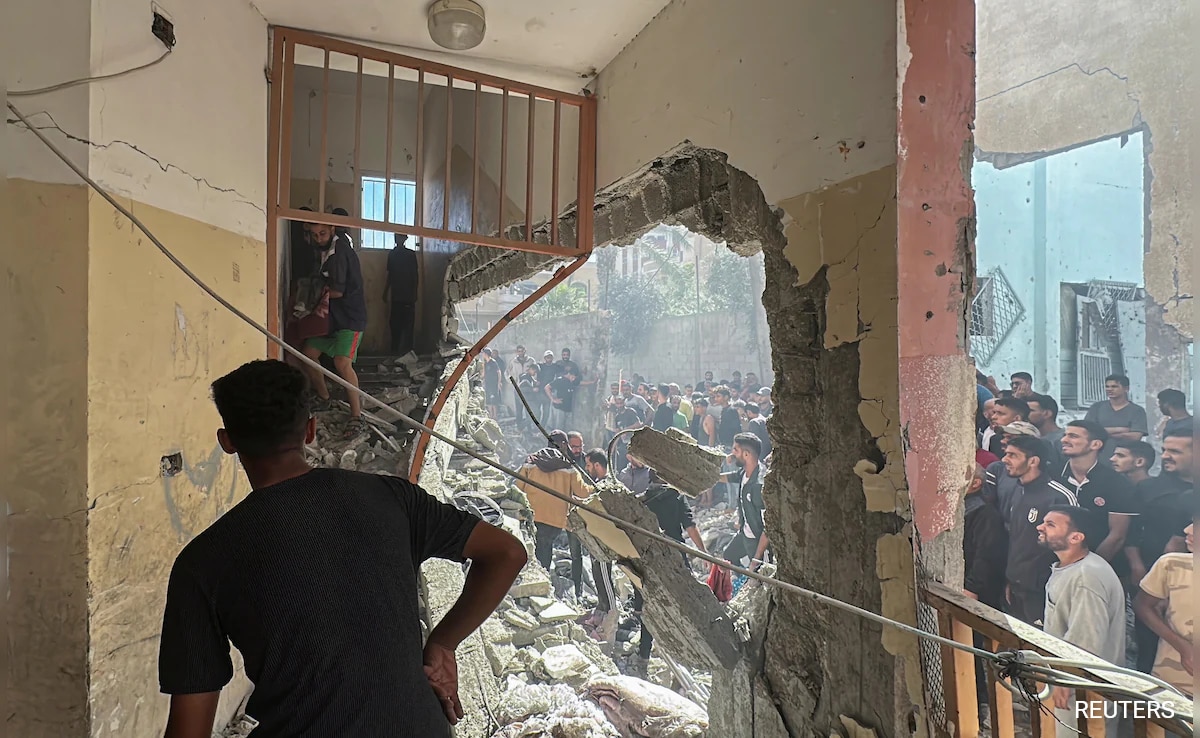
Limited space presents a significant challenge: numerous schools were severely damaged or completely destroyed. Many continue to function as shelters for Palestinians who have experienced multiple displacements during the territory's intense bombardment.
"We're essentially setting up tents among displaced people's tents, or using prefabricated structures or shelters," Crickx explained. "It's very much the most basic form of learning environment."
At one school—a cluster of UNICEF-branded tents established on a patch of land surrounded by bombed buildings in southern Khan Younis—children gather closely in a classroom, listening attentively to their teacher.
Crickx noted the difficulty in finding suitable locations for setting up these temporary classrooms. Another significant hurdle involves getting supplies into Gaza, whether construction materials to repair damaged schools or basic educational items like pencils and erasers.
Since the war began on October 7, 2023, with the Hamas-led attack on southern Israel, these supplies have been prohibited from entering Gaza. Israel, which controls the flow of goods into the territory, categorizes them as "non-critical, non-life saving," according to Crickx.
COGAT, the Israeli military body coordinating aid to Gaza, provided no immediate response regarding permission for school supplies.
Even children who manage to enroll in makeshift schools carry significant psychological trauma from war and displacement.
"The trauma level among Gaza's people, including children, is horrific," stated UNRWA communications director Juliette Touma.
UN agencies struggle to assess damage and calculate costs—with the ceasefire still in early stages, Gaza's reconstruction hasn't begun, and UN experts estimate the process could take years and cost approximately $70 billion.
Displaced families continue living in damaged school buildings. UNRWA's Touma reports about 75,000 people still shelter in the agency's schools.
Tahreer al-Oweini, one displaced resident, expresses guilt but acknowledges her lack of alternatives.
"I'm living in what should be an active classroom with a teacher, students, and a blackboard," she said. Around her, damaged walls and ceilings are covered with tarpaulins.
Al-Oweini describes her struggle to secure educational placements for her three daughters and son who are in elementary and middle school. Despite offering to provide furniture herself, she was still turned away by one school principal.
"The children have forgotten everything they learned," she lamented. "Their existence over the past two years has revolved around obtaining water, chasing aid vehicles, and experiencing war, destruction, and terror."
"They have lived in constant fear and horror," she added.
Even during intense fighting periods, efforts were made in displacement camps to prevent children from falling behind academically, despite everyone confronting bombardment, power outages, and shortages of essentials.
However, lessons were inconsistent, and some families kept their children close, unwilling to risk sending them to classes due to safety concerns.
It's a critical race against time, and UNRWA's Touma warns about a potential "lost generation"—the longer children remain out of school, the harder catching up becomes.
Touma worries that education deprivation increases children's vulnerability to "exploitation, including child marriage, child labor, and recruitment into armed groups."
Al-Oweini, like many desperate parents, maintains hope for her children's education.
"I want my children to follow their father's path and complete university education," she said, noting her daughters' aspirations to become doctors or engineers.
"They have ambition," she affirmed. "But without education, they face no future."
Source: https://www.ndtv.com/world-news/most-of-gazas-schools-destroyed-lakhs-of-children-cannot-go-back-to-class-9649725