
USS Gerald R Ford: US Deploys Advanced Aircraft Carrier to Caribbean Amid Escalating Anti-Drug Operations
- Date & Time:
- |
- Views: 63
- |
- From: India News Bull
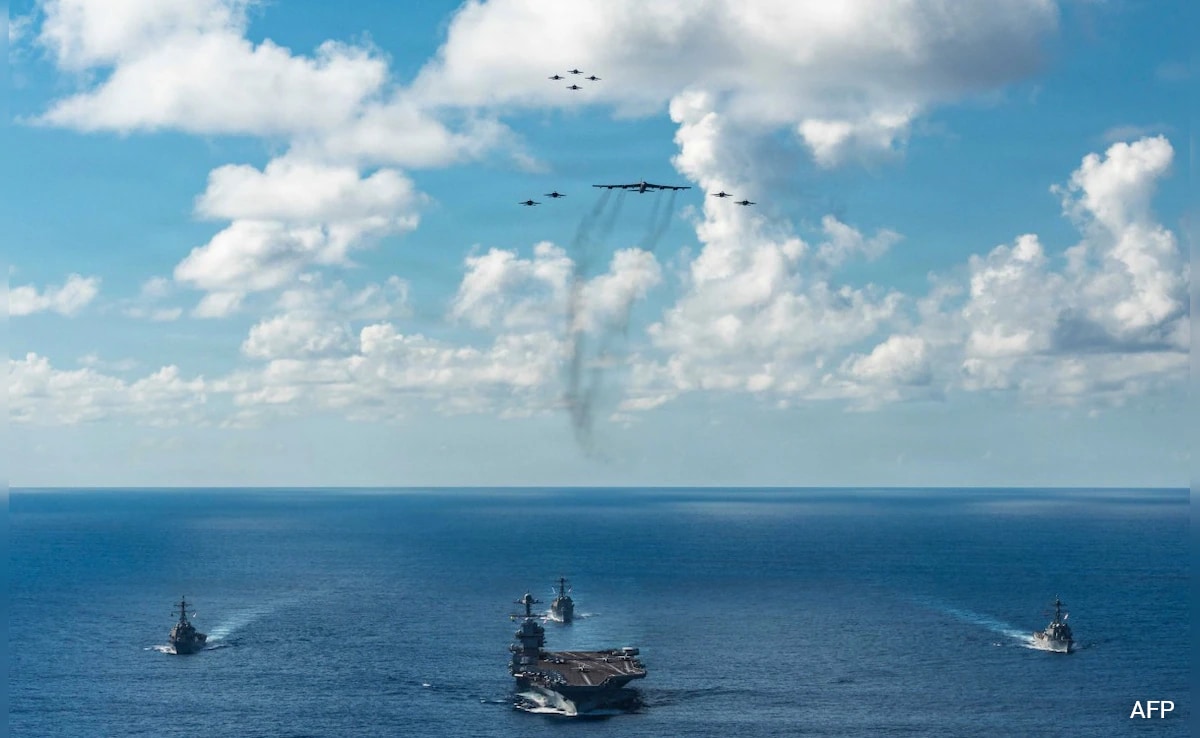
US Navy's Gerald R Ford Carrier Strike Group at an undisclosed location in Atlantic Sea (File)
The United States' most technologically advanced aircraft carrier entered the Caribbean Sea on Sunday, showcasing American military might and raising concerns about the Trump administration's intentions in South America amid ongoing military strikes against suspected drug-trafficking vessels.
The USS Gerald R. Ford's arrival, officially announced by the Navy, represents a significant development in what the administration describes as a counterdrug operation, though many view it as escalating pressure against Venezuelan President Nicolas Maduro.
The Ford's presence completes the most substantial concentration of US military power in the region in decades. The "Operation Southern Spear" now encompasses nearly a dozen Navy vessels and approximately 12,000 sailors and Marines.
Coinciding with the carrier's arrival, the military reported its latest lethal strike on a small vessel allegedly transporting illegal drugs. Southern Command shared footage on social media showing the boat's destruction in an attack occurring Saturday in international waters of the eastern Pacific Ocean, resulting in three fatalities. Additional information was not immediately available.
Since early September, US military strikes in the Caribbean and eastern Pacific have resulted in at least 83 fatalities across 21 separate attacks.
The carrier strike group, which includes fighter jet squadrons and guided-missile destroyers, navigated the Anegada Passage near the British Virgin Islands Sunday morning, according to Navy officials.
Rear Admiral Paul Lanzilotta, the strike group commander, stated that the deployment will strengthen an already substantial American naval presence to "protect our nation's security and prosperity against narco-terrorism in the Western Hemisphere."
Admiral Alvin Holsey, who oversees operations in the Caribbean and Latin America, emphasized that American forces "stand ready to combat the transnational threats that seek to destabilise our region."
Holsey, scheduled to retire next month after just one year in his position, characterized the strike group's deployment as "a critical step in reinforcing our resolve to protect the security of the Western Hemisphere and the safety of the American Homeland."
In Trinidad and Tobago, located merely 7 miles from Venezuela at its closest point, government officials confirmed that troops have begun "training exercises" with US military personnel, continuing through most of the week.
Foreign Affairs Minister Sean Sobers described these joint exercises as the second such operation in under a month, aimed at addressing violent crime in the island nation that has become a transit point for drug shipments destined for Europe and North America. The prime minister has openly supported US military strikes.
These exercises will involve Marines from the 22nd Expeditionary Unit who have been deployed aboard Navy ships positioned off Venezuela's coast for months.
The Venezuelan government has characterized these training exercises as acts of aggression but offered no immediate response Sunday regarding the aircraft carrier's arrival.
Concurrently, Army Secretary Dan Driscoll revealed Sunday that US troops have been conducting training in Panama, highlighting the administration's growing focus on Latin America.
"We're reactivating our jungle school in Panama. We would be ready to act on whatever" Trump and Defense Secretary Pete Hegseth required, he told CBS' "Face the Nation."
The administration maintains that the buildup of American forces regionally focuses on intercepting drug flows into the US, though it has provided no evidence supporting claims that those killed in vessel strikes were "narcoterrorists." President Trump has suggested military operations would extend beyond maritime strikes, stating the US would "stop the drugs coming in by land."
Aircraft carriers have long served as US instruments for pressure and deterrence against other nations, as their warplanes can strike targets deep within foreign territories. Some analysts argue the Ford is poorly suited for anti-cartel operations but could effectively intimidate Maduro in efforts to force his resignation.
Secretary of State Marco Rubio has stated that the United States does not recognize Maduro, widely accused of election fraud last year, as Venezuela's legitimate leader. Rubio has described Venezuela's government as a "transshipment organisation" openly collaborating with drug traffickers.
In a statement released Sunday evening, Rubio announced the State Department's intention to designate Cartel de los Soles, or Cartel of the Suns, as a foreign terrorist organization. Rubio claimed the cartel, allegedly led by Maduro and other high-ranking government officials, is among those "responsible for terrorist violence throughout our hemisphere as well as for trafficking drugs into the United States and Europe." Once this designation takes effect on November 24, providing "material support" to the cartel or its members will constitute a crime.
Maduro, who faces narcoterrorism charges in the US, has accused the US government of "fabricating" a war against him. On his Facebook page Sunday, Maduro wrote that the "Venezuelan people are ready to defend their homeland against any criminal aggression."
Venezuela's government recently highlighted a "massive" mobilization of troops and civilians prepared to defend against potential US attacks. Maduro and other socialist party officials have been attending weekend rallies supporting the establishment of neighborhood committees tasked with increasing socialist party membership and promoting party policies.
Trump has justified attacks on drug vessels by claiming the US is in "armed conflict" with drug cartels and asserting that the boats are operated by foreign terrorist organizations.
He has encountered resistance from regional leaders, the UN human rights chief, and US lawmakers, including Republicans, who have demanded more information about targeting criteria and legal justification for vessel strikes.
Senate Republicans, however, recently voted against legislation that would have restricted Trump's ability to launch attacks against Venezuela without congressional authorization.
Experts disagree whether American warplanes might be used to strike land targets within Venezuela. Regardless, the 100,000-ton warship delivers a clear message.
"This is the anchor of what it means to have US military power once again in Latin America," said Elizabeth Dickinson, International Crisis Group's senior analyst for the Andes region. "And it has raised a lot of anxieties in Venezuela but also throughout the region. I think everyone is watching this with sort of bated breath to see just how willing the US is to really use military force."
Source: https://www.ndtv.com/world-news/us-deploys-most-advanced-aircraft-carrier-uss-gerald-r-ford-in-caribbean-sea-9647603