
Meet Robin, Robot That Acts Like 7-Year-Old To Help Patients In Hospitals
- Date & Time:
- |
- Views: 78
- |
- From: India News Bull
Meet Robin, Robot That Acts Like 7-Year-Old To Help Patients In Hospitals
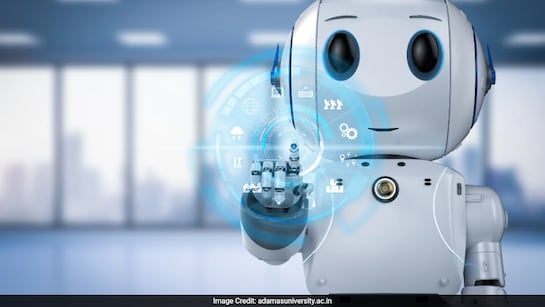
Robin mirrors the emotions of the person it is talking with (Representative Image)
Shortly after Meagan Brazil-Sheehan's 6-year-old son received a leukemia diagnosis, they encountered Robin the Robot while walking through the corridors of UMass Memorial Children's Medical Center.
"Luca, how are you?" Robin greeted in a high-pitched voice designed to sound like a 7-year-old girl. "It's been awhile."
Brazil-Sheehan mentioned they had only previously met the 4-foot-tall (1.2-meter-tall) robot with its large screen displaying cartoonish features once after their admission several days earlier.
"His face lit up," she recalled about the June interaction in Worcester, Massachusetts. "It was so special because she remembered him."
Robin is an artificial intelligence-powered therapeutic robot programmed to behave like a little girl while providing emotional support in nursing homes and pediatric hospital units, helping address staffing shortages. Since launching in the U.S. five years ago, Robin has become a familiar presence in 30 healthcare facilities across California, Massachusetts, New York and Indiana.
"Nurses and medical staff are really overworked, under a lot of pressure, and unfortunately, a lot of times they don't have capacity to provide engagement and connection to patients," explained Karen Khachikyan, CEO of Expper Technologies, the company behind Robin. "Robin helps to alleviate that part from them."
As AI increasingly integrates into daily life, it has established itself in medical care—offering services from note-taking during examinations to electronic nursing assistance. While some praise its efficiency, others express concern about its impact on patient care.
Robin operates with about 30% autonomy, while remote operators control the remainder under clinical staff supervision. Khachikyan noted that each interaction provides more data—while maintaining HIPAA compliance—bringing them closer to full autonomous functionality.
"Imagine a pure emotional intelligence like WALL-E. We're trying to create that," he said, referencing the 2008 animated film.
During a recent Friday at HealthBridge Children's Hospital in Orange County, California, a staff member provided Robin with a list of patients to visit and time allocations for each.
The sleek white triangle-shaped robot—designed specifically for hugging, according to Khachikyan—rolled into a room with a teenager recovering from a car accident. Robin played what it identified as his favorite song—"No Fear" by DeJ Loaf—while he danced along. In the hallway, Robin amused a young child in her mother's arms by wearing silly glasses and a big red nose. In another room, the robot engaged a patient in a simplified version of tic-tac-toe.
Samantha da Silva, a speech language pathologist at the hospital, observed that patients brighten when Robin enters their room, remembering not only their names but their favorite music.
"She brings joy to everyone," da Silva remarked. "She walks down the halls, everyone loves to chat with her, say hello."
Khachikyan explained that Robin mirrors the emotions of whoever it's conversing with. If a patient laughs, Robin laughs too; if they share something difficult, its face displays sadness and empathy.
In nursing homes, Robin engages residents with memory games for those with dementia, guides them through breathing exercises on challenging days, and offers companionship similar to that between grandchild and grandparent.
Khachikyan recalled an incident last year at a Los Angeles facility where a woman experiencing a panic attack specifically requested Robin. The robot played songs by her favorite musician—Elvis Presley—and showed videos of puppies until she calmed down.
With the Association of American Medical Colleges projecting a shortage of up to 86,000 physicians in the next 11 years, Khachikyan envisions Robin's capabilities extending far beyond emotional support.
He revealed they're developing Robin to measure patients' vital signs and monitor their condition, then transmit that information to medical teams. Future plans include enabling Robin to help elderly patients change clothes and use the bathroom.
"Our goal is to design the next evolution of Robin; that Robin will take more and more responsibilities and become even more essential part of care delivery," Khachikyan stated.
He emphasized this isn't about replacing healthcare workers but filling workforce gaps.
At UMass, Robin functions as part of a patient support team. When Luca needed an IV after going without one for some time, Micaela Cotas, a certified child life specialist, accompanied Robin to show him the IV and explain the procedure, while Robin played a cartoon depicting itself receiving an IV.
"It just kind of helps show that Robin has gone through those procedures as well, just like a peer," Cotas explained.
Khachikyan developed Robin during his Ph.D. studies. Having experienced loneliness growing up in a single-parent household in Armenia, he aimed to create a robot that could serve as a companion.
Developers tested the robot across various industries before an investor suggested pediatric hospitals would be ideal due to the stress and isolation children often experience.
"That was kind of an aha moment," he said. "We decided, OK let's try it."
After initial success in an Armenian pediatric hospital, they launched a pilot program at UCLA Mattel Children's Hospital in 2020.
Since its creation, Robin's personality has evolved significantly based on user interactions.
Khachikyan illustrated this with Robin's answer to "What is your favorite animal?" Initially programmed to say "dog" or "cat," they discovered children found "chicken" hilarious, so they kept that response.
"We created Robin's personality by really taking users into the equation," he explained. "So we often say that Robin was designed by users."
(This story has not been edited by NDTV staff and is auto-generated from a syndicated feed.)