
Africa Is 7 Times Bigger Than Europe. The World Map We're Used To Is A Lie
- Date & Time:
- |
- Views: 61
- |
- From: India News Bull
Representational Image
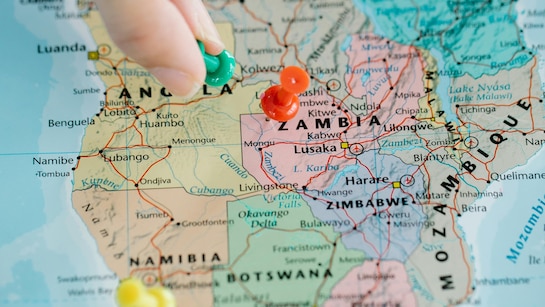
The globally ubiquitous Mercator world map portrays the European Union as approximately equal in size to Africa. However, the reality is striking: Africa's landmass exceeds Europe's by more than sevenfold. This significant misrepresentation has sparked "Correct the Map," a new African initiative advocating for cartographic representations that accurately reflect Africa's true dimensions.
"This map has historically diminished Africa's presence, reinforcing perceptions that the continent is smaller, marginal, and less significant," explained Fara Ndiaye, who co-founded Speak Up Africa, the organization spearheading this campaign alongside Africa No Filter.
Cartography experts informed AFP that transforming Earth's spherical form into a flat representation inevitably requires compromises, necessitating distortion through stretching, cutting, or omission of certain areas.
Maps throughout history have reflected their creators' perspectives of the world. Sixth-century BC Babylonian clay tablets positioned their empire centrally, while European maps from medieval times frequently emphasized religious landmarks.
Cartographers must make crucial decisions: a world map appears dramatically different depending on whether Australia, Siberia, or Europe occupies the central position.
The predominant map used today originated with Flemish cartographer Gerardus Mercator in 1569, designed primarily for maritime navigation purposes.
While Mercator's projection accurately preserved the shapes and angles of landmasses, it significantly distorted their relative sizes.
This projection inflates northern regions while compressing equatorial areas, making Europe and North America appear disproportionately large while minimizing Africa and South America.
The distortions are remarkable: a 100-square-kilometre area near Oslo, Norway, appears four times larger than an identical area surrounding Nairobi, Kenya.
Greenland seems to match Africa's size, despite being 14 times smaller in reality.
Alternative projections emerged during the 20th century, including Oswald Winkel's 1921 version and Arthur Robinson's 1963 model, both reducing distortions but sacrificing precision. The Gall-Peters projection from the 1970s restored proportional sizing but elongated landmass shapes.
In 2018, cartographers Tom Patterson, Bojan Savric, and Bernhard Jenny introduced the Equal Earth projection to balance accuracy with aesthetics.
This projection substantially increases the apparent size of Africa, Latin America, South Asia, and Oceania.
"Equal Earth maintains the relative surface areas of continents while preserving, as much as possible, their shapes as they appear on a globe," Savric explained to AFP.
This is now the projection officially endorsed by the African Union.
Speak Up Africa indicates their campaign's next phases involve advocating for adoption by African educational institutions, media outlets, and publishers.
"We're also engaging with the UN and UNESCO, as sustainable transformation requires support from global institutions," Ndiaye stated.
Some critics dismiss allegations of bias in traditional mapping.
"Asserting that the Mercator projection deliberately misleads people seems unsophisticated," Mark Monmonier, Syracuse University geography professor and author of "How to Lie with Maps," told AFP.
"For accurate country size comparisons, utilize bar graphs or tables, not maps."
Despite its distortions, the Mercator projection remains valuable for digital platforms because its accurate representation of land shapes and angles "makes directional calculations straightforward," according to Ed Parsons, former geospatial technologist at Google.
"While Mercator distorts feature sizes across large areas, it accurately portrays small features, which represents the most common application on digital platforms," he explained.
Prioritizing accurate relative sizes, as in the Equal Earth map, can complicate navigation calculations, though technology continues to evolve.
"Most mapping software has supported Equal Earth since its 2018 introduction," Savric noted. "The challenge lies in adoption, as people naturally resist change."
Some dismiss the African campaign's core premise.
Ghanaian policy analyst Bright Simons argues that Africa needs more than cartographic representation to "gain global respect."
"South Korea, regardless of how Mercator depicts it, possesses nearly the same GDP as all 50 African countries combined," he observed.
Nevertheless, advocates remain committed to their cause.
"We'll achieve success when children worldwide open their textbooks and see Africa as it truly is: vast, central, and indispensable," Ndiaye concluded.