
Mystery Solved: 15-Year-Old 'Fedora Man' Behind Viral Louvre Heist Photo Reveals His Story
- Date & Time:
- |
- Views: 51
- |
- From: India News Bull
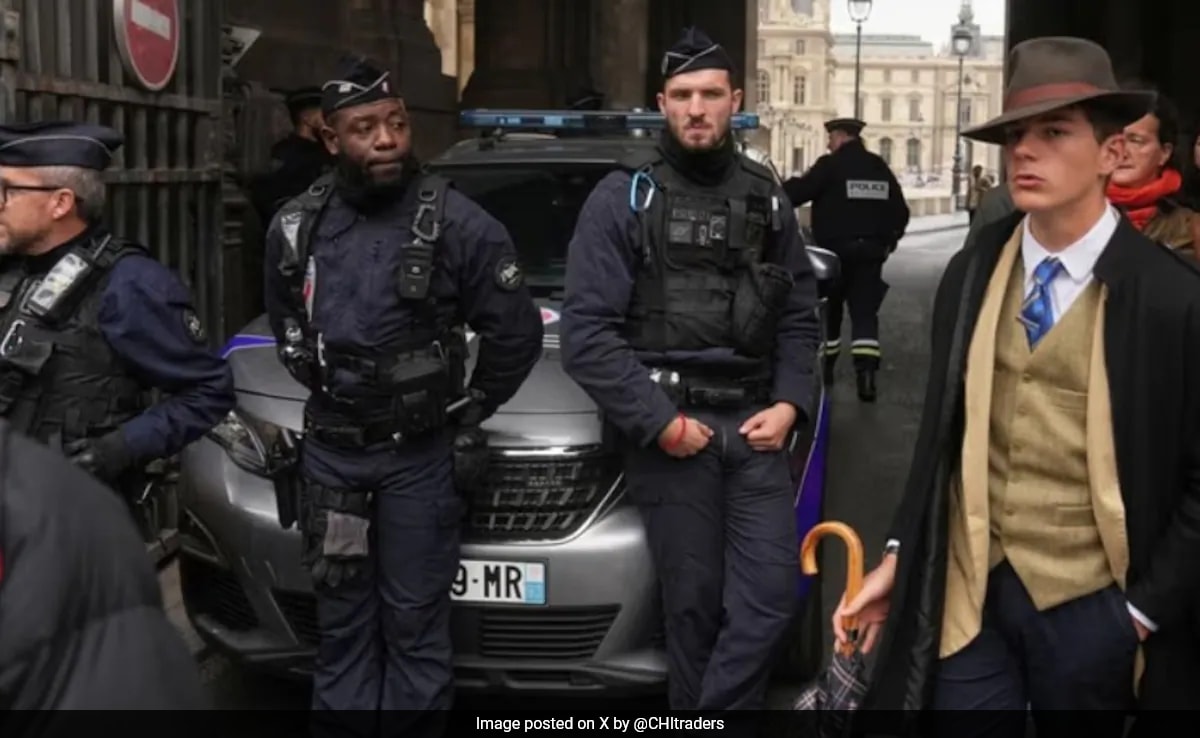
He maintained his silence for several days before changing his Instagram from private to public.
Paris:
When 15-year-old Pedro Elias Garzon Delvaux discovered an Associated Press photograph of himself at the Louvre during the crown jewels heist had garnered millions of views, he resisted the urge to immediately reveal his identity.
Instead, this Sherlock Holmes and Hercule Poirot enthusiast, who resides with his parents and grandfather in Rambouillet, 30 kilometres from Paris, decided to embrace the mystery surrounding him.
As speculation mounted about the elegantly dressed stranger in the "Fedora Man" image - was he a detective, an accomplice, or even an AI creation? - Pedro chose to remain silent and observe the theories unfold.
"I didn't want to immediately confirm it was me," he explained. "With this photograph, there exists a mystery worth preserving."
For his exclusive in-person interview since becoming an international sensation, he appeared before AP cameras at his home dressed similarly to that Sunday: sporting a fedora hat, his father's Yves Saint Laurent waistcoat, a jacket selected by his mother, a neat tie, Tommy Hilfiger trousers, and a restored Russian watch bearing marks of war.
His carefully angled fedora serves as his tribute to French Resistance hero Jean Moulin.
In person, Pedro is an intelligent, amused teenager who accidentally wandered into a global narrative.
The image that catapulted him to fame was intended to document a crime scene. Three police officers lean against a silver car blocking a Louvre entrance, hours after thieves executed a daylight raid on French crown jewels. To the right, a solitary figure in a three-piece ensemble walks past - a flash of film noir amidst a modern manhunt.
The internet did the rest. Users nicknamed him "Fedora Man" and cast him variously as an old-school detective, an inside man, a Netflix series concept, or not human at all. Many were convinced he was AI-generated.
Pedro understood the confusion. "In the photograph, I'm dressed more like it's the 1940s, while we're in 2025," he said. "There's a striking contrast."
Even some relatives and friends remained uncertain until they noticed his mother in the background. Only then did they realize: The internet's beloved fictional detective was actually a real teenager.
The truth was straightforward. Pedro had visited the Louvre with his mother and grandfather.
"We intended to visit the Louvre, but found it closed," he explained. "We weren't aware of any heist."
They inquired with officers about the closure. Moments later, AP photographer Thibault Camus, documenting the security perimeter, captured Pedro mid-stride.
"I didn't know when the picture was taken," Pedro said. "I was simply walking by."
Four days later, an acquaintance messaged him: Was that him in the photo?
"She informed me there were 5 million views," he recalled. "I was somewhat surprised." Then his mother called to tell him he appeared in The New York Times. "That doesn't happen every day," he remarked. Cousins in Colombia, friends in Austria, family acquaintances, and classmates followed with screenshots and calls.
"People told me, 'You've become a star,'" he said. "I was astonished that a single photograph could make someone viral within days."
The distinctive look that captivated tens of millions isn't a costume created for a museum visit. Pedro began dressing this way less than a year ago, inspired by 20th-century history and black-and-white images of suited statesmen and fictional detectives.
"I enjoy being elegant," he said. "I attend school dressed like this."
Among a sea of hoodies and sneakers, he stands out in his interpretation of a three-piece suit. The fedora, however, follows specific rules. It's reserved for weekends, holidays, and museum visits.
At his school, which doesn't require uniforms, his style has started influencing others. "One of my friends arrived this week wearing a tie," he mentioned.
He understands why people projected detective characteristics onto him: an improbable heist deserved an improbable detective. He admires Poirot - "very elegant" - and appreciates the notion that unusual crimes call for distinctive investigators. "When something extraordinary occurs, you don't envision a conventional detective," he observed. "You imagine someone distinctive."
This perspective aligns with his background. His mother, Felicite Garzon Delvaux, grew up in an 18th-century museum-palace, daughter of a curator and an artist, regularly taking her son to exhibitions.
"Art and museums are living spaces," she stated. "Life without art isn't really living."
For Pedro, art and imagery were woven into everyday existence. So when millions projected narratives onto a single frame of him in a fedora beside armed police at the Louvre, he recognized the power of imagery and allowed the myth to breathe before stepping forward.
He remained silent for several days before making his Instagram public.
"People needed to try discovering my identity," he explained. "Then journalists approached me, and I revealed my age. They were extremely surprised."
He maintains a relaxed attitude about future developments. "I'm waiting for film offers," he said with a smile. "That would be quite amusing."
In a story of theft and security failures, "Fedora Man" offers a gentler counterpoint - a teenager who believes art, style, and compelling mysteries belong in everyday life. One photograph transformed him into a symbol. Meeting him confirms he is, reassuringly, authentic.
"I'm a star," he says - less as boast than experiment, as if testing the phrase the same way he might try on a hat. "I'll continue dressing this way. It's my style."
Source: https://www.ndtv.com/world-news/not-detective-or-ai-louvre-fedora-man-is-a-teen-with-great-style-9604502