
Alarming 41°C Temperatures in Amazon Lake Killed Dolphins and Revealed Growing Climate Crisis
- Date & Time:
- |
- Views: 40
- |
- From: India News Bull
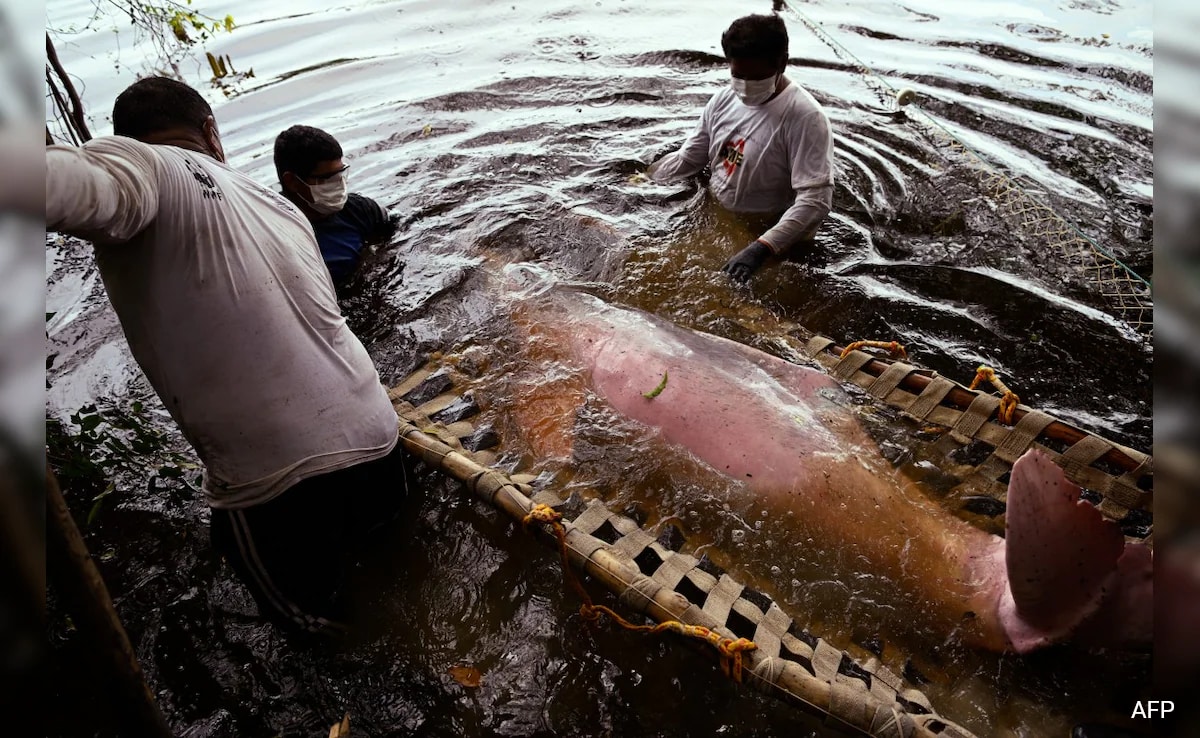
Researchers in Brazil were alarmed when they restrained an Amazon river dolphin in Lake Amana during September, amid a crisis unfolding in the region.
When dozens of dead dolphins began appearing on Lake Tefe in Brazil's Amazonas state, hydrologist Ayan Fleischmann was dispatched to investigate the cause.
The research team made a shocking discovery: a severe drought combined with an extreme heat wave beginning in September 2023 had transformed the lake into a virtual hot spring, with water temperatures reaching an unprecedented 41 degrees Celsius—exceeding the temperature of most spa baths.
These findings, published in the journal Science on Thursday, highlight the devastating impacts of global warming on tropical regions and aquatic ecosystems. The timing coincides with the commencement of the UN's COP30 climate talks in Brazil.
"The water was so hot you couldn't even place your finger in it," lead researcher Fleischmann from Brazil's Mamiraua Institute for Sustainable Development told AFP. He described the profound psychological impact of witnessing the carcasses of Amazon River dolphins and tucuxis, another freshwater dolphin species native to the region.
Fleischmann emphasized this represents an "overlooked problem," noting that tropical lakes—crucial for food security and livelihoods of local communities—have received significantly less scientific attention than their counterparts in Europe and North America, and were previously assumed to maintain relatively stable conditions.
While this research concentrated on the 2023 event, another record-breaking drought struck the Amazon just one year later. Such extreme events are becoming increasingly frequent, severe, and prolonged as a direct consequence of human-induced climate change.
The research team examined 10 central Amazonian lakes and discovered that five experienced extraordinarily high daytime water temperatures exceeding 37C, substantially above the 29-30C normal range.
Lake Tefe registered the most extreme reading, while simultaneously experiencing a reduction of approximately 75 percent in its surface area.
What made the findings particularly remarkable, according to Fleischmann, was that the same elevated temperature was measured consistently throughout the entire two-meter water column, not just at the surface.
Using computer modeling, the researchers identified four primary factors driving this phenomenon: intense solar heating, shallow water depths, minimal wind speeds, and high turbidity—a measurement of water cloudiness.
These factors create a reinforcing cycle. Shallow waters increase turbidity, trapping more heat, while limited wind reduces heat dissipation, leaving the water more exposed to clear skies and intense solar radiation.
Aquatic life faced an additional challenge from the dramatic temperature fluctuations, with Lake Tefe's daytime high of 41C followed by nighttime lows of 27C.
Although national and international attention concentrated primarily on the more than 200 dolphin deaths recorded within a period of less than two months, these represented only the visible portion of a broader socio-ecological disaster, with massive fish die-offs also occurring.
The lake even experienced a phytoplankton bloom that turned the water red as the algae responded to stress—the subject of another forthcoming paper co-authored by Fleischmann.
To analyze long-term patterns, the researchers examined NASA satellite data dating back to 1990, revealing that Amazonian lakes have been warming at approximately 0.6C per decade, exceeding the global average rate.
"The climate emergency is here, there is no doubt about it," Fleischmann stated emphatically.
He noted his plans to attend the COP30 summit to advocate for comprehensive long-term monitoring of Amazon's lakes and greater inclusion of local populations—including Indigenous peoples, non-Indigenous riverine communities, and Afro-descendant groups—in developing effective solutions.
Source: https://www.ndtv.com/world-news/hotter-than-spa-bath-amazon-lake-hit-41-degrees-celsius-in-2023-killing-several-dolphins-9591300