
Nancy Pelosi's Linguistic Legacy: The Power of Pelosi-isms in American Politics
- Date & Time:
- |
- Views: 74
- |
- From: India News Bull
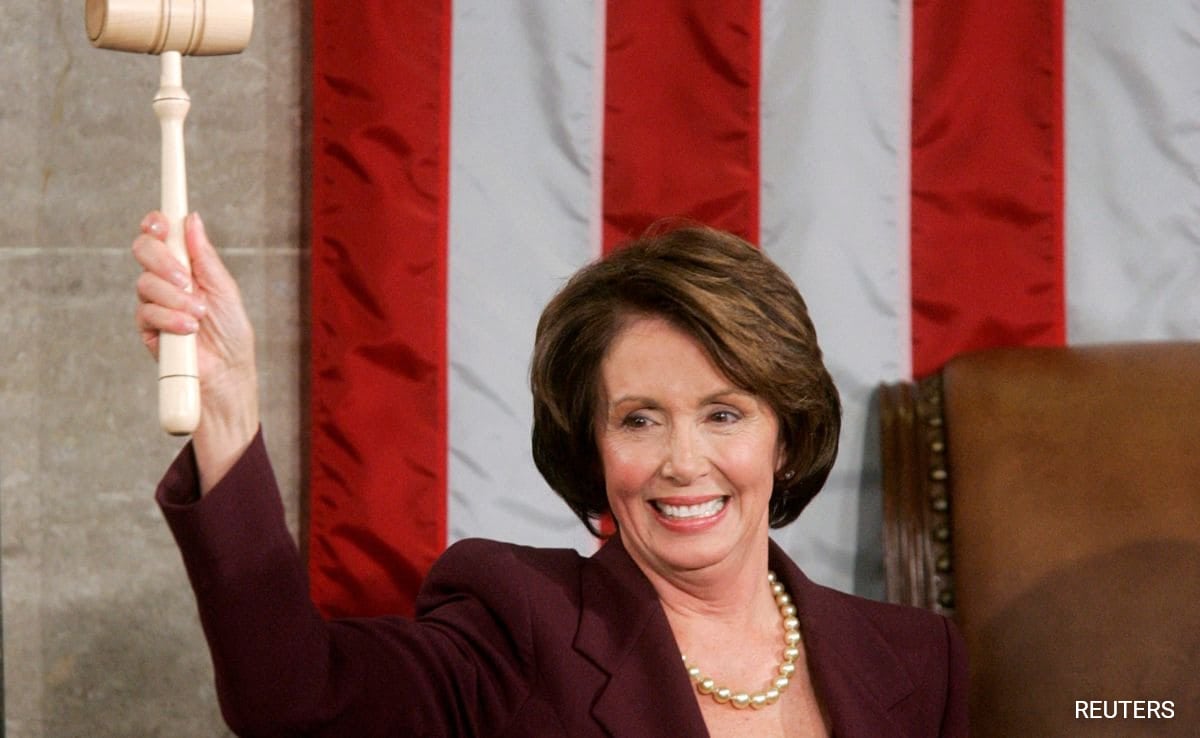
Politics, according to Nancy Pelosi, is a challenging field, especially for women. (File)
Washington:
Nancy Pelosi is concluding her groundbreaking career in the US House of Representatives, but her linguistic legacy will continue to resonate throughout Congress and beyond.
The enduring leadership of the first female Speaker of the House is reflected not only in her accomplishments but also in her distinctive phraseology. Her "Pelosi-isms" have characterized her leadership style and become embedded in political discourse, echoing through the halls of power.
"Know your power," Pelosi stated in her retirement announcement video, employing one of her signature phrases while providing her San Francisco constituents with a call to action.
In an era when the Democratic Party faces uncertainty and seeks strong leadership to counter President Donald Trump, Pelosi's distinctive expressions serve as reminders of language's power. Words have significance. They function as organizing principles, shorthand for shared visions and values, and guides through political challenges.
As Pelosi, at 85, prepares for her next chapter—planning to complete her final year in Congress—her language over time has encapsulated her legacy and offers guidance for future leaders.
During a summer interview with The Associated Press in her Washington office, Pelosi emphasized the importance of purpose.
"That's very important," Pelosi explained. "Because, when I left home to run for Congress, I had to know why I was doing that."
She acknowledged that politics presents significant challenges, particularly for women.
"It's not for the faint of heart. And it is tough. It's rough. So it's only doable if you know why you're doing it."
"My 'why' was 1 in 5 children in America lives in poverty, goes to sleep hungry at night," she revealed. "That was my 'why.'"
"In the arena, you have to be active," she explained.
What began as her acknowledgment of Theodore Roosevelt's "The Man in the Arena" speech has evolved into Pelosi's own version a century later.
Roosevelt celebrated "the man who is actually in the arena, whose face is marred by dust and sweat and blood; who strives valiantly."
The Pelosi Version: "You have to be ready to take a punch. You have to be ready to throw a punch—for the children."
It's "so obvious," she said. "I've used it for a while."
Congress, especially the often tumultuous House, is frequently viewed as the branch of government most closely reflecting the public mood, representing the nation's diversity.
Pelosi describes it as the "giant kaleidoscope" in politics.
"We take pride in our diversity, but unless we're unified we're not going to achieve what our goal is," she said about the Democratic side. "And that's something that people should fear. It's our strength."
Shortly after the 2018 midterm elections during Trump's first term, a government shutdown loomed when the president summoned congressional leaders to the White House.
With cameras recording in the Oval Office, Trump criticized and belittled the leaders regarding his demand for border wall funding.
Then he targeted Pelosi, who had been vilified by Republicans in an unsuccessful multimillion-dollar campaign to prevent her party from winning the House.
The president suggested she faced upcoming political challenges.
"Mr. President, please don't characterize the strength that I bring to this meeting as the leader of the House Democrats who just won a big victory," she responded.
Pelosi subsequently left the White House, her burnt orange winter coat swaying in the December afternoon, creating a lasting image of her return to power.
"What do you gain by agonizing?" Pelosi often asks.
This phrase, reportedly popularized by feminist leader Florynce "Flo" Kennedy in an earlier era, has become part of Pelosi's Capitol Hill vocabulary—and was utilized in a recent California redistricting election.
"The most important thing is time. It's the most precious commodity of all. So why are you using your time, agonizing over this?" she said. "We organize."
"Darling," Pelosi recalled the late Rep. Lindy Boggs advising her, "Don't make every fight your last fight."
It's a strategic approach Pelosi incorporated early in her career.
"Everybody is a resource to you," she said. "You never know where a vote might come from."
"E pluribus unum," a founding principle of the nation, comes from Latin meaning "out of many, one."
More recently, Pelosi has drawn inspiration from the national anthem.
"This is what I'm telling members now is our goal: We have to prove 'through the night that our flag is still there,'" she said. "And I think those things are very much at risk."
"Isn't that interesting, it's the same word?" Pelosi noted about recreation. "I made that up myself."
"Go home and recreate to recreate," she advises, "because you've got to be ready for the fight."
However, she added, "I don't always do it myself."
"You cannot tire. You must be there to the end," she emphasized.
It's an ability she says she learned from union leaders during negotiations.
But doesn't that contradict "recreate to recreate"?
"Resting is rusting," she concluded, "is strictly for me."
Source: https://www.ndtv.com/world-news/nancy-pelosi-retires-us-house-speaker-nancy-pelosi-to-retire-after-40-years-here-are-some-pelosi-isms-9590346