
Kim Jong Un Declines Trump Meeting: How North Korea's Strategic Alliances Strengthen Its Global Position
- Date & Time:
- |
- Views: 43
- |
- From: India News Bull
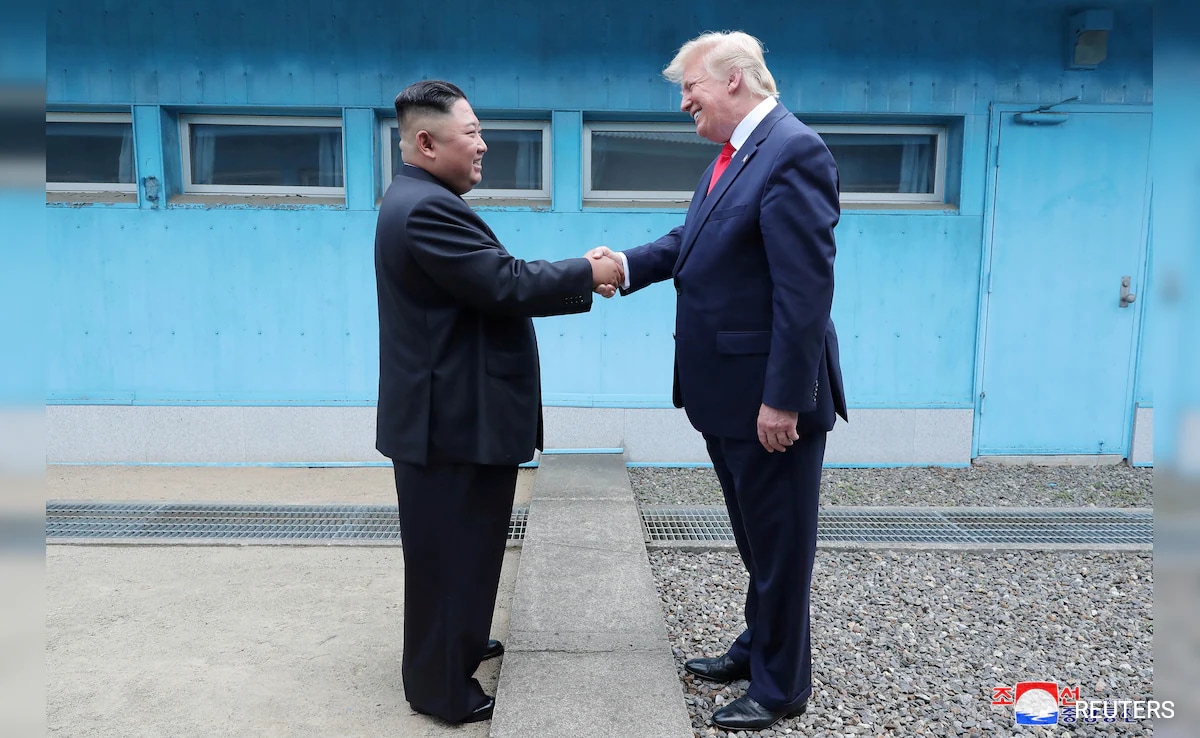
US President Donald Trump shakes hands with North Korean leader Kim Jong Un (File)
During his recent Asia tour, US President Donald Trump expressed openness for a meeting with North Korean leader Kim Jong Un, but analysts suggest the increasingly confident Kim had minimal motivation to engage in what would amount to a mere photo opportunity.
Throughout his extensive Asia visit, Trump repeatedly signaled his willingness to meet Kim, declaring he was "100 percent" open to talks and even making the unprecedented concession of acknowledging North Korea as "sort of a nuclear power."
Pyongyang, however, remained silent on these invitations, instead launching missiles and dispatching its foreign minister to strengthen relationships with Russia and Belarus, countries with which North Korea has cultivated stronger ties in recent years.
"The brutal reality is that Kim Jong Un had no incentive to participate," explained Seong-Hyon Lee, a visiting scholar at the Harvard University Asia Center, describing Washington's expectation of Kim's participation as a "fundamental miscalculation."
Trump's persistent overtures have instead served as a "victory" for the North Korean leader, lending significant credibility to both him and his nuclear program, according to Lee.
"President Trump gave Kim a massive, unearned concession," Lee noted.
The two leaders—whom Trump once famously claimed were "in love"—last met in 2019 at Panmunjom in the Demilitarized Zone (DMZ) between the two Koreas, following Trump's Twitter invitation to Kim.
That Trump-led diplomatic initiative eventually collapsed over disagreements regarding North Korea's denuclearization and sanctions relief.
Since that time, North Korea has proclaimed itself an "irreversible" nuclear state and established close connections with Russia, even sending troops to support Moscow's military campaign in Ukraine.
Kim now occupies a "pretty sweet spot," according to Soo Kim, a former CIA analyst.
"Russia's backing is probably one of the most decisive factors strengthening and cementing North Korea's strategic hand these days," she told AFP.
"He maintains the upper hand, which makes it easier for him to pass on Trump's invitation," Kim added.
Returning from South Korea and meetings with Chinese leader Xi Jinping, Trump claimed he had been too "busy" to meet with Kim, though he mentioned the possibility of returning.
This scenario contrasts sharply with 2019, when denuclearization and sanctions relief negotiations in Hanoi, Vietnam, dramatically fell apart—forcing Kim to endure a lengthy train journey back to Pyongyang with no agreement secured.
Vladimir Tikhonov, Korean Studies professor at the University of Oslo, told AFP that this experience had left Pyongyang hesitant.
"They don't want to venture forward too rushingly," he observed.
Instead, Tikhonov suggested that Pyongyang may be awaiting more concrete proposals from Trump, including formal diplomatic recognition and sanctions relief without requiring denuclearization.
With strengthened alliances elsewhere, Kim has little motivation to seek approval from Washington.
This week, North Korean foreign minister Choe Son Hui traveled to Moscow, where she and Russian President Vladimir Putin agreed to enhance bilateral relations.
Analysts report that North Korea is receiving substantial financial aid, military technology, and food and energy assistance from Russia.
This support has enabled North Korea to circumvent the stringent international sanctions imposed over its nuclear and missile programs—sanctions that once served as a crucial bargaining chip for the United States.
Unrestricted trade with China—which reached its highest level in nearly six years last month, according to analysts—has further alleviated Pyongyang's economic isolation.
Last month, Kim appeared alongside Xi Jinping and Russia's Vladimir Putin at an elaborate military parade in Beijing—a remarkable demonstration of his elevated status in global politics.
Kim now has "no reason to trade this new, high-status quo for a photo-op" with Trump, said Harvard's Lee.
Kim possesses a "strategic lifeline from Russia and China, and he sees the US-China competition as a long-term guarantee of his own maneuverability."
The North Korean leader is now operating from a "position of strength."
Source: https://www.ndtv.com/world-news/once-in-love-now-ignored-why-kim-jong-un-had-little-need-for-photo-op-with-us-president-donald-trump-9550798