
Historic First: Jim Morrison Completes Death-Defying Ski Descent of Everest's North Face
- Date & Time:
- |
- Views: 66
- |
- From: India News Bull
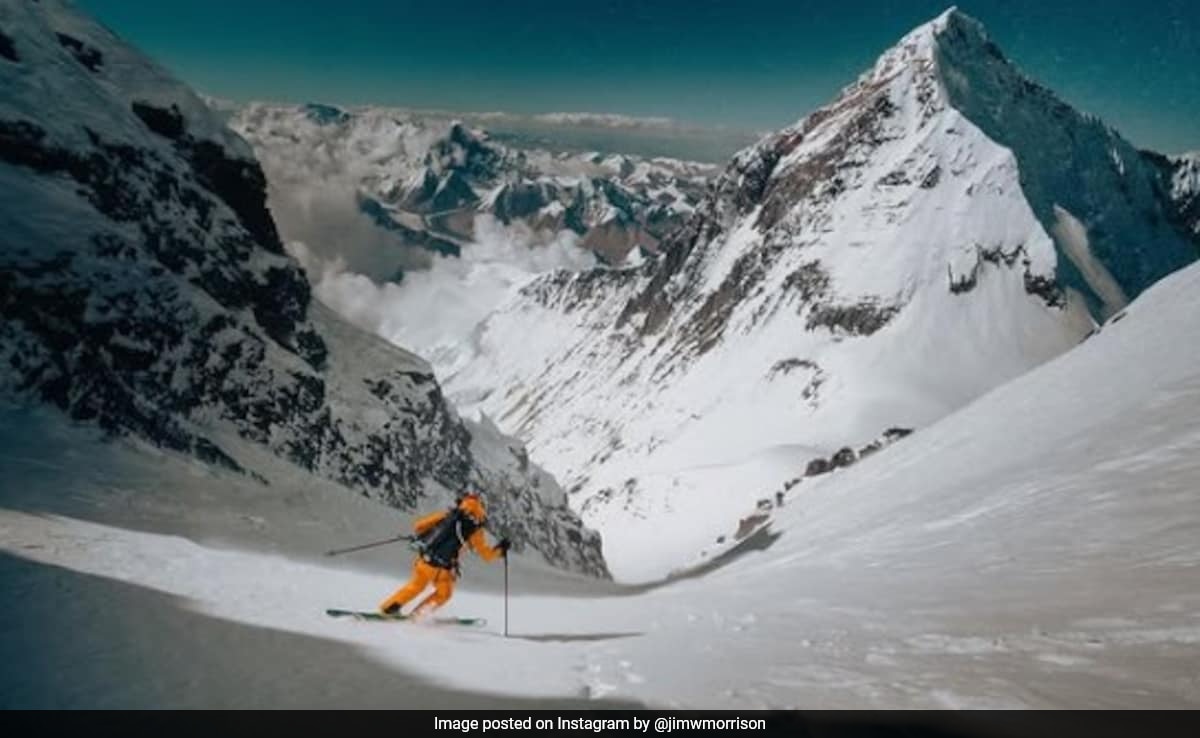
Jim Morrison conquered Everest's formidable North Face through the treacherous Hornbein Couloir.
Mountaineer Jim Morrison navigated his skis with precision, alternating left and right movements, sending cascades of snow down the steep gully of Mount Everest's North Face. His labored breathing echoed in the thin atmosphere as he faced what many consider the world's most unforgiving ski descent.
Below him stretched an intimidating 9,000-foot (2,700-meter) expanse of snow, ice, and jagged rock - a run no human had ever successfully completed until Morrison's groundbreaking achievement.
"It was a spectacular four hours of skiing down a horrific snow pack," Morrison shared with The Associated Press on Tuesday, reflecting on his historic October 15 descent.
View this post on Instagram
A post shared by National Geographic (@natgeo)
Morrison's journey began with climbing Everest's notorious North Face via the Hornbein Couloir, accompanied by 10 fellow mountaineers and renowned documentarian Jimmy Chin, who is co-directing a film about Morrison's unprecedented feat. Chin previously documented Alex Honnold's rope-free ascent of El Capitan for the acclaimed documentary "Free Solo."
This endeavor represents "the skiing equivalent to free soloing," Chin explained. "If your edge blows out or you slip anywhere on the line, you're gone. You fall 9,000 feet."
The ski descent originates at Everest's summit, approximately 29,000 feet (8,800 meters) above sea level, within the death zone where human survival is severely limited.
"When it comes to big mountain stuff and climbing, it's like landing on the moon," remarked Jeremy Evans, author of a book chronicling the last person to attempt this route. That individual, snowboarder Marco Siffredi, vanished on these slopes in 2002.
Morrison conceived this adventure with his life partner, celebrated ski mountaineer Hilaree Nelson. They had intended to accomplish it together before her tragic death in 2022 while skiing on the world's eighth-highest peak.
View this post on Instagram
A post shared by Jim Morrison (@jimwmorrison)
Following her passing, the expedition became Morrison's tribute to their shared dream.
At the base of their route up Mount Everest, before beginning their four-day ascent to the summit, the team gazed upward at their objective.
"We've spent an entire lifetime climbing in the big mountains," said Chin. "I've never to this day seen anything that's more intimidating as a climbing objective."
Only five individuals had previously climbed this route, with no successful attempts since 1991. Unlike the popular routes that follow Everest's ridgelines, this path—known as the Super Direct route—proceeds straight up the imposing North Face, and consequently straight down.
Their 12-person team began the ascent, traversing snowfields, rock sections, and ice patches while facing potential rockfalls and avalanches. They had meticulously planned their expedition during a narrow weather window, seeking adequate snow for skiing and safe conditions.
Each night, they spent hours carving platforms into the ice and snow where they could rest, always secured to the mountain with safety ropes.
During one particularly harrowing night, they huddled against the mountain face as fierce winds showered snow from above, threatening to dislodge their tent, Chin recounted.
Morrison managed to sleep. Chin, also needing rest and having done everything possible to secure their position, made a pragmatic decision.
"So I put in my earplugs because I figured if we go get blown off the mountain, I don't want to know what's happening," he said.
They survived the night. As they continued upward, Morrison evaluated the snow conditions he would soon ski down and found them deeply concerning. "Basically everything I saw looked terrifying. The snow conditions were really, really bad," he admitted.
Nevertheless, Morrison persevered, keeping Nelson's memory close as he ascended. "As I got higher and higher, and further into the death zone, I got closer and closer to her."
Upon reaching the summit, sunshine illuminated the panorama of Himalayan peaks surrounding them.
The team celebrated their achievement and captured photographs. Morrison scattered some of Nelson's ashes at the world's highest point.
Then, as Morrison prepared his skis and looked toward his teammates, the magnitude of what lay ahead struck him: "OK, now I'm in a completely different world. I'm on my own."
He began his descent, executing controlled hop turns. The route's details, which he had meticulously studied and visualized, consumed his focus. His mind wasn't dwelling on potential falls—only the next turn. Every breath required conscious effort at that extreme altitude.
He later messaged friends: "the conditions were abominable, and I was able to shred a lot of it."
At several points during the descent, Morrison utilized safety ropes, particularly on rocky sections, though he relied on them less than anticipated.
Upon approaching the bottom and crossing into safety, Morrison finally released his tension.
He screamed, wept, and spoke to Nelson's spirit.
The following morning, he walked out and gazed up at the towering North Face.
"And I could sort of feel Hilaree's presence at the very top, the top of the world."
Source: https://www.ndtv.com/world-news/mountaineer-jim-morrison-skis-down-everests-most-challenging-route-9537208