
Ostrich, Emu Ancestors Could Fly, Scientists Discover
It may sound like a joke, but scientists have long been puzzled by how the family of birds that includes African ostriches, Australian emus and cassowaries, New Zealand kiwis and South American rheas spread across the world -- given that none of them
- Date & Time:
- |
- Views: 49
- |
- From: India News Bull
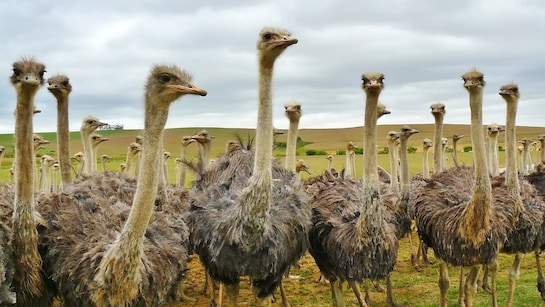
Scientists have discovered that the ancient ancestors of today's flightless birds once had the ability to fly. (File)
France:
The question of how ostriches traversed oceans might seem comical, but it represents a genuine scientific conundrum.
Researchers have long been baffled by the global distribution of palaeognaths—the bird family encompassing African ostriches, Australian emus and cassowaries, New Zealand kiwis, and South American rheas—particularly since these birds cannot fly. A study released Wednesday potentially resolves this mystery by revealing that their earliest known ancestors possessed the capacity for flight.
Among living palaeognaths, only the Central and South American tinamous can fly, though their aerial abilities are limited to brief escapes from danger or surmounting obstacles.
This widespread aerial limitation has made the family's global dispersion difficult to explain scientifically.
Previously, some researchers hypothesized that these birds' forebears were separated when the supercontinent Gondwana fragmented 160 million years ago, forming South America, Africa, Australia, India, New Zealand, and Antarctica.
However, genetic evidence has demonstrated that "the evolutionary splits between palaeognath species happened long after the continents had already separated," explained lead study author Klara Widrig from the Smithsonian National Museum of Natural History to AFP.
Widrig's team examined a lithornithid specimen, representing the oldest palaeognath group with discovered fossils, dating from the Paleogene period (66-23 million years ago).
The fossil of Lithornis promiscuus, originally discovered in Wyoming, had been housed in the Smithsonian's collection.
"Because bird bones tend to be delicate, they are often crushed during the process of fossilisation, but this one was not," Widrig noted.
"Crucially for this study, it retained its original shape," she added. This preservation allowed researchers to scan the creature's breastbone, where flight muscles would have attached.
They determined that Lithornis promiscuus could indeed fly—either through continuous wing-beating or by alternating between flapping and gliding.
This discovery raises another question: why did these birds eventually abandon flight?
According to Widrig, birds typically evolve flightlessness under two key conditions: "they have to be able to obtain all their food on the ground, and there cannot be any predators to threaten them."
Recent research has also indicated that lithornithids may have possessed a bony structure on their beak tips that enhanced their insect-foraging capabilities.
Regarding the absence of predators, Widrig theorizes that palaeognath ancestors likely began evolving toward flightlessness after dinosaurs became extinct approximately 65 million years ago.
"With all the major predators gone, ground-feeding birds would have been free to become flightless, which would have saved them a lot of energy," she explained.
The small mammals that survived the dinosaur extinction event—believed to have been caused by a massive asteroid—would have required time to evolve into formidable predators.
This interval would have provided flightless birds "time to adapt by becoming swift runners" like emus, ostriches, and rheas—or even "becoming themselves dangerous and intimidating, like the cassowary," Widrig concluded.
The findings were published in the Royal Society's Biology Letters journal.