
After Mass Nepal Jailbreak, Some Prisoners Surrender
Days after escaping alongside 13,500 others in a giant jailbreak during deadly anti-corruption protests in Nepal, Avinash Rai rubbed his belly after a meal -- and strolled back into prison.
- Date & Time:
- |
- Views: 52
- |
- From: India News Bull
Nepal:
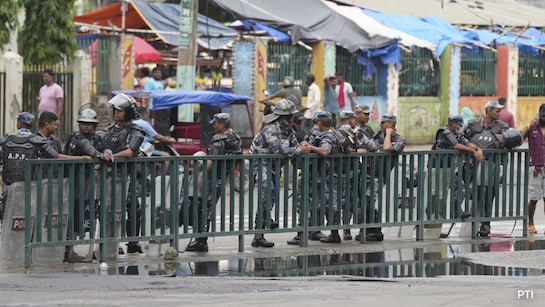
Several prisoners have voluntarily returned to custody days after being part of a massive jailbreak involving 13,500 inmates during Nepal's violent anti-corruption protests. Avinash Rai, a 46-year-old convicted smuggler, surprised his family when he appeared at their Kathmandu home during last week's turmoil that saw parliament set ablaze and the government overthrown.
The unrest claimed at least 73 lives and resulted in security breakdowns across the capital, with inmates escaping from damaged prisons throughout the country.
"We faced a situation where merely surviving was difficult," Rai told AFP, carrying two small bags as he surrendered himself at Kathmandu's Nakhu prison gates. "There were no police officers here—extensive arson and vandalism occurred. The gate was left open afterward."
Upon escaping, Rai encountered violent crowds and widespread fires across the city.
"It was extremely chaotic outside," he said about the disorder during his escape. "Now I'm returning."
The youth-led demonstrations in the Himalayan nation began September 8, initially triggered by a brief social media ban but fueled by frustration over corruption and persistent economic hardships.
At least 19 people died in the subsequent crackdown.
The following day, outrage over these deaths intensified, sparking nationwide fury—government buildings were set on fire and violence erupted in multiple correctional facilities.
Rai, imprisoned for smuggling illegal goods across the India-Nepal border, has completed 20 months of a 22-month sentence and has requested the new government to "demonstrate some clemency."
'Cops Searching'
Police report that over one-third of the escapees—5,000 out of 13,500—have been recaptured.
Some were intercepted by Indian security forces while attempting to cross the lengthy, porous border.
Many dangerous criminals remain at large.
Others, like Rai, have surrendered voluntarily—particularly those convicted of minor offenses or nearing sentence completion.
Nagendra Shreshtha, who accompanied Rai back to prison, said Rai's family was astonished when he appeared at their doorstep.
"It was incredible that all these inmates managed to escape," Shreshtha said. "We suggested that surrendering voluntarily was the sensible choice."
Rai wasn't alone at the prison entrance.
Som Gopali, 40, sentenced to five years for assault with nine months remaining, embraced his weeping wife while turning himself in.
"I was shocked when Som called me," said his sister Preeti Yonjan, 42, who also accompanied him to the jail gate.
"I was stunned and needed time to comprehend how he had escaped."
Many families expressed distress at seeing their relatives return to confinement after briefly experiencing freedom.
"He couldn't remain outside with police searching for him, especially when he's nearly completed his sentence," Yonjan explained.
'Things Must Change'
Nakhu prison still shows evidence of the recent disturbances.
Walls are blackened from fire, "Gen Z" youth protester slogans cover the entrance, and community volunteers have delivered donated mattresses, blankets, and kitchen utensils.
"Burnt residue is everywhere," said local volunteer Savyata Bhakti, 22.
"The first night after learning about the escape was tense, and everyone was extremely cautious about security."
Suresh Raj Aran, 40, whose 23-year-old son Sevak surrendered, explained that he fled only to escape the violence inside the prison.
"My son is innocent and we want him home with his parents, but only through proper legal channels," Aran stated.
Outside the prison, families expressed hope that Nepal's new interim government, which will lead the country toward elections in March 2026, would improve conditions.
According to the World Bank, an "overwhelming" 82 percent of Nepal's workforce is employed informally, with GDP per capita at just $1,447.
"Things must change—because if not now, then when?" said Poornima Gopali, 29, waving as her brother Som returned inside.