
TikTok, Trade, Taiwan Top Agenda For Call Between Trump, Xi
US President Donald Trump and Chinese President Xi Jinping will have plenty to discuss this week in their first conversation since June, with TikTok, Boeing planes, rare earth magnets and Taiwan among top items for negotiation.
- Date & Time:
- |
- Views: 62
- |
- From: India News Bull
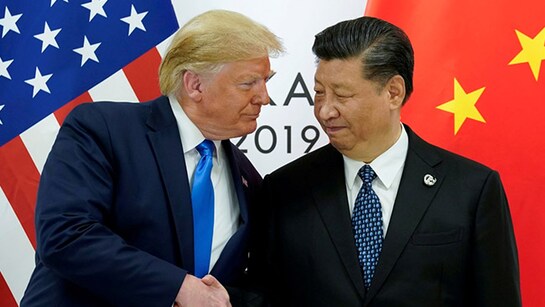
US President Donald Trump and Chinese President Xi Jinping (File)
US President Donald Trump and Chinese President Xi Jinping are scheduled for their first conversation since June this week, with numerous critical issues on the table including TikTok's future, Boeing aircraft deals, rare earth magnets, and tensions over Taiwan.
The leaders will speak ahead of a potential face-to-face meeting during the Asia-Pacific Economic Cooperation summit in South Korea scheduled for late October, following months of measured trade tensions and reciprocal actions on tariffs, export controls, and investment regulations. Trump announced on Truth Social that he would speak with Xi on Friday, emphasizing that "the relationship remains a very strong one!!!"
Chinese officials have not yet publicly acknowledged or commented on the planned call. On Tuesday, China's foreign ministry simply stated that "head-of-state diplomacy plays an irreplaceable strategic leading role" in relations between the world's two largest economies.
Preparatory groundwork was laid Monday when Treasury Secretary Scott Bessent and US Trade Representative Jamieson Greer met with Chinese counterparts in Madrid to develop a framework addressing the latest TikTok deadline, helping maintain momentum for high-level engagement. Defense Secretary Pete Hegseth and Secretary of State Marco Rubio engaged with their Chinese counterparts last week.
Following months of "trade truce" extensions and discussions at lower governmental levels, here are the key issues at stake for the Trump-Xi conversation and beyond:
Where does the US-China relationship stand under Trump's second term in office?Trump continues to express admiration for Xi's leadership style and appears to be adopting elements of Xi's approach as the US considers taking government stakes in technology giants like Nvidia Corp. and Intel Corp. In pursuit of a comprehensive agreement with Xi, Trump has avoided imposing secondary sanctions on China for Russian oil purchases while penalizing India, delayed action on banning TikTok, and spoken more favorably about Chinese students attending American universities.
Nevertheless, Trump has targeted China alongside all other trading partners in a renewed "liberation" campaign aimed at addressing what the US perceives as global trade imbalances.
Both nations have temporarily suspended their most extreme tariff measures against each other, which had seen US duties on Chinese imports reach as high as 145%, with the next deadline approaching in mid-November. A 20% tariff was implemented as punishment for what Trump considers insufficient Chinese efforts to combat fentanyl trafficking, an issue that has devastated American communities and challenged multiple administrations.
Both countries have acknowledged the necessity of maintaining stability in their relationship, despite considerable grandstanding and disagreements regarding each superpower's influence in Global South nations and ongoing conflicts in Ukraine and the Middle East.
What are some of the top priorities for the US and China on any trade deal?Trump aims to maintain trade pressure as part of his strategy to revitalize the US economy through tariffs, which have reached their highest levels in over a century. China, facing renewed domestic economic challenges, seeks the removal of these additional duties.
A key priority for Trump is securing the flow of rare-earth magnets – essential components for American manufacturing and a sensitive leverage point that China has utilized, particularly in response to successive tariff increases. The two powers have also exchanged measures regarding semiconductors, with the US adding 32 companies to its entity list and China responding with new investigations into American-made chips.
Trump has also demanded stronger action against entities in China facilitating the export or financing of fentanyl and related substances. This remains a sensitive issue for China, as officials have resisted implications that they are enabling drug trafficking.
What's more of the low-hanging fruit that either side could offer for a pact?China could satisfy Trump's desire for a significant win through a series of commitments to purchase more American exports.
Chinese investment in the US would likely face skepticism from Washington hawks, as such transactions now undergo intensive scrutiny. However, a substantial Chinese order for Boeing Co. aircraft, which would benefit both Trump and Xi, is expected to be central to any agreement.
Soybeans are frequently targeted in trade discussions and highly vulnerable to US-China negotiations. A Chinese decision to reduce purchases from Brazil in favor of American sources would boost Trump's efforts to please US farmers and increase Chinese imports.
From the US perspective, further easing of people-to-people connections could significantly improve relations. Additional measures facilitating Chinese students' presence in the US – particularly amid broader American immigration restrictions – represents one potential negotiating point.
What are some other, perhaps stickier, items for negotiation?Taiwan remains a major source of tension in US-China relations. Foreign Minister Wang Yi recently reiterated to the US that it should "exercise caution" regarding Taiwan, the self-governed island that China considers its territory. China may seek reductions in arms sales or military trainers to Taiwan.
Trump's MAGA base is reluctant to become more deeply involved in counter-China operations in the Asia-Pacific region, while allies such as the Philippines have pursued stronger military ties with the US amid increasing confrontations in the South China Sea.