
Social Media Has Us In Its Grip And Won't Let Go. The Charlie Kirk Killing Is A Case Study
Charlie Kirk's mastery of social media was key to his rise as an influence in conservative politics. So the extent to which his death and its aftermath have played out on those forums shouldn't come as a surprise.
- Date & Time:
- |
- Views: 91
- |
- From: India News Bull
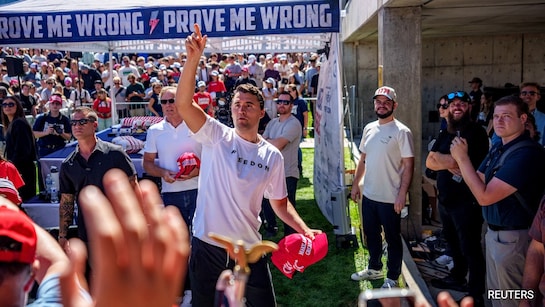
Disturbing footage of Kirk's September 10 assassination rapidly flooded social media platforms
Charlie Kirk built his influence in conservative circles largely through his social media expertise. Unsurprisingly, the digital landscape has become the primary arena for processing his tragic death in Utah.
In today's interconnected society, Americans have turned to social media to comprehend last week's shooting, while Kirk's supporters utilize these same platforms to monitor perceived disrespect toward him. Authorities are investigating Tyler Robinson, the accused shooter, focusing on his activities in the internet's darker recesses before allegedly committing the crime.
Meanwhile, as Americans focused on Kirk's story, Nepal experienced violent unrest triggered by government attempts to ban social media platforms.
These events prompt deeper examination of the technologies reshaping our lives, how their algorithms control our perception, and how our extensive engagement with them shapes our worldview.
Utah's Republican Governor Spencer Cox believes "cancer" inadequately describes social media's impact. "The most powerful companies in the history of the world have figured out how to hack our brains, get us addicted to outrage … and get us to hate each other," Cox stated on NBC's "Meet the Press."
Democratic Senator Brian Schatz from Hawaii advised Americans via social media to "pull yourself together, read a book, get some exercise, have a whiskey, walk the dog or make some pasta or go fishing or just do anything other than let this algo pickle your brain and ruin your soul."
Harrowing videos of Kirk's assassination on September 10 quickly dominated platforms like X, TikTok and YouTube, with companies still struggling to contain their circulation. Confrontational content and conspiracy theories gain traction because they accomplish exactly what these platforms intend – extending user engagement time.
"I do think we're in a moment here," observed Laura Edelson, a Northeastern University professor specializing in social media algorithms. "Our country is being digitally mediated. Where we interact with other people, how we interact with broader society, that is more and more happening over feed algorithms. This is the most recent in a long line of ways that society has been changed by media technology."
Divisive content and widespread circulation of Kirk's death footage weren't the intended goal but resulted directly from profit-maximizing decisions and reduced content moderation, according to Edelson.
"I don't think there are people twirling their mustaches saying how great it is that we've divided society, except the Russian troll farms and, more and more, the Chinese troll farms," she noted.
X owner Elon Musk posted that despite discourse potentially turning negative, "it's still good there is a discussion going." When asked about Cox's comments before departing for the UK, President Donald Trump, who created his own social platform, acknowledged that while social media can create "deep, dark holes that are cancerous," it wasn't entirely negative.
"Well, it's not a cancer in all respects," he told reporters. "In some respects, it is great."
Conservative media personality Ben Shapiro, who considered Kirk a friend, admired Kirk's willingness to engage with those holding different views, a practice increasingly rare in today's social media era.
"How social media works is a disaster area, fully a disaster area," Shapiro stated in a Free Press podcast interview with Bari Weiss. "There's no question it's making the world a worse place — and that's not a call for censorship."
Shapiro emphasized that problematic social media behavior transcends political lines. He highlighted the common use of "they" versus "us" framing when discussing Kirk's death, despite unclear motives and no evidence suggesting the shooter's actions reflect anything beyond his own decisions.
Liberal media company MeidasTouch has compiled inflammatory conservative social posts, particularly those suggesting "war." Simultaneously, conservatives have scoured social media for posts they deem disrespectful toward Kirk, sometimes attempting to get authors fired. The Libs of TikTok account advocated defunding a Washington state school district for refusing to lower flags to half-staff.
Florida Republican Representative Randy Fine requested identification of negative Kirk posts from government employees, public funding recipients, or licensed professionals like teachers and lawyers. "These monsters want a fight?" he posted on X. "Congratulations, they got one."
Karen Attiah, a Washington Post columnist, reported her termination following Bluesky posts expressing minimal sympathy for Kirk. She later clarified on Substack that "not performing over-the-top grief for white men who espouse violence was not the same as endorsing violence against them." A Post spokeswoman declined to comment.
Texas Democratic lawmaker James Talarico, recently announcing a U.S. Senate bid, observed on MSNBC that the primary political communication channels—algorithm-driven social media and cable television—fundamentally divide Americans. "We've got to find our way back to each other because that's the only way we can continue this American experiment," he stated.
Among the most persistent divisive forces are election-related falsehoods and misinformation proliferating through online channels for years. These have undermined faith in fundamental American institutions and fueled the anger that drove Trump supporters to violently storm the U.S. Capitol on January 6, 2021.
Whether meaningful reform is achievable remains uncertain. Nepal's turmoil illustrated government intervention risks: social media shutdowns prompted protests, suggesting attempts to silence government criticism. Police fired on one demonstration, killing 19 people.
Convincing social media companies to modify their algorithms presents significant challenges. These platforms thrive on attention and maximizing user engagement time. Without advertiser exodus over concerns about violent content association, little incentive exists for change, according to social media analyst Jasmine Enberg of Emarketer.
Young people increasingly recognize the dangers of excessive social media consumption, Enberg noted.
Yet completely disconnecting from devices? "The reality of the situation," Enberg concluded, "is that there's a limit to how much they can limit their behavior."