
Historic $102 Million Louvre Heist: Why France's Stolen Royal Jewels May Vanish Forever
- Date & Time:
- |
- Views: 45
- |
- From: India News Bull
Paris:
The magnificent collection of sapphires, emeralds, and diamonds that once belonged to French royalty may be lost forever, according to experts analyzing the audacious four-minute daylight robbery that has shocked France and left the government struggling to explain another security failure at the Louvre.
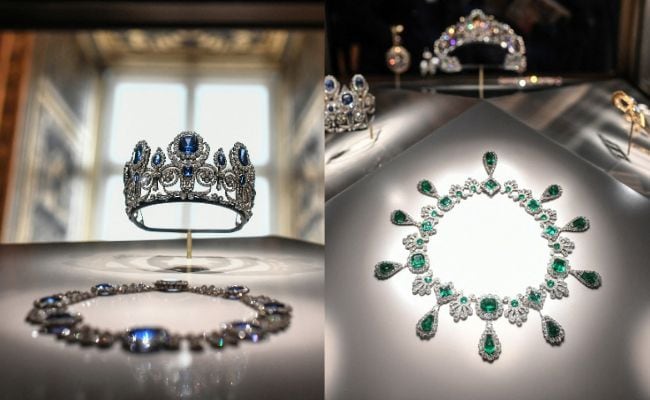
Each stolen treasure - including an emerald necklace with matching earrings, two crowns, two brooches, a sapphire necklace and a single earring - represents 19th century "haute joaillerie" at its finest. These pieces were more than mere adornments for royalty; they served as powerful political statements showcasing France's wealth, influence, and cultural significance. Their historical importance was so great that they survived the government's 1887 auction that dispersed most royal jewels.
The Louvre reopened Wednesday following Sunday morning's heist, though the Apollo Gallery where the theft occurred remains closed to visitors.
Paris prosecutor Laure Beccuau, who is leading the investigation, stated Tuesday that the stolen jewelry carries an estimated value of $102 million (88 million euros), not accounting for their historical significance. Approximately 100 investigators are currently engaged in the search for both the suspects and the missing gems.
This crown jewel theft has created another crisis for the French government regarding the Louvre, which already faces issues with overcrowding and outdated facilities. Recent incidents include activists throwing soup at the Mona Lisa in 2024 and staff strikes in June protesting mass tourism. President Emmanuel Macron has announced plans for the Mona Lisa - itself stolen in 1911 and recovered two years later - to receive its own dedicated space as part of a major renovation.
Experts believe the brilliant jewels, artifacts from France's historical past, are likely being rapidly disassembled and marketed as individual pieces that may no longer be recognizable as components of the French crown jewels.
"It's extremely unlikely these jewels will ever be retrieved and seen again," stated Tobias Kormind, managing director of 77 Diamonds, a major European diamond jeweler. "If these gems are broken up and sold off, they will, in effect, vanish from history and be lost to the world forever."
Crown jewels, both personal treasures and public symbols, are carefully secured from London's Tower to Tokyo's Imperial Palace as visual representations of national identity.
Authorities report the four robbery suspects worked in pairs - two operating a truck with a cherry picker to access the Galerie d'Apollon, while two others piloted motorcycles for the escape.
Officials confirmed eight pieces were taken from a collection whose designation as crown jewels dates to the 16th century when King Francis I declared them state property. According to the Paris prosecutor's office, two men wearing bright yellow jackets breached the gallery at 9:34 a.m. - thirty minutes after opening time - and departed at 9:38 a.m. before fleeing on motorcycles.
The stolen treasures include two crowns, or diadems. One, presented by Emperor Napoleon III to Empress Eugenie in 1853 as a wedding gift, contains over 200 pearls and nearly 2,000 diamonds. The second is a sapphire-and-diamond starry headpiece - along with a matching necklace and single earring - previously worn by Queen Marie-Amelie.
Also missing is a necklace featuring dozens of emeralds and more than 1,000 diamonds given by Napoleon Bonaparte to his second wife, Marie-Louise of Austria, in 1810, along with its matching earrings. The thieves also took a diamond-encrusted reliquary brooch and a large bodice bow worn by Empress Eugenie.
The robbers dropped or abandoned a ninth piece that sustained damage: Empress Eugenie's crown adorned with gold eagles, 1,354 diamonds, and 56 emeralds.
Other items in the crown jewel collection remained untouched, including the plum-sized Regent, a white diamond considered the largest of its kind in Europe. Before the theft, the Louvre's collection comprised 23 jewels.
Beyond their monetary value, the emotional impact of losing these treasures is profound. Many have characterized France's failure to protect these priceless items as a devastating blow to national pride.
"These are family souvenirs that have been taken from the French," conservative lawmaker Maxime Michelet declared Tuesday in Parliament while questioning the government about security at the Louvre and other cultural sites.
"Empress Eugenie's crown - stolen, then dropped and found broken in the gutter, has become the symbol of the decline of a nation that used to be so admired," Michelet continued. "It is shameful for our country, incapable of guaranteeing the security of the world's largest museum."
While not the first robbery at the Louvre in recent years, this heist stands out for its planning, execution speed, and cinematic quality, making it one of the most high-profile museum thefts in memory. The scenario eerily resembles the fictional theft of a royal crown from the Louvre by a "gentleman thief" in the French television show "Lupin" - itself based on stories from 1905.
According to theft investigator Christopher A. Marinello, a lawyer with Art Recovery International, the romantic notion of such thefts is largely a creation of entertainment media. He dismisses the idea of a "theft-to-order" orchestrated by a mysterious collector.
"These criminals are just looking to steal whatever they can," Marinello explained. "They chose this room because it was close to a window. They chose these jewels because they figured that they could break them apart, take out the settings, take out the diamonds and the sapphires and the emeralds" and transport them overseas to "a dodgy dealer that's willing to recut them and no one would ever know what they did."
What follows now is a race against time both for French authorities pursuing the thieves and for the criminals themselves, who face significant challenges finding buyers for the pieces in their complete royal form.
"Nobody will touch these objects. They are too famous. It's too hot. If you get caught you will end up in prison," said Dutch art detective Arthur Brand. "You cannot sell them, you cannot leave them to your children."
Source: https://www.ndtv.com/world-news/why-jewels-worth-102-million-lost-in-louvre-heist-may-never-be-recovered-9498549