
Pentagon Journalists Walk Out En Masse Rejecting New Media Restrictions on Military Reporting
- Date & Time:
- |
- Views: 72
- |
- From: India News Bull
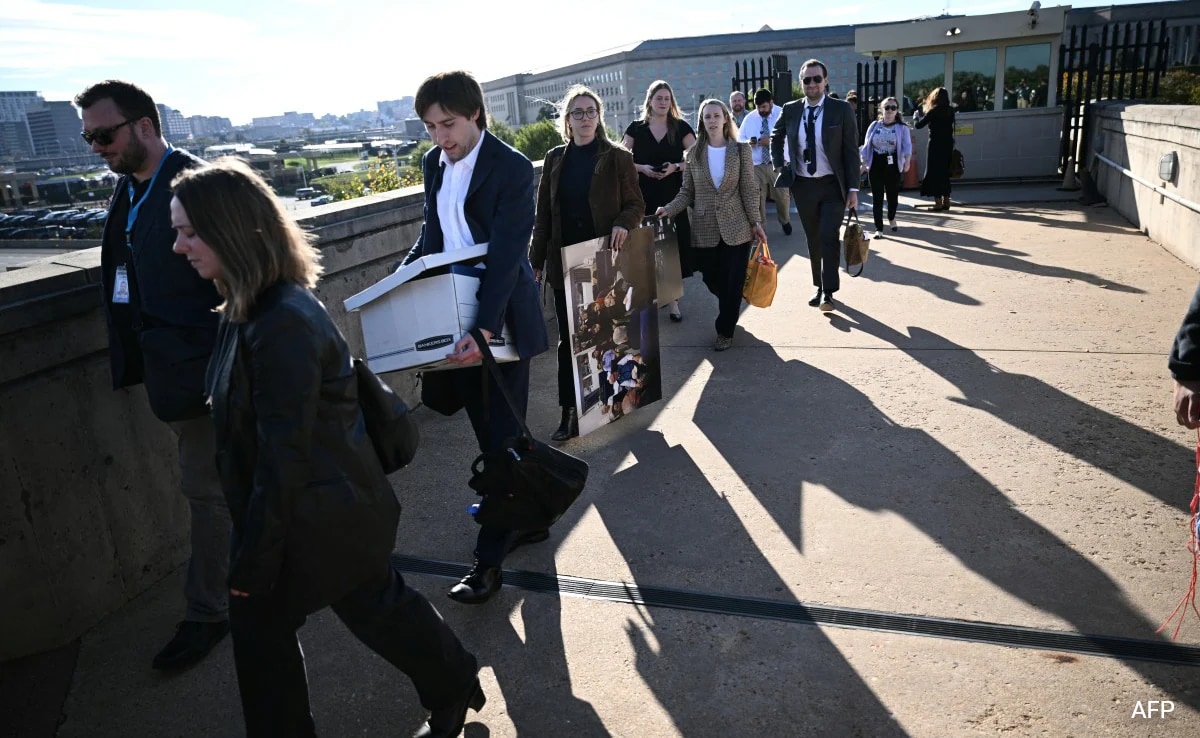
Reporters gathered their belongings after news organizations refused to sign new Pentagon media regulations.
New York:
On Wednesday, numerous journalists surrendered their access badges and departed the Pentagon, refusing to accept government-imposed restrictions on their reporting activities. This move further distances journalists covering American military affairs from the center of its authority. The national leadership described the new regulations as "common sense" measures intended to manage what they termed a "very disruptive" press.
Media outlets showed nearly unanimous opposition to the new regulations implemented by Defense Secretary Pete Hegseth, which would allow for journalists' expulsion if they attempted to report on information—classified or otherwise—not explicitly approved by Hegseth for public release.
Many reporters coordinated their departure at the 4 p.m. deadline set by the Defense Department. As the hour approached, document boxes lined Pentagon corridors while journalists transported chairs, a copying machine, books, and old photographs to the parking lot from their suddenly vacated workspaces. Shortly after 4, approximately 40 to 50 journalists collectively exited after surrendering their credentials.
"It's sad, but I'm also really proud of the press corps that we stuck together," said Nancy Youssef, a reporter for The Atlantic who has maintained a Pentagon desk since 2007. She carried a Middle East map to her vehicle.
While the practical implications of these new regulations remain uncertain, news organizations pledged to continue comprehensive military coverage regardless of their vantage point.
Images of journalists effectively protesting against impediments to their work are unlikely to sway supporters of President Donald Trump, many of whom harbor resentment toward journalists and applaud his efforts to complicate their profession. Within the past year, Trump has engaged in legal disputes with The New York Times, CBS News, ABC News, the Wall Street Journal, and The Associated Press.
During a White House press interaction on Tuesday, Trump endorsed his defense secretary's new regulations. "I think he finds the press to be very disruptive in terms of world peace," Trump stated. "The press is very dishonest."
Even before implementing his new press policy, Hegseth, previously a Fox News Channel host, has systematically restricted information flow. He has conducted only two formal press briefings, prohibited reporters from accessing numerous areas of the extensive Pentagon complex without escorts, and initiated investigations into media leaks.
Hegseth has characterized his new regulations as "common sense" and maintained that requiring journalists to sign a document outlining the rules signifies acknowledgment rather than necessarily agreement. Journalists view this as a meaningless distinction.
"What they're really doing, they want to spoon-feed information to the journalist, and that would be their story. That's not journalism," said Jack Keane, a retired U.S. Army general and Fox News analyst, speaking on Hegseth's former network.
During his service, Keane said he required new brigadier generals to undergo training about media's role in democracy to reduce intimidation and recognize reporters as conduits to the American public. "There were times when stories were done that made me flinch a little bit," he acknowledged. "But that's usually because we had done something that wasn't as good as we should have done it."
Youssef explained the absurdity of agreeing to rules prohibiting reporters from soliciting information from military officials. "To agree to not solicit information is to agree to not be a journalist," she stated. "Our whole goal is soliciting information."
Several reporters shared their badge surrender experiences on social media.
"It's such a tiny thing, but I was really proud to see my picture up on the wall of Pentagon correspondents," wrote Heather Mongilio, a reporter for USNINews covering the Navy. "Today, I'll hand in my badge. The reporting will continue."
Mongilio, Youssef and colleagues emphasized their commitment to continuing their work regardless of desk location. Some sources will maintain communication, though they note that Pentagon leadership threats have intimidated some military personnel.
In an essay, NPR reporter Tom Bowman recounted numerous occasions when Pentagon contacts and embedded military sources provided insights about developing situations, even when contradicting official narratives. Many understand media's essential function.
"They knew the American public deserved to know what's going on," Bowman wrote. "With no reporters able to ask questions, it seems the Pentagon leadership will continue to rely on slick social media posts, carefully orchestrated short videos and interviews with partisan commentators and podcasters. No one should think that's good enough."
The Pentagon Press Association, whose 101 members represent 56 news organizations, has opposed these regulations. Media organizations across the spectrum, from established institutions like The Associated Press and The New York Times to outlets like Fox and conservative Newsmax, instructed their reporters to depart rather than sign the new rules.
Only the conservative One America News Network agreed to the terms. According to Gabrielle Cuccia, a former Pentagon reporter terminated by OANN earlier this year for writing an online column criticizing Hegseth's media policies, the network's management likely believes this compliance will secure greater access to Trump administration officials.
Source: https://www.ndtv.com/world-news/journalists-exit-pentagon-rather-than-agree-to-new-reporting-rules-9463788