
Scientists Discover Evolving Ring System Around Centaur Object Chiron in Unprecedented Astronomical Observation
- Date & Time:
- |
- Views: 61
- |
- From: India News Bull
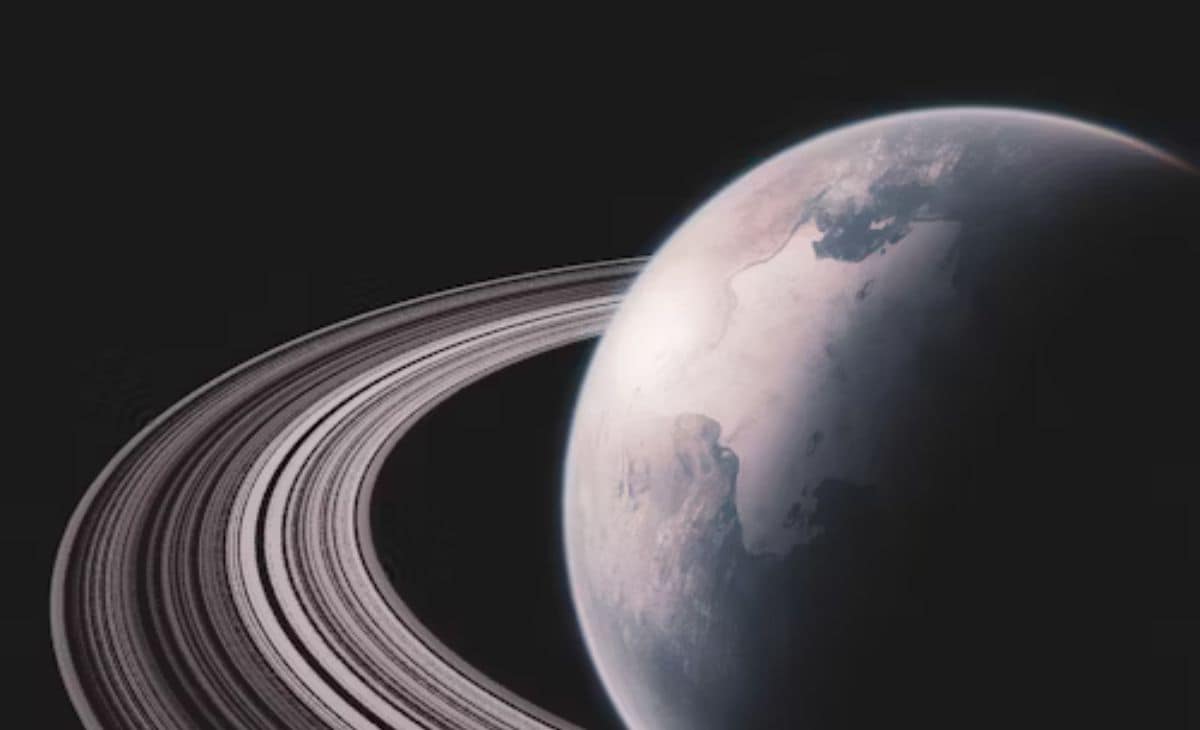
Since its discovery, astronomers have continuously monitored Chiron to understand its unique characteristics.
Washington:
Saturn's magnificent rings, spanning approximately 280,000 kilometers in diameter, represent one of our solar system's most spectacular features. However, researchers have discovered that smaller celestial bodies also possess impressive ring systems, albeit on a less grandiose scale.
Scientists have recently documented the first-ever observation of a ring system actively forming and evolving. This system, comprising four rings and diffuse material, surrounds Chiron, a small icy body that orbits the sun in the region between Saturn and Uranus.
Chiron belongs to a category of objects known as centaurs that inhabit the outer solar system between Jupiter and Neptune. These objects exhibit characteristics of both asteroids and comets. Officially designated "(2060) Chiron," it measures about 200 kilometers in diameter and completes one solar orbit in approximately 50 years. Centaurs primarily consist of rock, water ice, and complex organic compounds.
Following its discovery in 1977, astronomers have periodically observed Chiron and had long suspected it was surrounded by some form of material. In their latest research, scientists gathered their most comprehensive data on Chiron in 2023 using a telescope at Brazil's Pico dos Dias Observatory, complementing previous observations from 2011, 2018, and 2022.
The research team confirmed that Chiron is encircled by well-defined rings - three dense ones positioned approximately 273 km, 325 km, and 438 km from Chiron's center, plus a fourth ring about 1,400 km from its center. This outer ring, detected for the first time, is unusually distant from Chiron and requires additional observation to confirm its stability. The three inner rings are embedded within swirling dust arranged in a disk-like configuration.
By comparing data from various observations, researchers identified significant changes in the ring system, providing clear evidence that Chiron's rings are evolving in real time, according to Chrystian Luciano Pereira, lead author of the study published in the Astrophysical Journal Letters and postdoctoral researcher at Brazil's National Observatory.
"This provides a rare glimpse into how such structures originate and change," Pereira explained.
According to Pereira, Chiron's rings likely consist primarily of water ice mixed with small amounts of rocky material, similar to Saturn's rings. Water ice may be crucial for ring stability, as its physical properties allow particles to remain separated rather than consolidating into a moon.
Chiron occasionally displays comet-like behavior, ejecting gas and dust into space. In 1993, it even exhibited a small tail, reminiscent of a comet.
Researchers suggest several possible origins for the rings: they might be remnants from a collision that destroyed a small Chiron moon, debris from other space impacts, material ejected from Chiron itself, or some combination of these factors.
"It is an evolving system that will help us understand the dynamical mechanisms governing the creation of rings and satellites around small bodies, with potential implications for various types of disk dynamics in the universe," explained astronomer and study co-author Braga Ribas from the Federal University of Technology-Parana and the Interinstitutional Laboratory of e-Astronomy in Brazil.
All four major outer planets - Jupiter, Saturn, Uranus, and Neptune - possess ring systems, with Saturn's being the most extensive. Since 2014, astronomers have discovered rings around smaller celestial bodies as well. Chiron becomes the fourth such body known to have rings, joining fellow centaur Chariklo and two trans-Neptunian icy worlds, Haumea and Quaoar.
"This diversity reminds us that ring formation is not exclusive to large planets. It's a universal process that can occur wherever the right physical conditions exist," Pereira noted.
The international research team, comprising Brazilian, French, and Spanish scientists, employed a method called stellar occultation to observe the rings. They monitored Chiron as it passed in front of a distant star, temporarily blocking its light. By measuring the starlight dimming from different Earth locations, they could accurately determine the environment surrounding Chiron.
"We can reconstruct the shape and environment around the object with kilometer-scale precision," Pereira concluded.
Source: https://www.ndtv.com/world-news/astronomers-observe-rings-forming-around-icy-celestial-body-chiron-9459725