
Nepal Counts Cost After Deadly Protests
Nepal is assessing the multi-million dollar damage from last week's violent protests, when parliament, government offices and a newly opened Hilton Hotel were set ablaze.
- Date & Time:
- |
- Views: 71
- |
- From: India News Bull
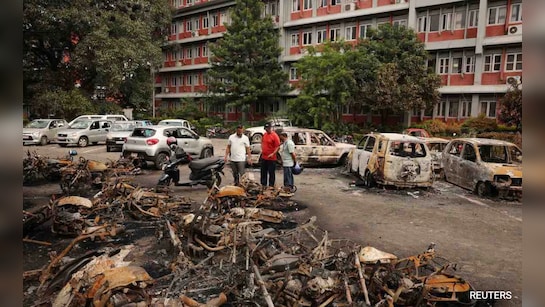
Nepal is evaluating the extensive damage worth millions of dollars following last week's violent demonstrations, during which the parliament, government offices, and a newly inaugurated Hilton Hotel were set on fire.
According to official reports, at least 72 individuals lost their lives during the two-day anti-corruption protests, with many more seriously wounded.
"The destruction is immense," police spokesperson Binod Ghimire informed AFP, noting that calculating the complete extent of damages, including those beyond the capital, would require time.
Nepal's newly appointed interim Prime Minister Sushila Karki referenced the "extensive loss of lives and property" as she commenced her duties on Sunday.
At the Supreme Court, staff are operating under tents outside the fire-damaged building, alongside rows of destroyed vehicles, attempting to recover water-damaged documents.
AFP journalists who visited the burned parliament building reported that entire halls had been transformed into blackened ruins by fires that burned uncontrolled for hours on September 9.
The Hotel Association of Nepal documented damage to more than 20 hotels, including the Hilton fire. Several others experienced looting.
Financial losses were estimated at 25 billion Nepali rupees ($177 million), affecting over 2,000 employees. The damage to the Hilton alone was estimated as high as $56 million.
Tourism represents a crucial employment sector, ranking fourth largest in the country and providing jobs to more than 371,000 people, according to government data, with annual visitor numbers exceeding one million.
Fire also engulfed Singha Durbar, the expansive palace that housed the prime minister's office and various ministries.
The historic structure now lies in ruins, its white pillars streaked with black.
Beyond government facilities, police stations were targeted, and courthouses were burned.
"All our records, evidence, files of the Supreme Court have been completely destroyed," Karki stated. "Extremely important state institutions were specifically targeted and attacked."
'Time And Resources'More than 12,500 prisoners who escaped during the unrest remain at large, presenting a significant security challenge.
Demonstrators targeted symbols associated with the ruling elite or wealthy. They set fire to politicians' homes, car dealerships, and private offices.
Media organizations were also targeted in the arson attacks.
The Kantipur Media Group's building suffered severe damage, although the broadcaster has resumed operations from a temporary studio and its newspaper has continued online.
Durga Khanal, 45, from the Department of Roads, reported that her office had been severely damaged.
"I support the change they are striving for, but I cannot endorse the destruction of physical infrastructure," she said.
New minister Kulman Ghising, who oversees energy, infrastructure, transport and urban development portfolios, has mandated a rapid damage assessment and requested a reconstruction plan within one week.
Nepal's chambers of commerce and industry federation indicated they are still gathering information.
"No type of infrastructure has been spared. Government, private sector, and media have all suffered losses," economist Chandra Mani Adhikari told AFP.
"Recovering and rebuilding everything will require substantial time and resources."