
Volcanoes Help Untangle Evolution Of Humans, Here's How
How did humans become human? Understanding when, where and in what environmental conditions our early ancestors lived is central to solving the puzzle of human evolution.
- Date & Time:
- |
- Views: 73
- |
- From: India News Bull
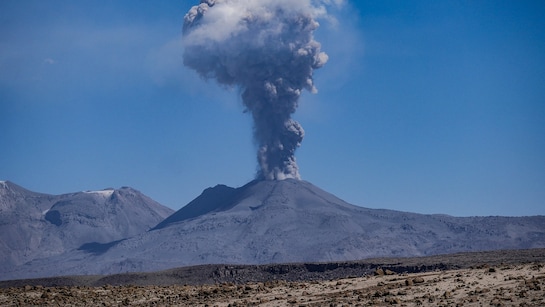
Ancient volcanic activity may be crucial for establishing a chronology of early human evolutionary development.
What transformed our ancestors into modern humans? To solve the human evolution puzzle, it's essential to determine when and where our early ancestors lived, and under what environmental conditions they thrived.
Establishing a precise timeline for early human evolution has been challenging – but ancient volcanic eruptions across East Africa might provide the solution.
Our recently published research in Proceedings of National Academy of Sciences refines our understanding of volcanic ash layers in Kenya's Turkana Basin, a region rich with early human fossil discoveries.
Through high-precision dating techniques, we've taken a modest yet significant step toward creating a more detailed chronological framework for human evolution.
The Great Rift Valley of East Africa contains numerous globally significant fossil sites. Among these, the Turkana Basin stands as perhaps the most critical region for research into early human origins.
This area lies within an active continental rift – a tectonic plate boundary – that has triggered volcanic activity spanning millions of years.
As early humans and their ancestors traversed these Rift Valley landscapes, periodic volcanic eruptions covered the terrain with ash particles, preserving their remains.
Over time, fossil-bearing layers became interspersed between volcanic ash deposits. For modern archaeologists, these ash layers serve as invaluable geological timestamp markers, sometimes across extensive geographical areas.
Volcanic eruptions function as exceptional chronological markers due to their geologically instantaneous nature. During eruptions, magma cools and solidifies into volcanic ash particles and pumice rocks.
Pumice frequently contains feldspar crystals that act as natural chronometers. These minerals can be directly dated using radiometric techniques.
By dating ash layers situated immediately above and below fossil discoveries, scientists can determine the age of the fossils themselves.
Volcanic ash layer (Lower Nariokotome tuff) with an embedded pumice in the famous palaeonthropological site where the most complete Homo erectus skeleton, the Nariokotome Boy, was found in West Turkana. Saini Samim
Even without datable minerals, volcanic ash layers assist in dating archaeological sites because ash particles from different eruptions possess unique chemical compositions.
This distinctive geochemical "fingerprint" allows scientists to trace specific eruptions across substantial distances, assigning ages to ash layers even without directly datable crystals.
For example, an ash layer discovered in Ethiopia or on the ocean floor can be matched to one in Kenya. If their chemical compositions correspond, they originated from the same eruption at the identical geological moment. This methodology has been employed in the region for decades.
Previous groundbreaking studies have established the geological framework of the Turkana Basin.
However, frequent regional eruptions often occurred just thousands of years apart, making many ash layers virtually indistinguishable temporally. Additionally, some ash layers have remarkably similar "fingerprints," complicating confident differentiation.
These challenges have made dating the Nariokotome tuffs – three volcanic ash layers in the Turkana Basin – particularly difficult. Though clearly separate ash layers in the geological record, their age estimates and chemical signatures appear very similar. Our research sought to distinguish them more precisely.
The Nariokotome Tuff Complex, showing several ash layers in the Nariokotome Boy paleonthropological site, West Turkana. Hayden Dalton
Contemporary dating technologies offer order-of-magnitude improvements in precision compared to previous methods.
Now, we can confidently differentiate volcanic ash layers erupted within just 1,000 to 2,000 years of each other. Applying this high-precision methodology to the Nariokotome tuffs, we identified three distinct volcanic events, each with a precise eruption date.
However, determining ages alone isn't sufficient to fully distinguish these volcanic layers. Since these ash deposits occurred temporally close together – potentially from similar volcanic sources – they exhibit remarkably similar major element geochemical "fingerprints." Major elements, while abundant in rocks, often provide limited information about a rock's age and origin.
This is where trace elements prove invaluable. These elements, present in minute quantities, provide much more distinctive chemical signatures.
Using laser-based mass spectrometry, we analyzed both ash particles and associated pumices for trace element composition. This yielded unique trace-element fingerprints for each layer – similar yet distinctly identifiable.
After establishing both precise age estimates and distinct geochemical profiles, we traced these ash layers across key archaeological sites.
The Nadung'a site in West Turkana, presumed to be a prehistoric butchering location containing approximately 7,000 stone tools, is now dated approximately 30,000 years older than previously estimated, based on our updated chronology.
More significantly, we demonstrated these refined methods' applicability beyond Kenya. We identified ash layers of equivalent ages from Kenya to Ethiopia's Konso Formation, indicating they originated from three separate eruptions that dispersed material across vast distances.
The Nariokotome tuffs represent an important case study demonstrating the powerful combination of high-precision dating with detailed geochemical fingerprinting. As we apply these techniques to additional ash layers within and potentially beyond the Turkana Basin, we'll develop a clearer understanding of key human evolution questions.
Did new tool technologies and species emerge gradually or rapidly? Did multiple hominin species coexist? How did changing environments, climate variations, and frequent volcanic activity influence early human evolution?
With precise geological timelines established for artifact discovery sites, we've advanced closer to answering these fundamental questions about early humanity.
The authors would like to acknowledge the contributions of David Phillips and Janet Hergt to this article.
Saini Samim, PhD Candidate, School of Geography, Earth and Atmospheric Sciences, The University of Melbourne and Hayden Dalton, Lecturer in Geoscience, The University of Melbourne
This article is republished from The Conversation under a Creative Commons license. Read the original article.