
Pakistan's Solar Farming Revolution: Balancing Energy Independence and Water Security
- Date & Time:
- |
- Views: 59
- |
- From: India News Bull
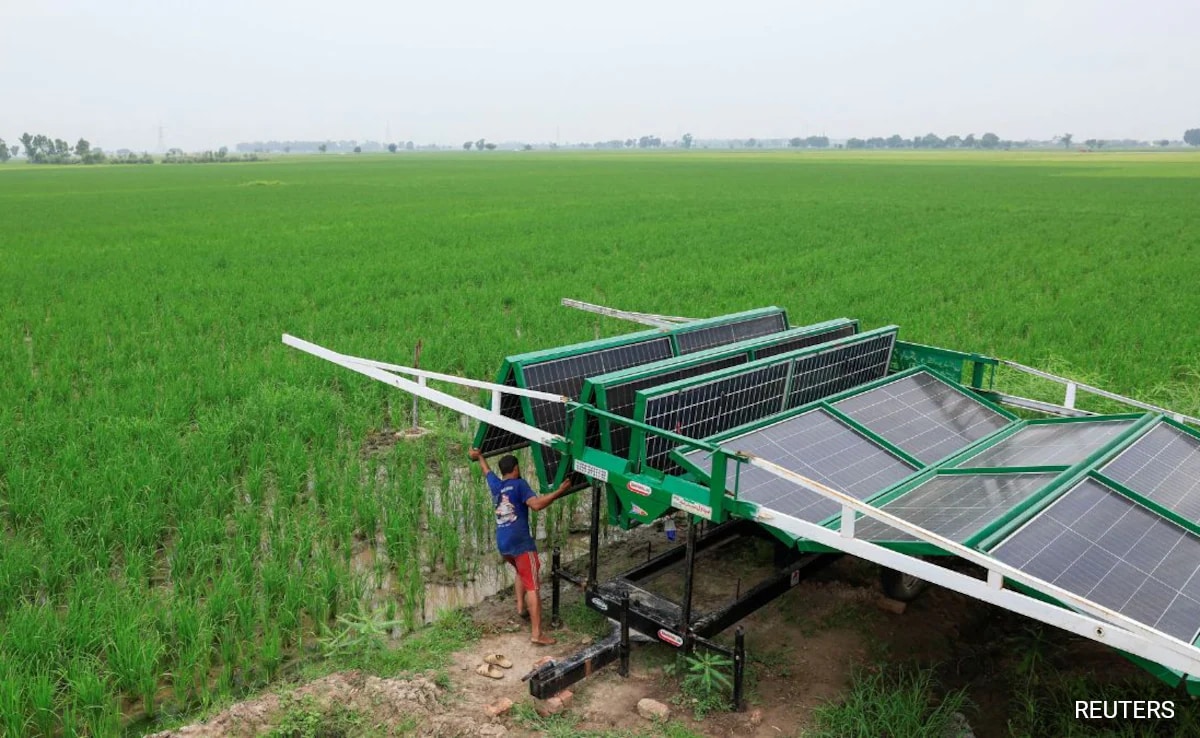
In Muridke, 61-year-old Karamat Ali recently sold approximately a dozen cows and buffalos that once provided milk for his extended family. With the proceeds, he invested in solar panels to power a tube well—a combination of water well and motorized groundwater pump—for irrigating his rice fields in Punjab province.
"Water supply to my paddy feed is smoother than before," Ali explains, highlighting how solar power has freed him from dependence on Pakistan's unreliable electricity grid and expensive diesel fuel.
This transition represents a growing trend across Pakistan, where farmers are increasingly abandoning traditional power sources in favor of solar-powered irrigation systems, according to interviews with ten agricultural producers, government officials, and industry analysts.
The solar revolution coincides with alarming groundwater depletion in Punjab, Pakistan's most populous province, as revealed in previously unreported water authority documents obtained by Reuters.
Six farmers interviewed confirmed they now irrigate their rice paddies more frequently—some implementing pulse irrigation multiple times daily—a practice made feasible only through solar water pumps. This shift has encouraged farmers to cultivate more water-intensive rice crops, with US Department of Agriculture data showing a 30% expansion in Pakistan's rice fields between 2023 and 2025. Meanwhile, land dedicated to less water-demanding maize cultivation decreased by 10%.
Farmers plant rice saplings in field in Muridke, Pakistan
While Pakistan lacks official records on tube wells, which don't require registration, energy economist Ammar Habib, an advisor to Pakistan's power minister, projects that farmers switching to solar power will drive a 45% reduction in agricultural electricity consumption from the national grid between 2022 and 2025.
Calculations based on Habib's data, verified by both Habib and Lahore-based renewables analyst Syed Faizan Ali Shah, suggest approximately 400,000 formerly grid-dependent tube wells have converted to solar. Habib estimates farmers have purchased an additional 250,000 solar-powered tube wells since 2023, bringing the total to roughly 650,000 solar-powered irrigation systems nationwide.
This report reveals previously undocumented details about the scale of Pakistan's agricultural solar transition and its impact on groundwater resources.
The solar boom, accelerated by significant power tariff increases in 2023, mirrors a global trend. Chinese solar panel production has driven an 80% price reduction since 2017, prompting farmers worldwide—from Brazil's forests to Iraq's drought-prone regions—to adopt solar-powered irrigation.
However, the proliferation of affordable solar panels poses a particular threat to Punjab's water table. According to internal maps from provincial water authorities, areas with water tables below 60 feet—designated as critically low—have increased by approximately 25% between 2020 and 2024, now covering 6.6% of Punjab. Regions with water depths exceeding 80 feet have more than doubled during the same period.
An irrigation department employee uses a dipmeter to check the groundwater level at a borehole in Pakistan
Pakistan's Power Minister Awais Leghari stated in June that linking solar tube wells to groundwater depletion was a "misconception," asserting farmers were extracting similar water volumes as before, merely replacing expensive diesel with solar. "The land under cultivation hasn't increased. They're just replacing expensive diesel with solar," he claimed.
When presented in September with farmer testimonies indicating increased irrigation and data showing expanded rice cultivation, the minister did not respond.
Punjab Irrigation Minister Muhammad Kazim Pirzada acknowledges the duality of the situation: "Solarization is good for the environment because it's clean energy. But at the same time, it is also impacting our water table."
His department continues investigating the relationship between tube wells and groundwater depletion while implementing protective measures. Recent flooding may have recharged some water tables in previously dry areas, the minister added.
Pakistan ranks among the world's most water-stressed nations and has experienced resource conflicts with upstream neighbor India, including brief hostilities in May. However, many Punjab farmers view water table concerns as a distant problem.
Agricultural communities have struggled with falling global wheat prices and record-high rural poverty following IMF-mandated energy tariff increases and taxes. For many, solar power represents economic salvation.
A farmer stands beside his solar panels, installed to run a tube well, in Muridke
Mohammad Naseem, 61, has saved approximately 2 million rupees (about $7,000)—more than four times Pakistan's per capita GDP—in power costs since purchasing solar panels four years ago. The ability to irrigate at will has modestly increased his rice production by 400-600 kg annually while improving crop quality and market prices.
"I wash it with water. I sleep near it," says Naseem, who dismantles his panels each evening to prevent theft—testament to their value.
Rai Abdul Ghafoor, a 38-year-old subsistence farmer currently saving for solar panels, states emphatically: "Solar panels should be installed at all costs."
While poorer farmers still rely on diesel and grid electricity, many agricultural communities pool resources to purchase shared solar systems. Haji Allah Rakha, an 80-year-old farmer with 16 panels, shares them with two neighboring families: "They contribute, and we all benefit."
Lahore-based solar merchant Shahab Qureshi explains: "Farmers share, rent and move panels like tractors. They sell land, jewellery, or take loans just to get it. Within five to six months, your return on investment is fulfilled."
Federal and provincial authorities have begun addressing the emerging water crisis, especially following India's suspension of the Indus Water Treaty earlier this year after the Pahalgam terror attack.
Punjab initiated aquifer-recharge pilot projects at over 40 locations before India's April decision, though officials note these efforts have gained urgency since. "This is our small effort to return the due share to the aquifer," explains Adnan Hassan, a Punjab irrigation department researcher. "If polluted water is injected (due to over-extraction), the next generation will suffer."
The province is also restoring infrastructure such as the colonial-era Ravi Siphon tunnel to stabilize river flows, hoping improved conventional irrigation will reduce groundwater extraction.
Independent environmental scientist Imran Saqib Khalid criticizes Pakistan's lack of comprehensive well mapping and real-time withdrawal monitoring necessary to address the water crisis. He describes the solar transition as having "no method to the madness," warning that without governance reforms, groundwater depletion will continue: "In the long run, this will have an impact on cropping intensities and the types of crops we can grow, which in turn will impact our food security."
Source: https://www.ndtv.com/world-news/how-solar-powered-farming-is-pushing-pakistan-towards-water-catastrophe-9383078