
Why The Moon Is Getting Slightly Farther Away From Earth Each Year
The Moon is getting1 inches (3.8 centimeters) farther away from the Earth every year.
- Date & Time:
- |
- Views: 76
- |
- From: India News Bull
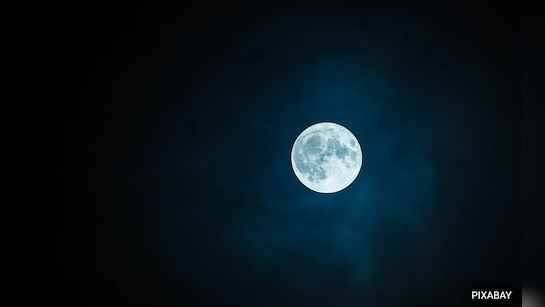
Our lunar companion is gradually increasing its distance from Earth by approximately 3.8 centimeters (1½ inches) annually.
Researchers determine the Moon's distance through laser technology, bouncing beams off reflective mirrors positioned on the lunar surface by astronauts and space missions.
By calculating the time light takes to travel to the Moon and return, scientists can accurately measure the lunar distance and track its changes over time.
The Moon's distance fluctuates throughout its monthly orbit around Earth. While the average distance is about 385,000 kilometers (239,000 miles), the Moon's elliptical orbit causes this measurement to vary by roughly 20,000 kilometers (12,400 miles). This orbital variation explains why certain full moons appear larger than others, creating what we call supermoons.
As an astrophysicist, I find the celestial mechanics between Earth and Moon particularly fascinating. These orbital dynamics have numerous interesting implications, and studying their evolution helps researchers better understand how both bodies have changed throughout their 4.5-billion-year shared history.
Tidal InteractionThe Moon's gradual retreat from Earth can be attributed entirely to tidal forces.
Tidal forces arise from gravitational differentials across an object. The Moon's gravitational pull is approximately 4% stronger on Earth's near side compared to its far side, due to the fundamental principle that gravitational force diminishes with distance.
This tidal force generates two oceanic bulges—one pointing toward the Moon and another on the opposite side of Earth. These bulges form because the Moon's gravitational influence isn't uniform across our planet. Its gravity exerts strongest pull on Earth's nearest side, creating a water bulge pointing moonward. Meanwhile, the weaker gravitational pull on Earth's far side effectively allows water to "lag behind," forming a second bulge.
As Earth rotates, these bulges migrate around the planet while maintaining their orientation toward the Moon due to lunar gravitation. Coastal cities like New York and Los Angeles experience water level variations of approximately 1.5 meters (5 feet) as a result of these tidal bulges.
These liquid protuberances don't align perfectly with the Moon—they "lead" it slightly because Earth's rotation pulls them forward. Importantly, these bulges also exert gravitational pull back on the Moon. The nearer bulge doesn't merely pull the Moon toward Earth's center, but also slightly forward in its orbit—similar to the momentum boost a race car gains while navigating a curve.
This forward pull from the nearer tidal bulge accelerates the Moon, expanding its orbital path. Comparable to a baseball leaving a bat during a home run—greater velocity at the point of impact results in a higher trajectory.
In essence, the gravity from Earth's nearer tidal bulge pulls the Moon forward, enlarging its orbit and incrementally increasing the Earth-Moon distance. This effect occurs gradually and is only measurable as an average over years.
Does Earth Feel The Impact?As the Moon's orbit expands, it gains momentum. Consider spinning a weight attached to a string—a longer string provides the weight greater momentum and makes it harder to stop.
Since Earth supplies the energy increasing the Moon's momentum, our planet's rotation consequently decelerates, transferring its momentum to the Moon. Essentially, as lunar orbital momentum increases, Earth's rotational momentum decreases correspondingly. This exchange gradually lengthens our day.
However, these effects are minimal: an annual increase of 3.8 centimeters against a distance of 384,000 kilometers represents just 0.00000001% yearly change. We'll continue experiencing eclipses, tides, and 24-hour days for millions of years to come.
Was The Moon Closer In Earlier Times?Earth's days were indeed shorter in the distant past.
The Moon likely formed approximately 4.5 billion years ago when a Mars-sized protoplanet collided with early Earth, ejecting substantial material into space.
This debris eventually coalesced into the Moon, initially orbiting much closer to Earth. Back then, the Moon would have appeared significantly larger in our sky.
By examining fossilized clam shells for growth patterns indicating daily cycles, paleontologists discovered evidence that 70 million years ago—near the dinosaurs' extinction—the day lasted only 23.5 hours, confirming astronomical predictions.
What Does The Future Hold?Will the Moon eventually escape Earth's gravitational influence as it continues its retreat?
Looking tens of billions of years ahead, Earth's rotation could potentially decelerate until achieving tidal locking with the Moon. At that point, Earth's rotation period would match the Moon's orbital period. This would halt the Moon's outward migration, and the Moon would be visible from only one hemisphere of Earth.
However, two factors prevent this outcome. First, in approximately one billion years, increasing solar luminosity will evaporate Earth's oceans. Without substantial water bodies to create tidal bulges, the Moon's outward migration will cease. Several billion years later, the Sun will expand into a red giant, likely destroying both Earth and Moon entirely.
Fortunately, these events lie so far in the future that they needn't concern us. For now, we can simply enjoy beach tides, solar eclipses, and our beautiful lunar companion.
(Author: Stephen DiKerby, Postdoctoral Researcher in Physics and Astronomy, Michigan State University)
(This article is republished from The Conversation under a Creative Commons license. Read the original article.)
(Disclosure Statement: Stephen DiKerby receives funding from NASA and NSF grants, as well as from Michigan State University.)