
The Bitter Relationship Between Israel And Arab States
Israel's bombing of Qatar last week risks a new breach with Arab states who are meeting on Monday, opening another chapter in a fractious history since Israel's creation in 1948 marked by repeated wars and periods of frosty peace.
- Date & Time:
- |
- Views: 68
- |
- From: India News Bull
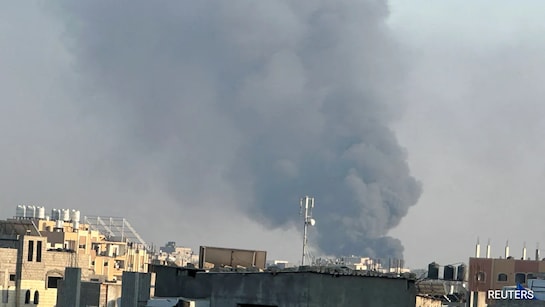
Israel has conducted multiple strikes against Iran-aligned groups in Iraq since the Gaza conflict began.
Israel's recent bombing of Qatar potentially creates a fresh rupture with Arab nations who are convening on Monday, marking another episode in their contentious history since Israel's establishment in 1948 - a period characterized by multiple wars and uneasy peace.
Below is an overview of how these relationships have evolved with major Arab countries, which have also maintained complex connections with Palestinian leadership throughout the years, adding challenges to Middle Eastern stabilization efforts.
EGYPT
Egypt and Israel engaged in armed conflicts in 1948, 1956, 1967 and 1973. However, Egypt became the first Arab nation to establish peace with Israel through the 1978 Camp David Accords. Egyptian President Anwar Sadat, the architect of this agreement, was assassinated three years later.
While Egyptian public opinion consistently shows the peace treaty remains unpopular, it has become a fundamental component of Cairo's foreign and security strategy and essential to its American relations. Israel and Egypt collaborate on energy resources, though broader trade remains limited.
Cairo strongly condemned suggestions from Israeli and American politicians about potentially relocating Gaza's population partially to Egypt's Sinai Peninsula.
JORDAN
Jordan, the second Arab country to forge peace with Israel in 1994, maintains the closest Arab ties to Palestinians. Approximately half of Jordan's population is Palestinian in origin - many descended from those who fled or were expelled during Israel's 1948 establishment.
Jordan administered the West Bank and east Jerusalem from 1948 until Israel occupied these Palestinian territories following the 1967 war. The Hashemite dynasty under King Abdullah has maintained custodianship of Jerusalem's Muslim and Christian holy sites since 1924.
Similar to Egypt, Jordan's peace agreement with Israel forms a crucial element of its security framework and foreign policy, particularly regarding its relationship with the United States. Nevertheless, widespread anger over Israeli treatment of Palestinians persists in Jordan and intensified during the Gaza war.
UAE
The Gulf emirate surprised many in the Arab world by normalizing relations with Israel in 2020 - becoming the first to participate in Donald Trump's "Abraham Accords" initiative.
This agreement enabled the United Arab Emirates and Israel to align more closely against perceived threats from Shi'ite Iran and Sunni Islamist groups, while Abu Dhabi viewed it as strengthening its economy and regional influence.
However, the UAE has consistently maintained that normalization was intended to advance Palestinian statehood - a position increasingly challenged by the Gaza conflict and accelerated Israeli settlement construction in the West Bank.
Israel's airstrike against Qatar, a neighboring monarchy and fellow Gulf Cooperation Council member, now pushes the UAE relationship into uncertain territory.
BAHRAIN, SUDAN, MOROCCO
Bahrain, another Gulf monarchy, followed the UAE in establishing ties with Israel shortly afterward. Morocco, which already maintained connections with Israel, agreed to strengthen these relations under the Abraham Accords in exchange for U.S. recognition of its sovereignty over the disputed Western Sahara territory. Sudan became the fourth participant in the accords but was unable to implement normalization before descending into civil conflict.
SAUDI ARABIA
As guardian of Islam's holiest sites, Saudi Arabia has consistently portrayed itself as a defender of Palestinian interests while keeping possibilities open for future Israeli relations.
In 2000, Saudi Arabia coordinated Arab states to adopt the Arab peace initiative, offering complete normalization with Israel in exchange for Palestinian statehood with Jerusalem as its capital and refugee return provisions.
Recent years suggested Saudi Arabia might follow the UAE and Bahrain's approach, but the Gaza conflict and Israeli strikes on Gulf ally Qatar have significantly diminished this prospect.
SYRIA
Israel captured much of Syria's Golan Heights during the 1967 war and formally annexed the region in 1981. Under the Assad regime, aligned with Israel's regional adversary Iran, relations remained openly hostile.
Throughout Syria's civil war, Israel conducted numerous bombings targeting Iran-linked assets in Syrian territory. Following the Assad regime's collapse in December, Israel has intensified strikes on Syrian military installations, captured Mount Hermon and deployed troops into southern Syria.
LEBANON
Lebanon hosts numerous Palestinian refugees and accommodated the Palestine Liberation Organization from 1970. Israel repeatedly clashed with the PLO and invaded Lebanon to combat the organization in 1978 and 1982, occupying southern Lebanon until 1990.
The Iran-supported Hezbollah emerged as Israel's primary border adversary. Last year's conflict, triggered by events in Gaza, resulted in significant Hezbollah setbacks and an unstable ceasefire agreement.
IRAQ
Israel destroyed Iraq's nuclear reactor in a 1981 bombing operation. Following the Gaza war, Israel has repeatedly targeted Iran-aligned groups operating within Iraq.
YEMEN
Yemen's Iran-backed Houthi movement has attempted missile and drone attacks against Israel since 2023 in response to the Gaza conflict. Israel has conducted airstrikes against Houthi leadership and military positions.
(This story has not been edited by NDTV staff and is auto-generated from a syndicated feed.)