
United Nations "Not Even Coming Close To Living Up" To Its Potential: Trump
- Date & Time:
- |
- Views: 86
- |
- From: India News Bull
Trump returned to UN to criticize the institution's effectiveness
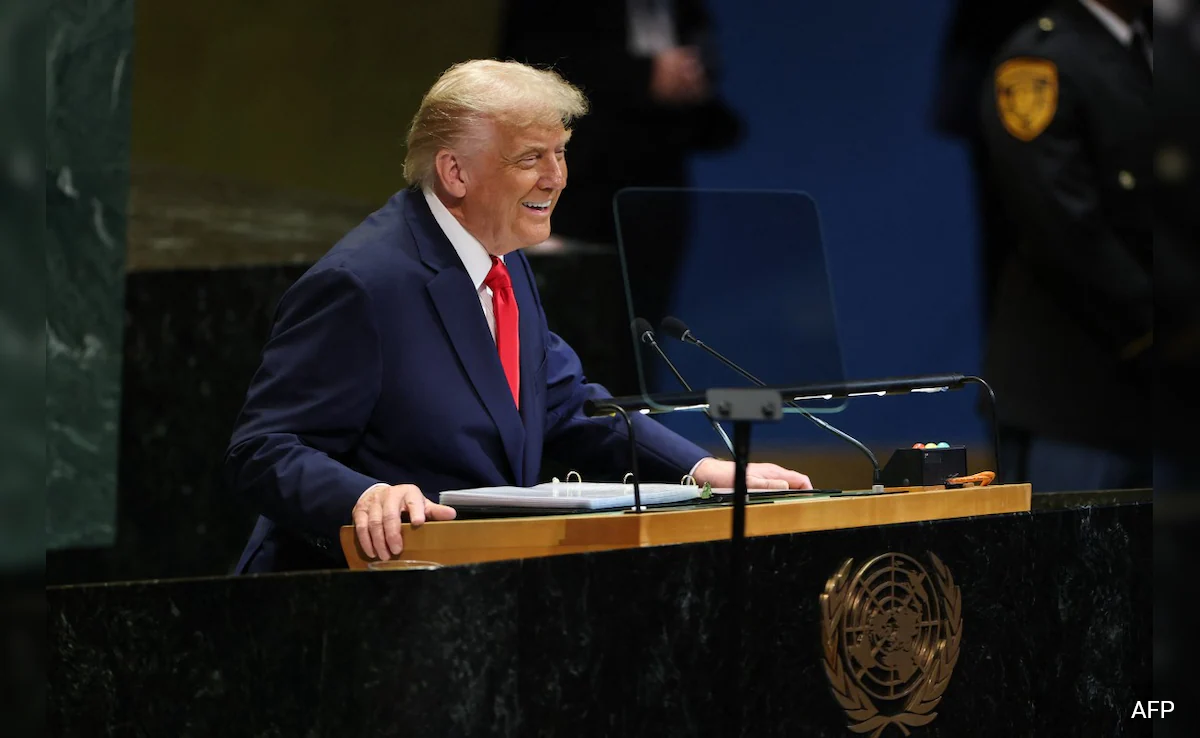
President Donald Trump addressed the United Nations General Assembly on Tuesday, highlighting what he considers his second-term foreign policy achievements while criticizing the international organization for failing to reach its full potential.
Trump challenged European nations, warning they face ruin if they continue with what he described as a "double-tailed monster" of permissive migration policies and costly green energy initiatives.
World leaders paid close attention to his remarks, particularly given Trump's swift actions to reduce American support for the UN since returning to office. His administration's skepticism toward multilateralism was evident even during his first term.
Following his recent inauguration, Trump immediately issued an executive order withdrawing the United States from the World Health Organization. He subsequently ended U.S. participation in the UN Human Rights Council and initiated a comprehensive review of American membership in hundreds of intergovernmental organizations to determine their alignment with his "America First" priorities.
Trump intensified his criticism during Tuesday's address, dismissing the UN's approach as "empty words don't solve wars."
"What is the purpose of the United Nations?" Trump questioned. "The U.N. has such tremendous potential. I've always said it. It has such tremendous, tremendous potential. But it's not even coming close to living up to that potential."
The president's speech contained striking contrasts. He portrayed himself as a peacemaker and listed his administration's successes in various global hotspots. Simultaneously, Trump defended his decisions to authorize military strikes against Iran and alleged drug smugglers from Venezuela, while arguing that globalist policies threaten successful nations.
The American president's annual address is typically a highlight of the General Assembly. This year's speech comes during one of the most volatile periods in the UN's 80-year history, with global leaders confronting ongoing conflicts in Gaza, Ukraine, and Sudan, concerns about emerging artificial intelligence technologies, and anxiety regarding Trump's apparent hostility toward the international body.
Trump's return to the White House has raised new questions about American military intervention after he ordered airstrikes on Iranian nuclear facilities in June and multiple strikes this month targeting alleged drug-smuggling vessels in the Caribbean.
The latter operations, including at least two fatal attacks on boats from Venezuela, have fueled speculation in Caracas that Trump might be setting the stage for President Nicolás Maduro's removal.
Some U.S. lawmakers and human rights advocates have criticized these actions as extrajudicial killings, arguing that Trump is using military force against suspected drug smugglers rather than interdicting the vessels, seizing contraband, and prosecuting suspects through proper legal channels.
In his address, Trump praised his administration's policies expanding oil and natural gas drilling in the United States and its aggressive approach to illegal immigration, implying other nations should follow similar paths.
He sharply criticized European countries with more welcoming migration policies and ambitious carbon reduction initiatives, claiming these approaches damage their economies and cultural heritage.
"I'm telling you that if you don't get away from the 'green energy' scam, your country is going to fail," Trump declared. "If you don't stop people that you've never seen before that you have nothing in common with your country is going to fail."
He added, "I love the people of Europe, and I hate to see it being devastated by energy and immigration. This double-tailed monster destroys everything in its wake, and they cannot let that happen any longer."
This portion of his speech elicited uncomfortable laughter and groans from some delegates.
Trump emphasized "the renewal of American strength around the world" and his efforts to resolve multiple conflicts, while repeatedly criticizing global institutions for inadequately addressing wars and major global challenges.
General Assembly President Annalena Baerbock countered this perspective in her opening remarks, stating that despite the organization's challenges, abandonment is not the solution. "Sometimes we could've done more, but we cannot let this dishearten us. If we stop doing the right things, evil will prevail," she said.
Following his address, Trump's schedule included one-on-one meetings with UN Secretary-General António Guterres and leaders from Ukraine, Argentina, and the European Union. He also planned a group meeting with officials from Qatar, Saudi Arabia, Indonesia, Turkey, Pakistan, Egypt, the United Arab Emirates, and Jordan.
Trump was set to return to Washington after hosting a reception Tuesday evening with over 100 invited world leaders.
The president has faced challenges fulfilling his 2024 campaign promises to swiftly end both the Israel-Hamas conflict in Gaza and Russia's invasion of Ukraine. His response has been relatively subdued as some longstanding American allies use this year's General Assembly to promote international recognition of a Palestinian state—a move strongly opposed by both the U.S. and Israel.
France became the latest nation to recognize Palestinian statehood on Monday during a high-profile UN meeting aimed at building support for a two-state solution to the Middle East conflict, with additional countries expected to follow suit.
Trump has focused primarily on securing a ceasefire agreement that would lead to Hamas releasing its remaining 48 hostages, including 20 believed to still be alive.
In his address, however, he strongly criticized the push for Palestinian statehood recognition. "The rewards would be too great for Hamas terrorists," Trump stated. "This would be a reward for these horrible atrocities, including Oct. 7."
Regarding Russia's war in Ukraine, Trump noted that despite his Alaska summit with Russian President Vladimir Putin and White House meeting with Ukrainian President Volodymyr Zelenskyy over a month ago, little progress has been made. Although Trump announced arrangements for direct talks between Putin and Zelenskyy following those meetings, Putin has shown no interest in such engagement, and Moscow has intensified its attacks on Ukraine.
European leaders and American lawmakers, including key Republican allies, have urged Trump to implement stronger sanctions against Russia. Meanwhile, Trump has pressed Europe to stop purchasing Russian oil, which he sees as fueling Putin's war efforts.
Trump suggested that a "very strong round of powerful tariffs" would "stop the bloodshed, I believe, very quickly." He reiterated his calls for Europe to "step it up" and cease buying Russian oil.
Despite challenges in resolving conflicts in Ukraine and Gaza, Trump has openly expressed his desire for a Nobel Peace Prize, repeatedly making the disputed claim that he has "ended seven wars" since returning to office.
"Everyone says that I should get the Nobel Prize - but for me, the real prize will be the sons and daughters who live to grow up because millions of people are no longer being killed in endless wars," he stated.
Trump highlighted his administration's efforts to mediate conflicts between Israel and Iran, India and Pakistan, Egypt and Sudan, Rwanda and the Democratic Republic of Congo, Armenia and Azerbaijan, and Cambodia and Thailand.
"It's too bad that I had to do these things instead of the United Nations doing them," Trump remarked. "Sadly, in all cases, the United Nations did not even try to help in any of them."
While Trump has indeed played a role in mediating relations among several of these nations, experts suggest his impact may not be as definitive as he claims.