
'I'm Not A Doctor': Trump's Autism Announcement Gives Covid Flashbacks
- Date & Time:
- |
- Views: 60
- |
- From: India News Bull
'I'm Not A Doctor': Trump's Autism Announcement Gives Covid Flashbacks
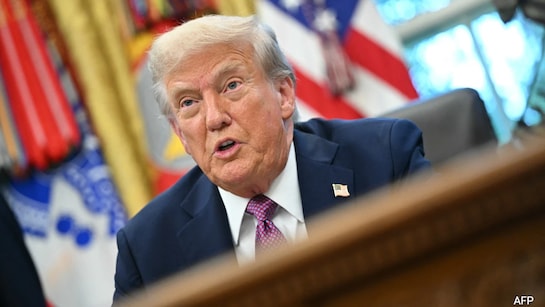
Trump advised against using the painkiller Tylenol, particularly for pregnant women.
United States:
The medical assertions and self-declared expertise displayed during Donald Trump's Tuesday press conference on autism evoked strong reminiscences of his previous pandemic communications.
The parallels to his first presidential term were unmistakable, recalling the infamous moment when he suggested exploring disinfectant injections as a potential COVID-19 treatment.
Five years later, his statements were equally startling.
With significant public health implications, as he recommended pregnant women avoid Tylenol before sharing his perspectives on vaccines, the consequences remained just as serious.
"There's discussion—though I cannot confirm its accuracy—that in Cuba, where Tylenol is unavailable due to financial constraints, autism rates are virtually nonexistent," Trump stated at the White House.
This represented perhaps the most striking assertion during his more than hour-long press conference attended by an AFP journalist—though certainly not his only controversial statement.
"The Amish community, for example, has practically no autism," Trump claimed about the traditional religious group known for eschewing modern technology and traveling in horse-drawn carriages.
Turning to his vaccine-skeptical Health Secretary Robert F. Kennedy Jr. to verify this information, Trump added: "Bobby wants to be very careful with what he says. I'm not so careful with what I say."
Repeatedly throughout the conference, the 79-year-old president acknowledged that his personal theories were exactly that—theories—even while positioning himself as the nation's chief medical advisor.
"This is based on what I feel," Trump admitted while reiterating long-disproven concerns regarding the MMR vaccine that combines protection against measles, mumps, and rubella.
Trump also advocated for increasing the time between childhood vaccinations that have formed the foundation of global public health initiatives for decades—before adding: "I'm not a doctor but I'm giving my opinion."
'Tough it out'
The billionaire former reality television personality has built his reputation on challenging established political and diplomatic norms, a strategy that has secured him two electoral victories.
However, it's in matters of health where his viewpoints have often diverged most dramatically from mainstream scientific consensus.
During the COVID-19 pandemic, Trump consistently opposed lockdown measures and mask requirements, while promoting unproven medications such as hydroxychloroquine.
He faced widespread ridicule when, during one of his many impromptu White House COVID briefings in 2020, he offered increasingly unusual suggestions for treating the disease.
Trump contemplated methods of bringing "light inside the body"—and disinfectant.
"I see the disinfectant, it knocks it out in a minute... is there a way we can do something like that by injection inside," he inquired to a perplexed expert.
In his second term, Trump's appointment of Kennedy as health secretary has introduced previously marginalized medical perspectives into core government policy.
Trump himself acknowledges a longstanding interest in autism and demonstrated absolute confidence in his viewpoints on Monday—despite struggling to pronounce "acetaminophen," the active component in Tylenol.
"Don't take it," Trump repeatedly warned.
He encouraged pregnant women experiencing pain to avoid the medication and instead "tough it out," offering limited alternatives for managing fevers that could endanger both mother and child.
Shifting to vaccines, Trump shared additional personal theories.
He maintained that children should not receive Hepatitis B vaccination until age 12, rather than shortly after birth, stating: "Hepatitis B is sexually transmitted. There's no reason to give a baby that's almost just born hepatitis B."
Trump further claimed that children were receiving "too much liquid" during immunizations against potentially fatal illnesses—repeating a common anti-vaccine argument.
"They pump so much stuff into those beautiful little babies, it's a disgrace," he declared. "It looks like they're pumping into a horse."
(This story has not been edited by NDTV staff and is auto-generated from a syndicated feed.)