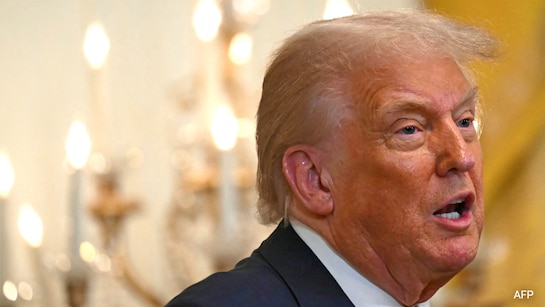
All About Trump's H-1B Visa Overhaul That Has Sparked Confusion, Fear
- Date & Time:
- |
- Views: 77
- |
- From: India News Bull
Trump's sudden announcement to impose a $100,000 fee on H-1B visas has created widespread confusion and anxiety among Indian workers in the United States.
Washington:
The Trump administration's unexpected decision to implement a $100,000 fee on H-1B visas has left employers, students, and workers from the US, India, and other countries shocked and perplexed.
Following the Friday announcement, the White House has attempted to calm anxious companies by clarifying that the fee doesn't apply to current visa holders and that their H-1B employees traveling abroad will not be prevented from re-entering the United States without paying $100,000. The new policy became effective at 12:01 a.m. Eastern on Sunday.
Despite these reassurances, Leon Rodriguez, a Seyfarth law firm partner and former director of U.S. Citizenship and Immigration Services under Obama, noted that "there's still some folks out there recommending to their H-1B employees that they not travel right now until it's a little clearer."
Here's an overview of the H-1B visa program and the Trump administration's changes:
Established by the 1990 Immigration Act, H-1B is a nonimmigrant visa designed to allow American companies to recruit individuals with technical skills that are scarce in the United States. These visas aren't intended for permanent residence, though some eventually stay by transitioning to different immigration statuses.
An H-1B visa permits employers to hire foreign workers with specialized skills and at least a bachelor's degree or equivalent. Valid for three years with a possible three-year extension, economist Stephen Brown of Capital Economics estimates "around 700,000 H-1B visa holders in the country and another half a million or so dependents" currently.
According to the Pew Research Center, at least 60% of H-1B visas approved since 2012 have been for computer-related positions. However, hospitals, banks, universities, and various other employers regularly apply for these visas.
Annual new visa issuance is capped at 65,000, plus 20,000 additional visas for individuals with advanced degrees. These visas are distributed via lottery. Some employers, including universities and nonprofits, are exempt from these limitations.
Pew reports that nearly three-quarters of successful applicants in 2023 were from India.
The White House announced the $100,000 fee, which took effect approximately 24 hours later. Currently, the application fee is $215, plus other minor processing charges.
Commerce Secretary Howard Lutnick initially stated the fee would apply annually, totaling $600,000 over the maximum renewal period. The White House later clarified it was a one-time fee that wouldn't affect current visa holders.
Trump also introduced a $1 million "gold card" visa for wealthy individuals.
These actions will likely face legal challenges claiming the president improperly bypassed Congress in dramatically overhauling the legal immigration system.
Critics argue H-1B visas undermine American workers by bringing in foreign workers often willing to work for lower wages. Companies like Tata Consultancy Services frequently provide Indian workers to corporate clients.
The White House proclamation stated: "To take advantage of artificially low labor costs incentivized by the program, companies close their IT divisions, fire their American staff, and outsource IT jobs to lower-paid foreign workers."
A 2020 report by the left-leaning Economic Policy Institute found that 60% of H-1B positions certified by the U.S. Labor Department receive wages below the job's median rate.
Capital Economics' Brown wrote that "it is hard to disagree with the administration's argument that the program needs reform."
Brown noted many tech firms can likely afford the $100,000 fee to recruit skilled workers.
"Nonetheless," he added, "the upfront fee will clearly be too high for many companies to stomach. Last year, the healthcare, retail and accommodation & food services sectors accounted for a quarter of H-1B visas between them, and firms in those sectors will probably find it harder to afford the fee."
The increased fee—along with other Trump administration immigration restrictions—will likely reduce the U.S. labor supply and drive wages higher, according to Brown.
Navneet Singh, who operates "Go Global Immigration" consultancy in India's Punjab state, said H-1B policy changes will significantly impact future migration to the U.S., especially from India.
"Trump is trying to suffocate new immigrants who are skilled, so that they won't take the jobs away from the average American. But by doing so, they will be making (U.S.) production expensive," Singh stated.
He predicted the new policy would create advantages for international competitors. "Countries like France, Netherlands, Germany and Canada are set to gain from this move," he added.
Some Indian students hoping to study in the U.S. are disappointed.
Due to the new policy, "opportunities will shrink, especially for Indians, since so many of us depend on H-1B visas to build a career there," said one anonymous student in New Delhi who had planned to study in the U.S.
"It feels like a door closing. All this adds to the mutual loss of knowledge and skills caused by the new policies," said another aspiring student who requested anonymity. "It's not just about money or getting a job but it also affects family decisions, education loans, and even the sense of stability for those already there."
Greg Morrisett, dean and vice provost at Cornell Tech, said startups and small businesses will likely be most affected by the fees since there's "no way they can" pay them. Cornell Tech has launched about 120 startups, and the "vast majority" involve international students. The consequence? "They'll pick up and move to Europe or Asia, wherever they can find," he said.
"The big tech companies will likely move a lot of operations and things into other countries. We saw this when, for example, you know, Ireland made it really attractive from a tax perspective. All of a sudden all the headquarters move to Ireland," Morrisett said.
He added that startups—"the next Amazon, the next Google will give up here and go somewhere else and then we won't have that advantage in the next generation of tech leadership."
(This story has not been edited by NDTV staff and is auto-generated from a syndicated feed.)