
Revolutionary Discovery: Ancient Humans Created Fire 400,000 Years Ago - New Evidence Rewrites Human Evolution Timeline
- Date & Time:
- |
- Views: 44
- |
- From: India News Bull
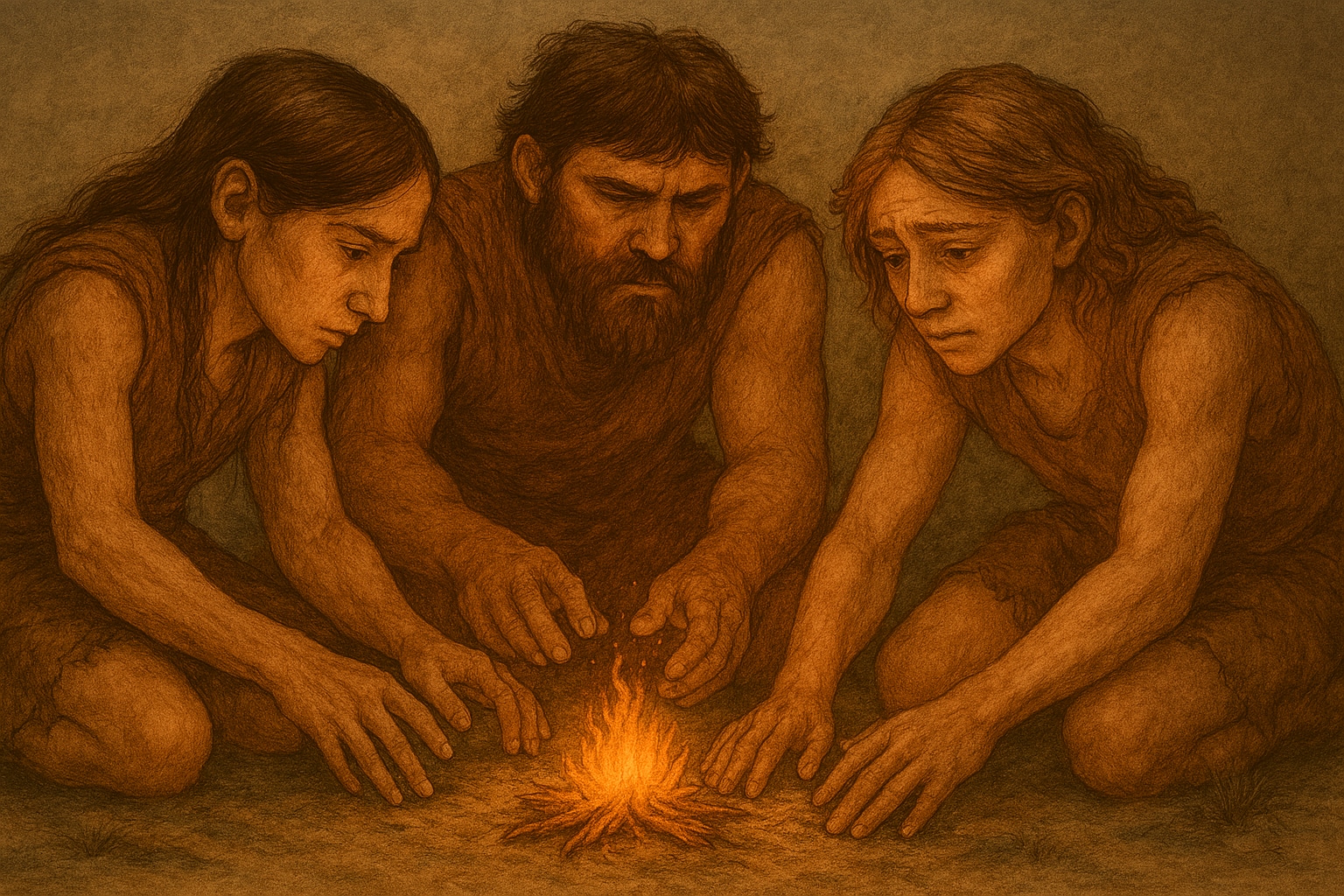
Fire allowed early populations to survive colder environments, deter predators and cook food. (AI Image)
London:
British scientists have uncovered evidence suggesting ancient humans mastered fire-making approximately 400,000 years ago, significantly earlier than previously believed. Their discovery at an archaeological site in eastern England pushes back the timeline for controlled fire by roughly 350,000 years.
Published in the journal Nature, these findings dramatically revise our understanding of early human capabilities. Until this discovery, the oldest confirmed evidence of deliberate fire-making came from Neanderthal sites in northern France, dating to approximately 50,000 years ago.
The breakthrough emerged at Barnham, a long-studied Paleolithic site in Suffolk. A research team led by the British Museum identified several compelling pieces of evidence: a patch of baked clay, flint hand axes showing fractures from extreme heat, and two fragments of iron pyrite—a mineral known to produce sparks when struck against flint.
To verify their hypothesis, researchers conducted four years of analysis to eliminate the possibility of natural wildfires. Geochemical tests revealed temperatures exceeding 700 degrees Celsius (1,292 Fahrenheit) and evidence of repeated burning in the same location—a pattern consistent with a constructed hearth rather than a lightning strike.
Rob Davis, a Paleolithic archaeologist with the British Museum, emphasized that the combination of high temperatures, controlled burning, and pyrite fragments demonstrates "how they were actually making the fire and the fact they were making it."
The presence of iron pyrite, which does not occur naturally at Barnham, suggests these early humans deliberately collected the material, understanding its fire-starting properties.
Deliberate fire-making evidence rarely survives in the archaeological record. Ash easily scatters, charcoal decomposes, and heat-altered sediments often erode over time. At Barnham, however, the burned deposits were preserved within ancient pond sediments, enabling scientists to reconstruct how early humans utilized the site.
The implications for human evolution are profound. Fire provided early populations with the means to survive in colder environments, keep predators at bay, and cook food. Cooking breaks down toxins in plants and kills pathogens in meat, improving digestion and releasing additional energy to support larger brain development.
Chris Stringer, a human evolution specialist at the Natural History Museum, noted that fossils from Britain and Spain suggest Barnham's inhabitants were likely early Neanderthals whose cranial features and DNA indicate growing cognitive and technological sophistication.
Fire also facilitated new forms of social interaction. Evening gatherings around hearths would have created opportunities for planning, storytelling, and strengthening group bonds—behaviors associated with language development and more organized societies.
Archaeologists observe that the Barnham site aligns with a broader pattern across Britain and continental Europe between 500,000 and 400,000 years ago, when early human brain size began approaching modern levels and evidence of increasingly complex behavior became more apparent.
Nick Ashton, curator of Paleolithic collections at the British Museum, described it as "the most exciting discovery of my long 40-year career."
For archaeologists, this finding helps address a fundamental question: when did humans transition from relying on lightning strikes and natural wildfires to creating flame at will, wherever and whenever they needed it?
Source: https://www.ndtv.com/world-news/humans-were-making-fire-400-000-years-ago-far-earlier-than-thought-study-9796262