
Volodymyr Zelensky: The Defiant Wartime Leader Facing His Greatest Challenges
- Date & Time:
- |
- Views: 50
- |
- From: India News Bull
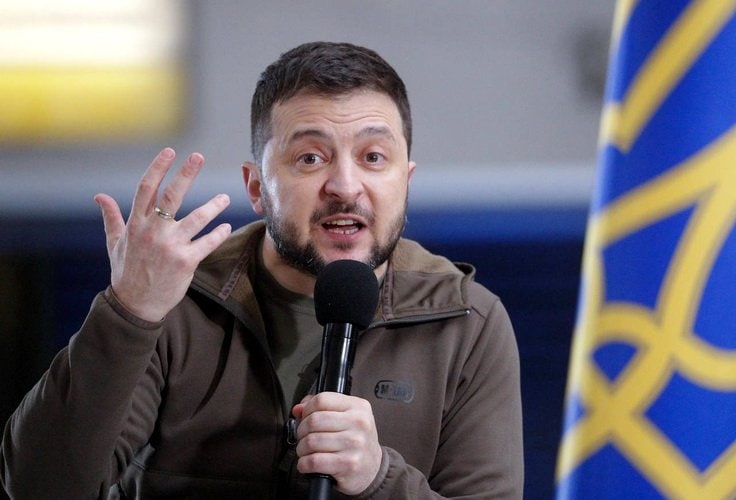
Volodymyr Zelensky has consistently demonstrated an ability to prevail when facing overwhelming challenges.
Ukraine's leader was expected by Russia to fall within days following the February 2022 invasion that Moscow anticipated would be a swift, victorious campaign.
Instead, the former comedian transformed into the embodiment of his nation's resistance, repeatedly overcoming seemingly insurmountable obstacles amid relentless Russian assaults that have claimed tens of thousands of Ukrainian lives.
Currently, Zelensky confronts what he describes as "one of the most difficult moments of our history," with Russian forces advancing at their fastest rate in a year and a domestic corruption controversy forcing him to dismiss his influential chief aide.
Additionally, US President Donald Trump is advocating a peace plan widely perceived in Kyiv as near-capitulation, while supporting Russia's demand for new presidential elections in Ukraine.
Despite the suspension of elections under martial law, Zelensky has expressed willingness to hold a vote if the United States and Europe provide security guarantees.
"I am ready for the elections," the 47-year-old stated.
The charismatic president has repeatedly demonstrated resilience when facing extreme pressure.
When Russian forces advanced on Kyiv in February 2022, Zelensky—Ukraine's youngest-ever president—rejected a US evacuation offer, remaining in the capital to direct the resistance.
"We are not putting down arms," he declared in his now-iconic address to Ukrainians, delivered outside the presidential compound in darkness.
As Moscow captured successive towns, launched missile strikes against cities, and forced millions to flee, Zelensky maintained national morale through daily video messages.
Tirelessly visiting allies, he persuaded Western nations to arm Ukraine.
His defiance angered his adversary Vladimir Putin, a former KGB agent with 25 years in power who had anticipated easily outmaneuvering the political newcomer.
Unlike the Russian leader, Zelensky regularly visits frontline troops, as well as ordinary citizens, children, families, and victims of Russian attacks.
According to one senior Kyiv official speaking anonymously to AFP, being among people energizes him.
"I don't think the office-based part is his thing," they remarked.
His "informal," everyday-person approach has earned him admiration and confidence domestically and internationally.
According to his wife Olena Zelenska, the full-scale February 2022 invasion shocked her husband, who had anticipated Russia would at most occupy eastern portions of Ukraine.
The subsequent discovery that Russian forces had massacred dozens of civilians in Bucha, a Kyiv suburb, marked a turning point.
Walking through streets previously strewn with bodies was one of the few instances where Zelensky appeared visibly shaken.
"It's very difficult to talk," he said, his voice trembling. "These are war crimes."
Before assuming office, Zelensky had pledged to resolve the conflict with Russian-backed separatists in eastern Ukraine.
"We just need to stop shooting," he had told journalists, speaking in Russian.
Now he openly acknowledges his hatred for Putin, whom he has labeled a "dictator" and "murderer".
"He became much tougher," observed someone from Zelensky's entourage who knew him long before his political career.
Once almost universally admired, that hardened resolve has caused friction with Trump over the past year, most notably during their controversial Oval Office encounter.
Though Zelensky won a landslide presidential victory in 2019, he made limited progress on campaign promises during his initial years in office.
Russia's invasion temporarily suspended internal politics—traditionally spirited and unpredictable.
However, tensions have escalated as the conflict continues.
Critics have accused him of marginalizing opponents—such as removing popular former army chief Valery Zaluzhny—and concentrating excessive power with his now-dismissed chief aide Andriy Yermak.
A former senior security official told AFP that "the word 'strategy' is an obscenity" within Zelensky's administration, with "no planning beyond tomorrow, or the day after tomorrow".
From his team, he demands both creativity and rapid execution.
"He's someone who, when given two options, one and two, tries to find a third, original one," noted a current official.
"That is definitely his strong suit, which probably lets him, you could say, turn the chessboard around."
"He'll ask 10 times, 'Why can't we speed up here? Why can't we push this through faster?'"
Surveys indicate most Ukrainians maintain confidence in Zelensky—approximately 60 percent expressed trust in him last October.
However, this represents a decrease from near-universal approval at the war's outset.
Regarding potential elections, a November poll placed him first with 20.3 percent support, closely followed by Zaluzhny at 19.1 percent.
A father of two from a Russian-speaking Jewish family, Zelensky attributed much of his early career success to Russia's entertainment industry.
A comedy competition sending winners to Moscow provided his escape from Kryvyi Rih, his industrial, crime-ridden hometown.
In 2013, he co-hosted a New Year's Eve program on Russian state television, entertaining figures who would later denounce him on pro-war propaganda broadcasts.
On Ukrainian television, he portrayed a fictional president, leveraging this role for his actual presidential campaign.
Following Russia's 2014 annexation of Crimea and support for separatists in eastern Ukraine, Zelensky as a comedian addressed Putin directly on camera:
"If you need it, I will even beg on my knees, but do not put our country on its knees."
Source: https://www.ndtv.com/world-news/volodymyr-zelensky-under-pressure-wartime-leader-used-to-defying-the-odds-9795420