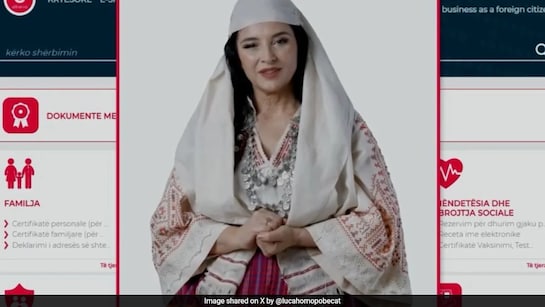
"Who Has Control?" Experts Question Albania's AI-Generated Minister
- Date & Time:
- |
- Views: 61
- |
- From: India News Bull
Albanian politicians are frequently ensnared in corruption scandals involving public funds.
Albania recently unveiled an AI-generated minister designated to oversee a new public tenders portfolio.
"Diella" is being hailed as the world's first virtual minister, with Albanian Prime Minister Edi Rama claiming the appointment would eliminate widespread corruption in government contracts—a significant hurdle to the Balkan nation's European Union aspirations.
However, numerous technical, political, and ethical concerns have emerged regarding this virtual lawmaker.
In his announcement about Diella's role, Rama boldly asserted that public tenders would now be "100 percent free of corruption".
"Diella never sleeps, she doesn't need to be paid, she has no personal interests, she has no cousins, because cousins are a big issue in Albania," stated the prime minister, whose country ranks 80th out of 180 in Transparency International's corruption index.
Albanian politicians are regularly implicated in corruption scandals connected to public funds.
The former mayor of Tirana was arrested while serving in office and remains in custody, suspected of corruption related to government contract awards.
Opposition leader and former prime minister Sali Berisha is likewise suspected of awarding public contracts to associates.
Could Diella resolve these issues?
Experts are skeptical.
"Like any AI system, she depends entirely on the quality and consistency of the data and the reliability of the models behind her," explained Erjon Curraj, a digital transformation and cybersecurity expert.
While Diella's exact mechanisms remain undisclosed, the system likely utilizes Large Language Models (LLM) to process queries—similar to the vast text databases powering generative chatbots like ChatGPT or Gemini.
However, if input data is incomplete, biased, or outdated, the AI's decisions will inevitably reflect these deficiencies, and it "might misinterpret documents, wrongly flag a supplier, or miss signs of collusion," Curraj warned.
"LLMs reflect society; they have biases. There's no reason to believe it solves the problem of corruption," asserted computer scientist and artificial intelligence specialist Jean-Gabriel Ganascia.
"Assuming a machine has no biases implies we must submit to the machine," Ganascia added.
The Albanian opposition has filed an appeal with the Constitutional Court over accountability concerns regarding the AI's decisions.
"Who will control Diella?" Berisha questioned in parliament.
Ganascia concurs that issues of accountability and control are paramount regarding AI.
"If public decision-making is entrusted to a machine, it means there is no longer accountability; we are reduced to the state of slaves."
"What worries me is the idea of a machine governing, offering the 'right' answer, and preventing any deliberation," stated the researcher, who is also a philosopher.
"A politician takes responsibility, but here, the idea is that the machine is perfect, and we cannot go against its decisions anyway."
Addressing these concerns, a decree published Thursday indicates that Rama "also holds responsibility for the creation and operation of the virtual Ministry of Artificial Intelligence Diella."
The announcement captured international headlines, something the prime minister excels at—whether by attending international meetings in sneakers, announcing a TikTok ban, establishing a Bektashi State modeled after the Vatican, or opening migrant camps for individuals intercepted at sea by the Italian government.
However, implementation often falls short of announcements.
TikTok remains easily accessible in Albania, only a few dozen migrants have been transferred to the camps, and Italian courts continue to contest the initiative's legality.
Little progress has been observed regarding the Bektashi State since its announcement a year ago.
As for Diella, whose face belongs to well-known Albanian actress Anila Bisha—who signed an image rights contract expiring in December—it remains uncertain whether her appointment will withstand Constitutional Court scrutiny.
It's equally unclear whether this initiative will comply with European Union standards, which Albania hopes to join within five years.
"So far, there is no information about how Diella actually works," noted Albanian political scientist Lutfi Dervishi.
"If a corrupt system provides manipulated data, or filters are set up on what it must not see, Diella will merely legitimise old corruption with new software."