
Analyzing the Potential Framework for a Ukraine-Russia Peace Agreement: Territorial Claims, NATO Status, and Security Guarantees
- Date & Time:
- |
- Views: 61
- |
- From: India News Bull
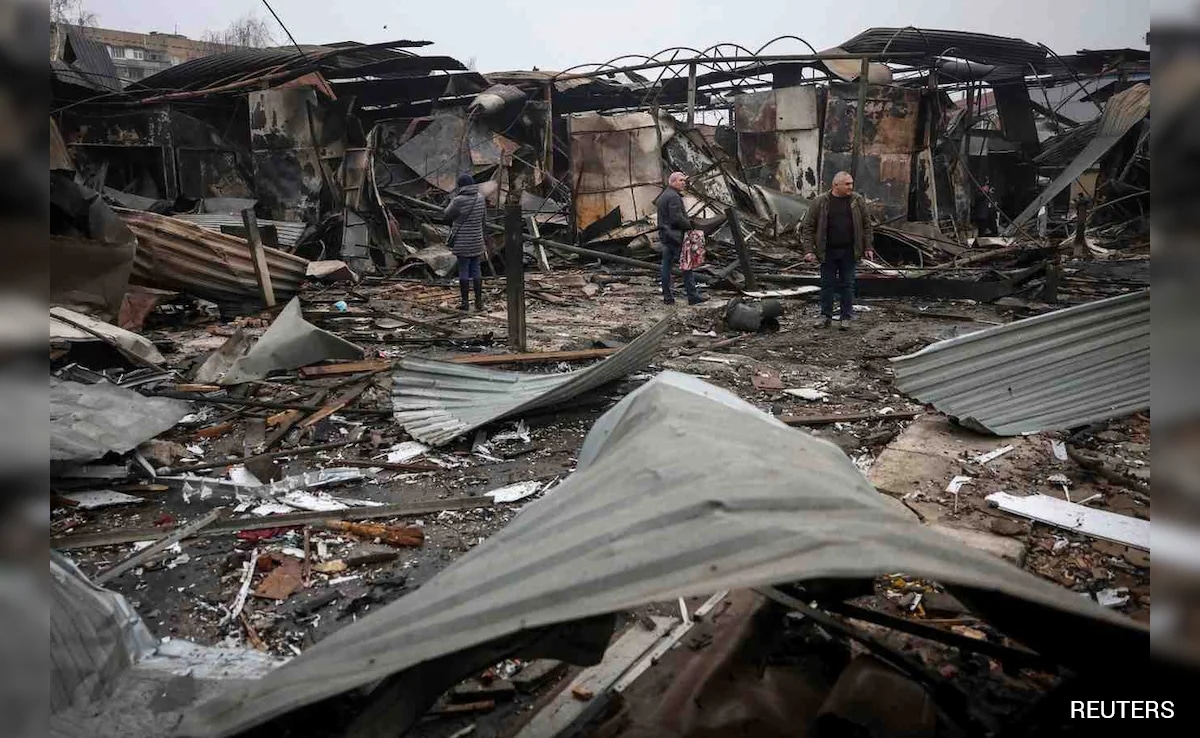
Vendors inspect market in Ukraine, hit by a Russian military strike (File)
US President Donald Trump's representative, Steve Witkoff, recently visited Moscow to engage in discussions with Russian President Vladimir Putin regarding a potential agreement to end the ongoing conflict in Ukraine.
Last week, a leaked set of US draft peace proposals emerged, prompting European powers to present counter-proposals. Since then, US and Ukrainian officials have conducted talks in Geneva and Florida, though they have not disclosed specific details about these discussions.
What might a potential peace agreement entail?
Regarding territorial division, Russia, which initiated its invasion of Ukraine in February 2022, currently controls approximately 116,000 square kilometers (44,800 square miles), representing over 19% of Ukraine's territory, according to Russian military sources.
This represents just a one percentage point increase compared to two years ago. However, Russian forces have advanced more rapidly in 2025 than at any point since 2022, according to pro-Ukrainian maps. Kyiv maintains that Russia has incurred significant human casualties in these advances, while Moscow counters that Ukraine has also suffered substantial losses.
Russia claims that Crimea, which it annexed in 2014, along with the Donetsk and Luhansk regions (collectively known as Donbas), plus the Zaporizhzhia and Kherson regions, now legally constitute Russian territory. The United Nations has declared these annexations illegal under international law, and most countries do not recognize them.
Russia also controls portions of additional Ukrainian regions including Kharkiv, Sumy, Mykolaiv, and Dnipropetrovsk, though it has not succeeded in gaining control over the entire Donbas region.
Under the initial 28-point US proposal, Ukraine would be required to withdraw from heavily fortified areas of Donbas under its control—approximately 5,000 square kilometers—which would then become a neutral demilitarized buffer zone, internationally recognized as Russian territory.
These proposals suggest that Crimea, Luhansk, and Donetsk would be recognized as de facto Russian territories, including by the United States. Russian territorial gains in Zaporizhzhia and Kherson up to the current front line would also receive "de facto" recognition.
European powers, viewing the initial US draft as overly favorable to Russia, offered a counter-proposal whereby Ukraine would commit to not reclaiming Russian-controlled territory through military means.
US and Ukrainian officials subsequently discussed an additional set of proposals, with President Zelensky stating that the Florida talks had "refined" a framework peace agreement developed in Geneva.
Zelensky has acknowledged that some Russian-occupied territories might be recognized as temporarily de facto occupied but has rejected any de jure recognition. He has consistently opposed territorial concessions, stating he lacks the mandate for such decisions, and has urged Western allies not to reward Russia for its aggression in Ukraine.
Regarding NATO, one of Putin's central demands for ending the war is a written commitment from Western leaders to halt the eastward expansion of the US-led military alliance. Russian officials frequently reference an assurance to this effect given by US Secretary of State James Baker to Soviet leader Mikhail Gorbachev in 1990.
The initial US peace proposals included provisions that NATO would not expand further, that Ukraine would constitutionally prohibit itself from joining NATO, and that NATO would incorporate a statutory provision preventing Ukraine's future admission. Ukraine would receive short-term preferential access to the European market while its EU membership application was under consideration.
The European counter-proposal significantly modifies these NATO-related clauses, suggesting that Ukraine's potential NATO membership would depend on consensus among existing NATO members.
NATO leaders agreed in 2008 that Ukraine and Georgia would eventually become members. In 2018, Ukraine's parliament voted to enshrine NATO membership as a constitutional goal.
Trump has indicated that previous US support for Ukraine's NATO membership contributed to the conflict and has suggested Ukraine will not attain membership. NATO maintains that individual countries determine whether they seek alliance membership.
Regarding security guarantees, Ukraine emphasizes the necessity of robust safeguards against future Russian aggression. Russia demands limitations on the size of Ukraine's military and insists on Ukrainian neutrality.
The US has approached security guarantees cautiously, wary of commitments that might involve NATO in a potential future conflict with Russia over Ukraine.
Ukraine and its European allies express doubts about Moscow's reliability as a guarantor, arguing that Ukrainian neutrality would leave Europe vulnerable. Conversely, Russia questions the trustworthiness of Ukraine and European powers.
Moscow has also demanded protections for Russian speakers and Orthodox believers. Kyiv rejects any restrictions on its armed forces and maintains that Russian speakers already enjoy adequate protections, noting that Zelensky's first language is Russian, which he uses frequently.
On financial matters, the initial US proposals suggest that Russia would be reintegrated into the global economy and invited to rejoin the G8, an informal forum from which Russia was suspended in 2014 following its annexation of Crimea.
The United States proposed establishing a long-term agreement with Russia to develop projects in energy, natural resources, infrastructure, artificial intelligence, data centers, Arctic rare-earth metal extraction, and other mutually beneficial corporate opportunities.
European Union leaders are working toward an agreement to utilize frozen Russian assets held in Europe as the foundation for a €140 billion ($163 billion) loan to Ukraine. Russian officials maintain that such action would be illegal.
A peace agreement might also involve Russia and the United States resuming talks on strategic nuclear arms control.
The future status of the Zaporizhzhia nuclear power station, located in Ukrainian territory under Russian control, remains uncertain.
Media speculation suggests Russia might offer US companies stakes in its vast natural resources sector.
Washington has proposed holding elections in Ukraine. Putin claims the Kyiv leadership lost legitimacy after failing to hold elections when Zelensky's elected term expired. Kyiv contends that elections cannot be conducted while under martial law and defending its territory against Russian forces.
Source: https://www.ndtv.com/world-news/explained-a-look-at-what-ukraine-peace-deal-may-look-like-9740758