
India Plans 'Bodyguard' Satellites After Risky Orbital Near-Miss: Report
- Date & Time:
- |
- Views: 73
- |
- From: India News Bull
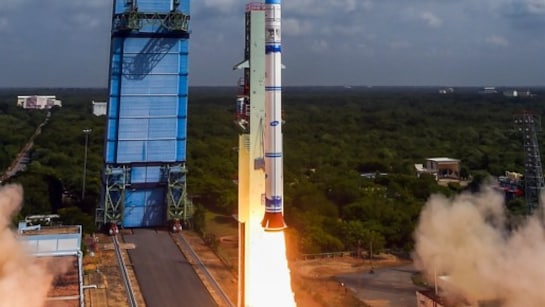
The Indian government is collaborating with startups to develop appropriate solutions. (Representative Image)
India is formulating a strategy to enhance its capability to defend satellites from potential attacks, according to individuals familiar with the situation, following a concerning close encounter in orbit that highlighted national security vulnerabilities posed by other spacecraft.
According to sources who requested anonymity due to the sensitive nature of the information, Prime Minister Narendra Modi's administration intends to develop what are termed "bodyguard satellites" designed to identify and neutralize threats to orbiting spacecraft. Satellites also played a crucial role during India's recent conflict with Pakistan in May, which brought the two nations perilously close to full-scale warfare.
The individuals revealed a previously undisclosed incident that emphasized the necessity for action—when a satellite from a neighboring country came dangerously near to one of India's satellites.
This close call in mid-2024 involved one of the Indian Space Research Organisation's (ISRO) satellites orbiting approximately 500-600 kilometers (311-373 miles) above Earth, in the same orbital region that is becoming increasingly congested with communication satellites such as Elon Musk's Starlink network.
The spacecraft from a neighboring country, which the sources declined to identify, approached within 1 kilometer of an ISRO satellite that was performing functions with potential military applications, including mapping and ground object monitoring.
Although a collision did not occur, such an unusually close approach was potentially a demonstration of capabilities that could have been intended to showcase the other nation's technological prowess, according to the sources.
ISRO and the Department of Space did not respond when asked for comment.
The satellite-protection initiative forms part of a broader effort by PM Modi's government to expand security assets in orbit, including a 270 billion Indian rupees ($3 billion) program for approximately 50 surveillance satellites, with the first launch anticipated next year.
India has experienced multiple armed conflicts over the past seven decades with both Pakistan and China—countries with significantly different space capabilities.
Pakistan operates just eight satellites, compared to India's more than 100, according to data from N2Y0.com, a website tracking such spacecraft. The same source indicates that China manages more than 930 satellites.
New Delhi and Beijing have unresolved territorial disputes that have resulted in confrontations, including a 2020 incident in which at least 20 Indian soldiers and an undisclosed number of Chinese personnel died during border fighting.
Officials from both India and the United States have cautioned that China's People's Liberation Army represents an increasing threat in space. Beijing's satellite program has expanded rapidly in both scale and sophistication, as Indian Air Marshal Ashutosh Dixit warned in June at a seminar organized by the Centre for Air Power Studies in New Delhi.
The government is now partnering with startups to identify appropriate solutions, according to the informed sources.
While discussions remain in preliminary stages, the objective may be to deploy Light Detection and Ranging (LiDAR) satellites to more rapidly identify threats, providing sufficient time for ground technicians to transmit instructions for the targeted satellite to alter its position.
The LiDAR satellites would need to function as components of a larger system incorporating ground-based radars and telescopes, according to Sudheer Kumar N, former director at ISRO's Capacity Building Program Office and current independent consultant.
"We currently lack continuous in-orbit tracking capability on a 24/7 basis," he stated, "but several startups are developing such technology."
ISRO fulfilled a crucial national security function during May's armed conflict between India and Pakistan. Over 400 scientists worked continuously to support the agency's Earth observation and communication satellites, as ISRO chairman V Narayanan revealed in a September 9 address.
During the hostilities, China provided assistance to Pakistan, helping Islamabad adjust its satellite coverage, according to a May statement from a research group under India's defense ministry.