
PM Modi Unveils Vikram-I: India's Private Space Sector Milestone in Satellite Launch Technology
- Date & Time:
- |
- Views: 54
- |
- From: India News Bull
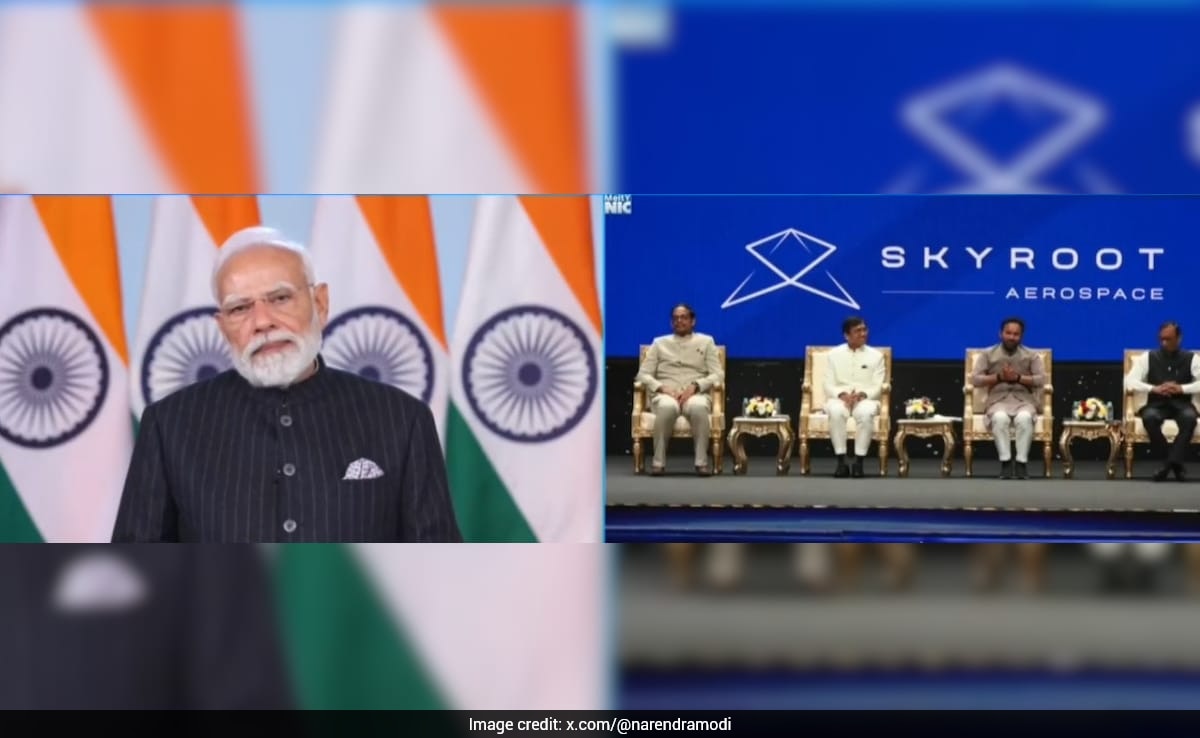
Prime Minister Narendra Modi virtually presided over the inauguration of Skyroot Aerospace's Infinity Campus in Hyderabad while also unveiling Vikram-I, the first privately developed orbital rocket in India.
During the ceremony, PM Modi expressed confidence that India is positioned to become a global leader in satellite launch systems, describing the achievement as a testament to the nation's credibility and innovative capabilities.
"India has established its distinct mark in credibility, capacity, and value within the space sector," stated Prime Minister Modi. He commended Skyroot's founders Pawan Chandana and Bharath Daka as "significant inspirations for the country's youth."
In his address, the Prime Minister emphasized that the expansion of the private space industry, led by enterprises like Skyroot, directly reflects the government's reforms aimed at encouraging innovation and private participation in space exploration.
PM Modi reflected on India's space journey, noting that despite beginning with limited resources, the nation's aspirations were never constrained. "From transporting rocket components on bicycles to developing the world's most reliable launch vehicles, India has demonstrated that dreams are not limited by resources but are powered by determination," he remarked.
The Prime Minister highlighted the "transformative reforms" that have opened India's space sector to private innovation, including the implementation of a new space policy and the establishment of IN-SPACe to facilitate industry collaboration with ISRO.
"For decades, ISRO has propelled India's space journey forward," Modi stated, emphasizing how credibility, capacity, and value have secured India's unique position in the sector.
He noted the emergence of over 300 space startups, many of which began with modest resources but substantial ambitions.
"This development has sparked a private space revolution in India. Generation Z engineers, designers, programmers, and scientists are creating innovative technologies that have given India a distinctive identity in the global space arena," Modi observed.
The Prime Minister highlighted the growing "worldwide demand for small satellites and launch frequencies," describing it as a "significant opportunity for India."
"International companies are seeking to manufacture satellites here, require launch assistance, and desire technological partnerships. We must capitalize on this opportunity," he stated, adding that India's cost-effective and reliable approach has heightened global expectations.
Prime Minister Modi connected the space sector's development to India's broader startup revolution across various domains including fintech, agritech, health-tech, climate-tech, edu-tech, and defense technology.
"India now represents the world's third-largest startup ecosystem with 150,000 registered startups, including numerous unicorns. Innovation is no longer confined to major cities but has extended to smaller towns and villages," he observed.
He also discussed advancements in deep-tech manufacturing, referencing semiconductor fabrication facilities and design centers as examples of India's growing influence in global supply chains. The PM mentioned plans to open the nuclear sector to private participation and elaborated on its potential to address various national challenges. He highlighted initiatives like One Nation, One Subscription that are helping young people access global research.
"The future belongs to Indian youth and innovators," PM Modi declared, expressing his expectation that five space-tech unicorns would emerge soon. He reaffirmed India's ambition to refine launch capabilities and establish the 21st century as India's century.
The 'Infinity Campus' represents a cutting-edge facility that founder Pawan Chandana stated "would be capable of producing one rocket monthly." This development is expected to significantly enhance India's private space capabilities. The campus encompasses an extensive 200,000 square feet workspace.
The unveiled Vikram-I is Skyroot's inaugural orbital rocket, engineered to deploy satellites into orbit. Its successful implementation will further strengthen India's position in the global commercial launch market.
Skyroot Aerospace, established by IIT alumni and former ISRO scientists Pawan Chandana and Bharath Dhaka, has positioned itself as an industry pioneer. The company made history as the first Indian private enterprise to successfully launch a rocket into space with its sub-orbital vehicle, Vikram-S, in November 2022. The new Infinity Campus and Vikram-I rocket are anticipated to enable Skyroot's transition from sub-orbital launches to comprehensive commercial orbital missions.
Source: https://www.ndtv.com/india-news/pm-narendra-modi-unveils-vikram-i-says-worlds-most-reliable-rocket-launcher-will-be-indian-9708827