
How the Muthoot Family Built a $13 Billion Fortune From India's Gold Obsession
- Date & Time:
- |
- Views: 54
- |
- From: India News Bull
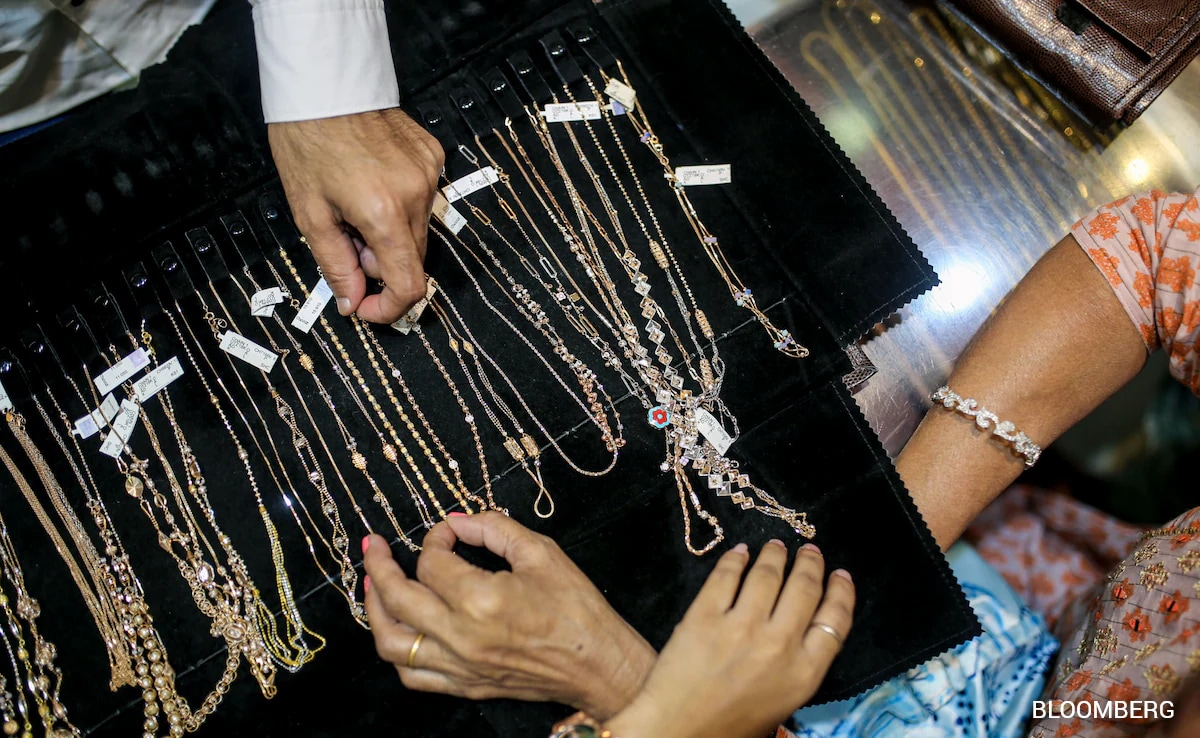
Customers observe necklaces inside a jewelry store during the Dhanteras festival in Mumbai.
Gold is experiencing a remarkable surge, and India's billionaire Muthoot family is capitalizing on this trend.
Their family-operated enterprise, which has provided gold loans for nearly nine decades, is thriving as consumers leverage rising bullion prices to exchange jewelry for short-term cash. This boom has driven the company's stock to unprecedented heights, elevating the Muthoots' collective fortune to over $13 billion, according to the Bloomberg Billionaires Index.
"The market is exploding," says George Alexander Muthoot, 70, the managing director of his namesake firm and third-generation executive of the business. "Even for wealthy individuals, taking gold loans has become fashionable today."
Muthoot Finance Ltd.'s ascension highlights the growing influence of India's shadow banking sector, which contributes significantly to the country's economic development. Gold lending across all institutions increased by 35% in the 12-month period ending June, reaching 13.4 trillion rupees ($151 billion), representing the most rapid growth among consumer loan categories, as reported by CRIF High Mark Credit Information Services Pvt.
The company's primary challenge now is maintaining its edge against competitors, with gold prices approaching record highs. Competition is intensifying after Bain Capital agreed to invest approximately $500 million for an 18% stake in gold lender Manappuram Finance Ltd. Meanwhile, Mitsubishi UFJ Financial Group Inc. is reportedly negotiating to acquire 20% of shadow bank Shriram Finance Ltd. for $2.6 billion. Muthoot Finance's strategy to expand its network of over 7,500 branches by up to 200 annually may not suffice to preserve its leadership as India's premier gold lender.
During a recent earnings call, analysts questioned Muthoot about the company's approach to addressing foreign competitors and local banks aggressively expanding their gold-loan portfolios. He dismissed these concerns, stating that the overall market is growing.
"There is no need to take any hasty or knee-jerk reactions," Muthoot stated. "The operational challenges will eventually catch up with them."
No nation values gold as much as India, where households possess approximately 34,600 tons, valued at around $3.8 trillion, according to Morgan Stanley estimates. This exceeds the combined holdings of the central banks of the US, Germany, Italy, France, Russia, and China. For India's 1.4 billion population, this translates to nearly 25 grams per person, valued at more than $3,250 at current prices. (In comparison, the country's gross domestic product per capita is just $2,820, according to the IMF.)
Gold is deeply embedded in India's culture, often associated with Hindu religious practices. Dhanteras, celebrated at the beginning of the Diwali festival of lights, is a popular occasion for purchasing gold and worshipping Lakshmi, the goddess of wealth. Weddings also prompt significant gold purchases, with brides traditionally adorned in gold bangles, bracelets, rings, and necklaces.
The practice of using gold as collateral for loans has existed for centuries. Long before the Muthoots established their business, small jewelers would offer cash to help clients navigate financial difficulties. The loan amount—sometimes as modest as $17—is determined by the jewelry's value. Higher gold prices increase their worth, leading to larger loans and greater interest income for lenders like Muthoot Finance.
"It's much easier to borrow from Muthoot," says Sandarsh, a 27-year-old driver in Bengaluru who requested to be identified only by his first name. He secured a loan of approximately 500,000 rupees in 2023, using half of his family's gold collection. He was charged 1.25% monthly, lower than the rate offered by State Bank of India. He utilized the funds to invest in a biryani business, which ultimately failed, though he repaid the loan.
The Muthoot family is Orthodox Christian, a small minority in the predominantly Hindu country. Family members typically have English given names, with George being particularly common. Nine of the 15 company directors are named George. Muthoot and his brothers represent the 19th generation of the family lineage.
George Alexander Muthoot displays photographs of Ninan Mathai Muthoot, founder; M. George Muthoot, founder of banking; and M.G. George Muthoot, group chairman, at the company's headquarters in Kochi.
Their business model is remarkably straightforward. Clients bring their jewelry to a branch, where staff evaluate the gold content before offering a loan of up to 75% of the value. A minimum of 18-karat gold is required. To determine purity, staff members rub the item against an obsidian testing stone—called a Kasauti—to create a faint streak, then apply a nitric acid solution. If the line disappears, it may indicate fake or low-quality gold. Borrowers typically take loans for periods of four to 12 months before reclaiming their heirlooms after repayment. Muthoot Finance charges 1% to 1.5% monthly on loans, with annualized rates potentially exceeding 19%.
"We only finance used jewelry," Muthoot explained in an interview from his office in Kochi, the commercial center of Kerala state at India's southern tip. "Most of the gold belongs to families. When they provide it as collateral, they intend to retrieve it."
Muthoot Finance branches are surprisingly modest considering the value of the assets they contain. They tend to be located in low-income neighborhoods often avoided by major banks.
One branch in Mumbai's financial district is situated on a quiet side street behind a busy thoroughfare. A hardware store and family-owned grocery shop are adjacent, where vendors selling custard apple and papaya park their carts.
The outlet is secured by a sliding metal grille, resembling an old-fashioned elevator door. Its facade features the bank's logo of two elephants facing each other, their curved trunks forming an "M" for Muthoot. Along the wall are bright red posters of actor Amitabh Bachchan, a brand ambassador and one of India's most prominent Bollywood stars, forming a traditional namaste greeting with his hands.
A security guard, cooled from the intense heat by a fan duct-taped to a small stool, secures the door with a heavy padlock whenever a customer enters. After clients are screened with a handheld metal detector, they are served by staff from behind glass partitions.
Once the jewelry is deposited, it's stored in the branch's vault, with doors controlled from the company's head office. The entire process takes less than an hour, and no credit history is required. The strict security measures are essential: Muthoot Finance held 209 metric tons of gold for clients—valued at almost $28 billion—slightly exceeding the gold reserves in Singapore's official foreign reserves.
Outstanding gold loans by the Keralite firm reached 1.25 trillion rupees at the end of September, surpassing the 725.5 billion rupees in similar loans issued by State Bank of India, the country's largest lender. Nevertheless, SBI's gold loan portfolio grew by 87% from the previous year, outpacing Muthoot Finance's 45% growth rate.
While Muthoot Finance has dominated the gold financing industry, the company could diversify its revenue by offering additional products, according to Parijat Garg, a Mumbai-based credit consultant who has monitored the company for a decade. Gold loans currently account for nearly 90% of the group's business, which also encompasses home financing and insurance.
"If I'm a gold loan customer, I may have insurance needs, I may have remittance needs," Garg noted.
Despite their often low-income clientele, defaults are uncommon. Muthoot's non-performing loan rate of 2.3% is comparable to commercial banks, which are subject to stricter regulations. Jewelry confiscated due to defaults is sold at auction.
The steady growth has resulted in three consecutive years of stock gains for the company, including a 73% increase this year. Consequently, four family members have more than doubled their fortunes. Three of them each own at least 10% of the firm, which now has a market value of almost $17 billion.
The family is already preparing the next generation for leadership, according to Muthoot. When asked whether female family members might someday lead the business, he described it as a "sensitive" matter.
"They get married, they go to the husband's family," he explained.
Among his three deputies is George Muthoot Jacob, a 42-year-old nephew who holds law and business degrees from England.
When asked why he returned to India instead of remaining in the UK like many other affluent Indians, the younger Muthoot seemed surprised by the question.
"We have a great family business here," he replied.
(This story has not been edited by NDTV staff and is auto-generated from a syndicated feed.)
Source: https://www.ndtv.com/india-news/billionaire-family-turns-indias-gold-obsession-into-a-fortune-9668433