
'Mini India On Moon': Astronaut Shubhanshu Shukla's Blueprint For Indian Lunar Village
In a Bengaluru lab, a blueprint of a futuristic Indian lunar village is being built with the help of astronaut Shubhanshu Shukla, months after he returned to Earth aboard the Axion-4 mission.
- Date & Time:
- |
- Views: 59
- |
- From: India News Bull
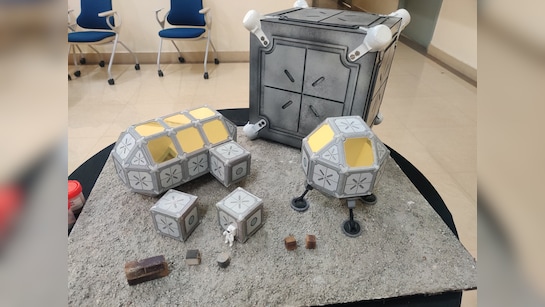
Astronaut Shubhanshu Shukla has designed modular habitats that will be assembled on the lunar surface.
Bengaluru:
A futuristic Indian lunar village blueprint is taking shape in a Bengaluru laboratory with the assistance of astronaut Shubhanshu Shukla, who recently returned to Earth after completing the Axion-4 mission.
India is establishing groundwork for a permanent lunar settlement, with official aims to land an Indian on the moon by 2040. This development comes as the United States, having previously sent 12 astronauts to the Moon for brief missions, prepares for long-term lunar presence through its Artemis program.
At the core of India's ambitious vision is a laboratory at Indian Institute of Science (IISc), Bengaluru, where researchers are developing scalable models of the planned "Indian village" on the moon's surface.
The initiative is spearheaded by Dr. Aloke Kumar, associate professor in the Department of Mechanical Engineering, with active participation from Mr. Shukla. The ISRO-IISc Space Technology Cell has officially granted a project titled "Bacterial growth induced self-healing and smart consolidation of structural mass" for lunar and Martian habitats. A team of six scientists is currently working on the designs.
"We should definitely dream of it, and I think our Prime Minister has already given us a vision of an Indian on the moon by 2040," said Dr Kumar. "So, we have to create the groundwork for a small colony on the moon right now. That is exactly what our lab is working on."
Modular Habitats: BHEEM Takes Shape
The cornerstone of this vision is a modular structure called Bhartiya Extraterrestrial Expandable Modular Habitat (BHEEM). These habitats are engineered to be transported in rocket payloads and assembled by astronauts on the lunar surface.
"These will all come as small pieces that can go up in a rocket's payload fairing," explained Dr Kumar. "There, the astronauts will assemble these structures. What you see in the models in the lab are small assembled structures, and then a slightly bigger one, and then a full-scale prototype."
The modularity enables scalability, allowing astronauts to expand their living quarters as required. The structures are designed to shield inhabitants from harsh lunar conditions, including micrometeorite impacts and extreme temperatures.
Bricks From Moon Dust: In-Situ Resource Utilisation
Beyond transporting Earth materials, the IISc team is exploring in-situ resource utilization, which involves using lunar soil (regolith) to construct bricks on the moon.
"On the moon, we have a lot of fine sand-like structure. The technical name for that is lunar regolith," said Dr Kumar. "Our first inhabitants can start using this regolith to make bricks. That is exactly what we have made here - bricks of different sizes using lunar regolith simulants (sand similar to lunar soil but made from rocks found on Earth)."
These bricks are not merely theoretical. The laboratory has successfully produced prototypes using both lunar and Martian simulants, paving the way for future construction on both celestial bodies. "Sometimes we are also making bricks out of Martian regolith simulants," Dr Kumar added. "So, we can prepare simultaneously to go to Mars."
Martian and lunar look-alike brick
The Astronaut Behind The Bricks
Mr. Shukla's contribution to this project is both technical and visionary. During the COVID-19 pandemic, he and Dr. Kumar began conceptualizing lunar habitats, eventually leading to BHEEM's development.
"BHEEM grew out of discussions between me and him (Mr Shukla) during COVID times," said Dr Kumar. "We became good friends and realised we had to make a modular structure. This was Shubhanshu and my idea, and later others joined in."
Mr. Shukla is pursuing his Masters in Technology (M Tech degree) in Dr. Kumar's laboratory, where he learned to operate experimental equipment, gaining skills that proved valuable during his time aboard the International Space Station (ISS). Shukla's training was interrupted by his 18-day space Axiom-4 Mission to the International Space Station in July.
"He was trained here in my lab," Dr Kumar confirmed. "He also worked on bricks and materials that could be used for permanent habitation."
One of Mr. Shukla's projects involved cultivating bacteria in Martian soil simulants. Martian soil presents a hostile environment due to high iron and perchlorate content. Mr. Shukla's research focused on preparing microbes to survive in such conditions, a crucial step for future bioengineering on other planets.
Astronaut Shubhanshu Shukla in the Dr Aloke Kumar's lab at IISc, Bengaluru, where he is pursuing M Tech
"Shukla has been obsessed with this idea of human habitation on the moon and Mars for a very long time," said Dr Kumar. "I think it's the right obsession for a Gaganyatri."
Viksit Bharat, Even On The Moon
With Prime Minister Narendra Modi announcing plans for a pool of 40-50 astronauts, India's lunar aspirations are becoming increasingly tangible. The work at IISc is establishing the foundation for a "Chhota Bharat" on the moon, where Indian astronauts could eventually live, work, and flourish.
"I would hope that we will be able to put some of these together and there will be an Indian station on the moon," said Dr Kumar. "Multiple astronauts, all very well trained, living on the moon and making a small, chhota sa Bharat over there."