
The Economic Divide at Pushkar Fair: Buffaloes and Horses Worth Crores While Camel Values Struggle Despite Ban Lift
- Date & Time:
- |
- Views: 45
- |
- From: India News Bull
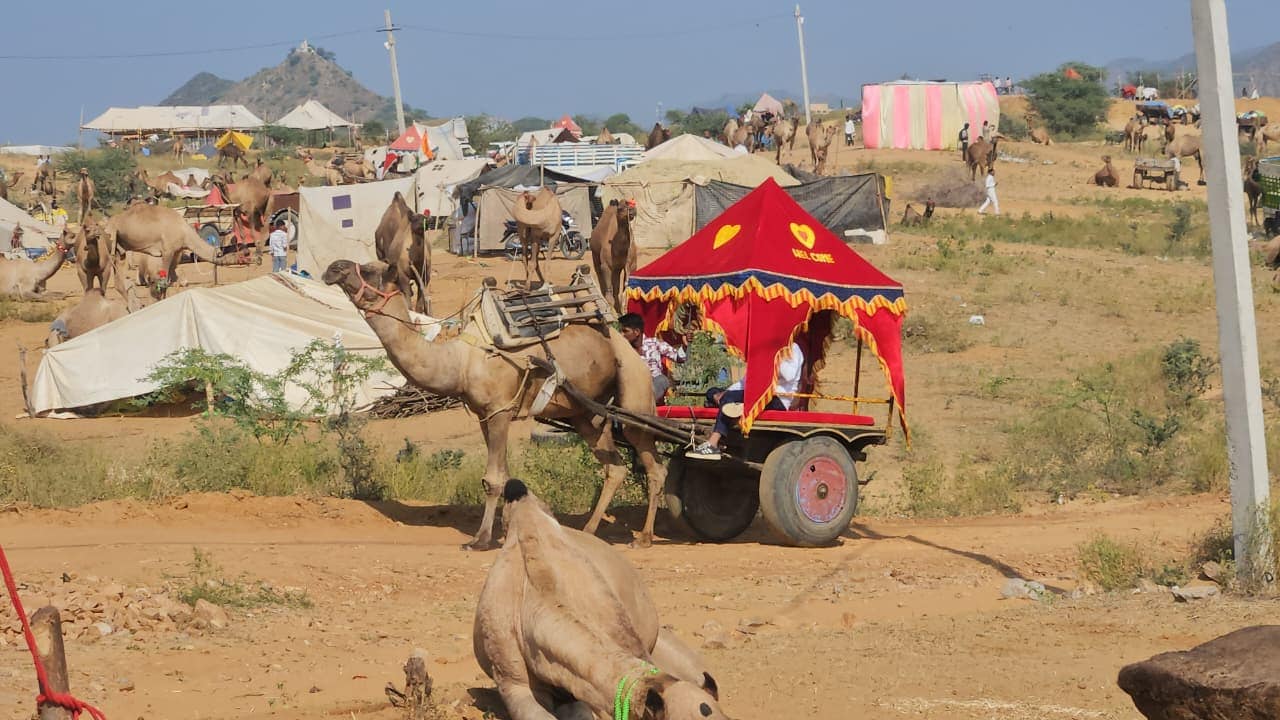
The camels at this year's Pushkar Fair are being sold for prices ranging from Rs 20,000 to Rs 1 lakh.
At Rajasthan's legendary Pushkar Fair, where prized buffaloes and horses command valuations exceeding one crore rupees, the iconic "ship of the desert" - the camel - is struggling to maintain relevance in a diminishing marketplace.
While the fair showcases stars like Balveer, Badal, Nagina, and Shehzadi attracting extraordinary prices, camels are only fetching between Rs 10,000 and Rs 1 lakh, with owners still facing bureaucratic challenges and transportation restrictions.
The Crorepati Buffalo of Pushkar, Balveer, a Murrah buffalo from Rajasthan's Didwana, has emerged as one of this year's main attractions. At just 35 months old, this impressive jet-black buffalo weighs 800 kilograms, stands 5 feet 8 inches tall, and carries a valuation of Rs 1 crore.
Dungaram, Balveer's proud owner, explains: "Balveer secured first prize in the buffalo category competition due to his gleaming coat and remarkable strength. We maintain his condition with a diet of ghee, milk, green fodder, and khal or protein cake, a specialized animal feed."
Primarily used for breeding purposes, Balveer generates approximately Rs 80,000 monthly. "The Murrah breed is renowned for its robust structure and glossy coat. It also produces premium quality milk. Balveer's mother produced 22 litres of milk daily, and his lineage traces back to Bhattu Kalan in Haryana," Dungaram notes.
He elaborates on the genetic factors behind Balveer's substantial value: "A buffalo's milk production capacity is determined by genetics and physical structure. Simply increasing feed won't enhance yield. Therefore, Balveer will produce offspring with inherently high milk production capabilities."
Dungaram adds, "As Balveer matures, the value of his semen will increase significantly. Currently, collection occurs twice monthly, generating up to Rs 80,000, as he's under three years old. Once he exceeds four years, this amount will double or triple. His monthly maintenance costs approximately Rs 35,000. Though I'm not actively seeking to sell him, an offer of Rs 1 crore would merit consideration."
The equine sensation at the Pushkar Fair is Badal, an extraordinary horse from Ajmer's Kekdi. This majestic animal has become a social media phenomenon due to his impressive height and noble bearing. According to reports, Badal has received a Bollywood film role offer worth Rs 15 lakh, a deal his owner Rahul confirms as finalized. "Ten lakh rupees have already been paid upfront, with the remaining Rs 5 lakh scheduled after the month-long filming," Rahul states proudly.
A stunning white mare named Shehzadi is also capturing attention at the fair. Celebrated for her elegant dancing movements and pristine white coat, she carries a price tag of Rs 51 lakh. Meanwhile, Nagina, a remarkable mare from Punjab valued at over Rs 1 crore, arrived at the fair in grand style, transported in her personal air-conditioned horse float.
Despite the glamour surrounding other animals, camels - traditionally the backbone of Rajasthan's desert economy - face uncertain prospects. With prices beginning at Rs 5,000 and rarely exceeding Rs 1 lakh, camel owners had higher expectations this year following the government's decision to lift restrictions on transporting camels outside Rajasthan.
The ban, implemented during Vasundhara Raje's government, was enacted after camel populations in the state plummeted to approximately two lakh, according to the 2019 livestock census. Although the restriction has been eased, administrative obstacles persist: buyers still require an SDM permit, veterinary health certification, and documentation stating the purpose of transport before moving animals from the fair or across state borders.
Hanuwant Singh, secretary of Lok Pashu Palak Samiti, an NGO dedicated to camel preservation, describes the situation as dire: "Camel numbers have declined alarmingly in Rajasthan. Our estimates indicate only about 1.5 lakh camels remain. Approximately 5,000 camels have been brought for trade this year, but despite the ban's removal, buyers continue experiencing difficulties transporting the animals."
"This year's camels are selling for between Rs 20,000 and Rs 1 lakh. Last year, due to the ban, prices dropped as low as Rs 1,500. However, camel owners remain discouraged. Many buyers from UP and Bihar cannot transport their purchased animals home because transportation regulations haven't been simplified. There's also concern regarding male camels potentially being transported for slaughter, necessitating continued government vigilance," Singh further explained.
On Wednesday, cow vigilante groups in Behror along the Delhi highway intercepted a vehicle transporting eight camels purchased at the Pushkar Fair, allegedly bound for Firozpur on the Haryana-UP border. The driver, Jahid from Baghpat in Haryana, was assaulted on suspicion of transporting camels for slaughter.
He was subsequently arrested on charges of animal cruelty, and the camels were confiscated. Police officials state that the matter remains under investigation.
Representatives from the Animal Husbandry Department clarified that while the transportation ban has been lifted, "permits will still be issued only after obtaining a health certificate and documentation regarding transport purpose from the appropriate authority at the Pushkar fair."
For some camel owners, the fair provided modest relief. "I sold my four-year-old male camel Moti for Rs 35,000. It was a reasonable price. Previously, camels never commanded such valuations," said Kishnaji, a camel owner from Chandawal village in Pali district.
Nevertheless, uncertainty continues to overshadow the desert fair. If transportation restrictions remain complex, the fragile recovery in camel prices may prove unsustainable.
Source: https://www.ndtv.com/india-news/buffaloes-horses-fetch-crores-at-pushkar-fair-camels-rs-10-000-heres-why-9543908