
Delhi's Third Cloud Seeding Trial Since 1957: Fighting Air Pollution With Artificial Rain Technology
- Date & Time:
- |
- Views: 58
- |
- From: India News Bull
Over the years, research on cloud seeding has expanded significantly across India.
New Delhi:
Delhi recently conducted an artificial rain experiment after a 53-year hiatus, primarily aimed at combating the city's severe air pollution crisis.
According to Roxy Mathew Koll, a climate scientist from the Indian Institute of Tropical Meteorology in Pune, this marks only the third such trial in the capital, following initial experiments during the monsoon of 1957 and another in the early 1970s.
On Tuesday, the Delhi government collaborated with IIT-Kanpur to execute the cloud-seeding operation in select areas of the national capital. Environment Minister Manjinder Singh Sirsa announced that additional trials are scheduled in the coming days.
Officials reported that the aircraft departed from Kanpur and flew over regions including Burari, north Karol Bagh, and Mayur Vihar before landing at the Meerut airfield.
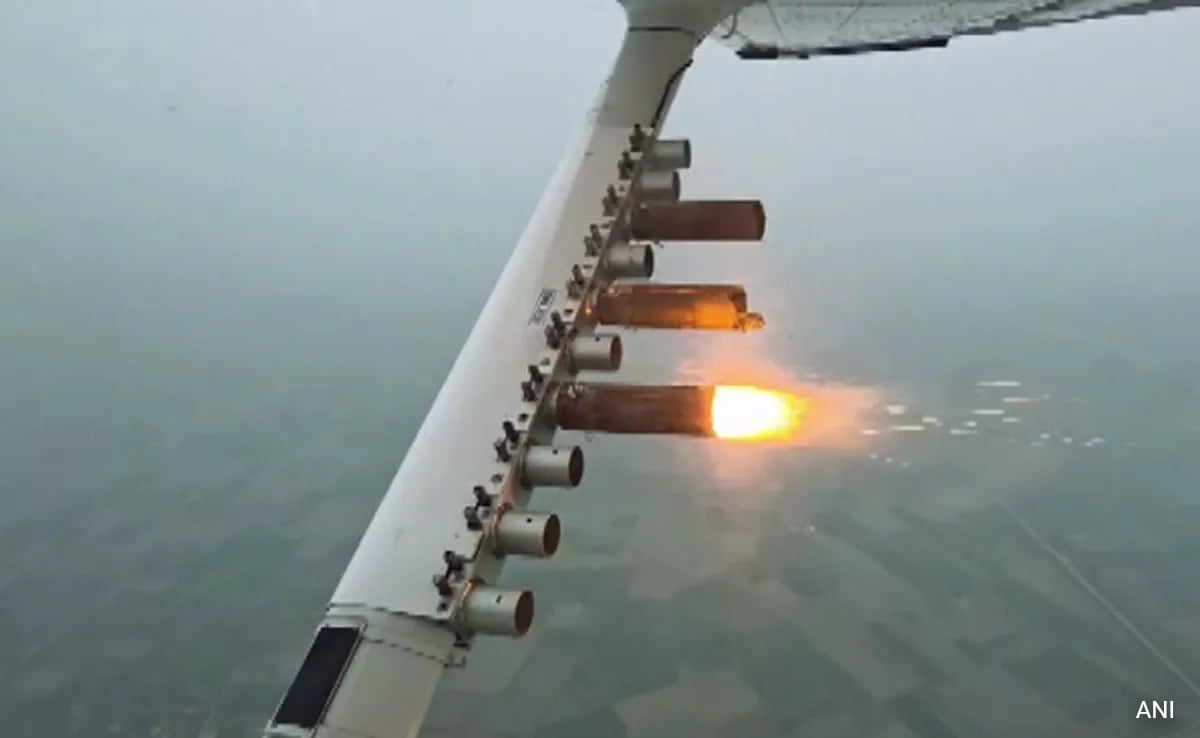
"The Cessna aircraft departed from Kanpur, released eight fire flares, and completed the trial in approximately thirty minutes," Sirsa stated in a video announcement.
This initiative forms part of the Delhi government's comprehensive strategy to address deteriorating air quality that plagues the national capital during winter months.
A report from the Indian Institute of Tropical Meteorology (IITM) indicates that the second series of trials in 1971-72 were conducted at the National Physical Laboratory campus, covering an approximate 25-km radius over central Delhi.
During those experiments, silver iodide particles released from ground-based generators served as nuclei around which moisture condensed to form raindrops.
Twenty-two days between December 1971 and March 1972 were identified as favorable for experimentation. Seeding occurred on 11 of these days, while the remaining days served as control periods for comparison purposes.
Preliminary analysis suggested increased rainfall on seeded days, indicating that artificial precipitation could be triggered under appropriate weather conditions.
Cloud seeding research has since expanded throughout India.
New research centers were established near Chennai (formerly Madras) and Pune, equipped for both ground-based and aircraft seeding operations.
Under IITM's Cloud Aerosol Interaction and Precipitation Enhancement Experiment (CAIPEEX) program, scientists have conducted extensive studies on clouds and rainfall patterns across different regions of India for over a decade.
During CAIPEEX Phase IV (2017-2019), IITM researchers conducted experiments in Maharashtra's Solapur, a rain-shadow area receiving limited natural rainfall. They examined 276 clouds over two years to evaluate cloud seeding effectiveness.
According to IITM, cloud seeding involves introducing cloud-forming particles into existing clouds to enhance rainfall.
Two primary techniques exist: hygroscopic and glaciogenic seeding. Hygroscopic seeding targets warm clouds, where tiny seed particles attract water vapor, helping droplets merge and grow until they precipitate as rain.
Glaciogenic seeding focuses on cold clouds, introducing silver iodide particles that form ice crystals near cloud tops, which subsequently melt and fall as rain.
Results from the CAIPEEX IV experiment demonstrated that hygroscopic seeding increased rainfall by up to 46 percent in certain areas, with an average increase of 18 percent over a 100 square kilometer area.
In Solapur alone, IITM reports that the technique generated approximately 867 million liters of additional water.
Modern cloud seeding employs sophisticated technology: aircraft equipped with flares disperse seeding material into suitable clouds, ground-based radars monitor cloud movements, and automatic rain gauges measure ground precipitation.
Scientists analyze real-time data to identify the most appropriate clouds for seeding, maximizing efficiency.
Globally, over 56 countries practice cloud seeding, including Australia, China, Russia, Thailand, the UAE, and the United States, employing it for weather modification, rainfall enhancement, and pollution reduction.
The current Delhi project, approved by multiple regulatory bodies including the Directorate General of Civil Aviation (DGCA), aims to evaluate whether artificial rainfall could provide a viable solution to combat escalating pollution levels during winter months.
On May 7, the Delhi Cabinet approved funding for five cloud-seeding trials at a total cost of Rs 3.21 crore.
Source: https://www.ndtv.com/india-news/delhis-cloud-seeding-trial-3rd-such-exercise-in-city-since-1957-9532143