
Former Hurriyat Chief Abdul Gani Bhat Dies At 90
Former Hurriyat Conference chairman Abdul Gani Bhat, who was seen as a moderate among the separatist leadership, died at his Sopore residence on Wednesday. He was 90.
- Date & Time:
- |
- Views: 57
- |
- From: India News Bull
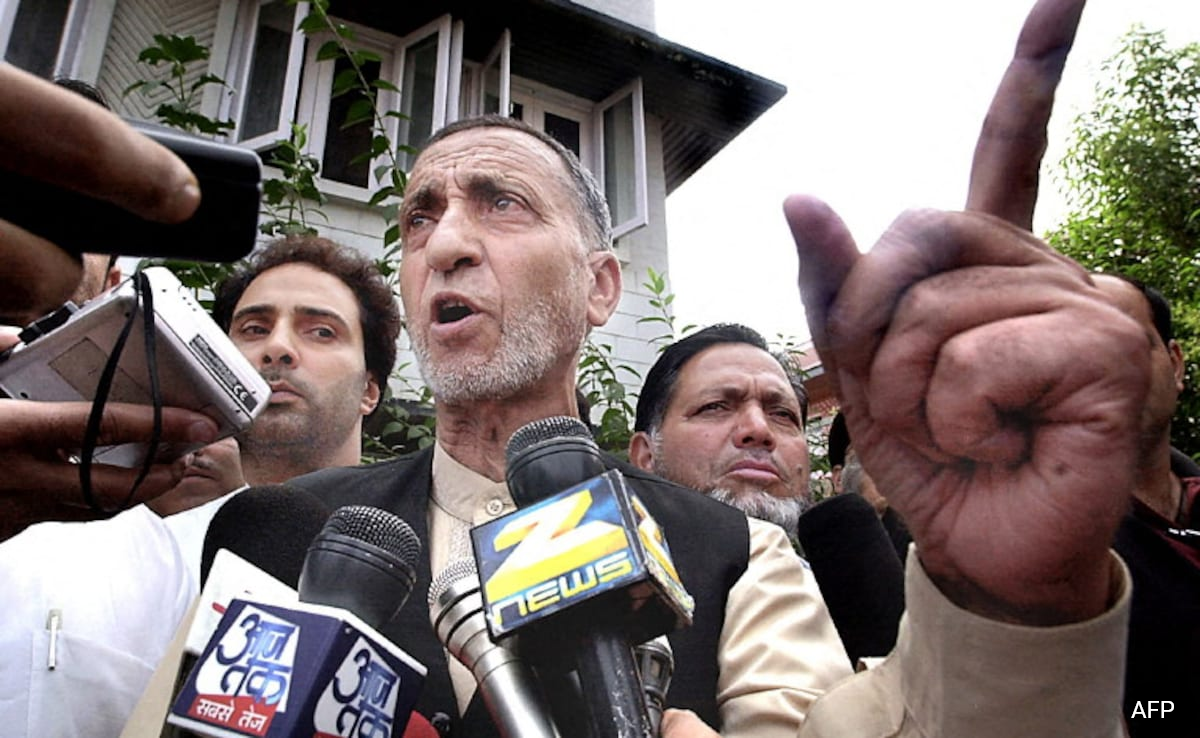
Abdul Gani Bhat is expected to be laid to rest in his ancestral graveyard in Sopore.
Srinagar:
Abdul Gani Bhat, the former chairman of Hurriyat Conference who was regarded as a moderate voice among separatist leaders, passed away on Wednesday at his residence in Sopore. He was 90 years old.
According to Hurriyat chairman Mirwaiz Umar Farooq, Mr. Bhat, who had been largely confined to his home in Baramulla district's Sopore due to health issues in recent years, died this evening.
"I just received confirmation of the sad news from Bhat Sahib's son," Mr. Mirwaiz informed PTI.
Family sources indicated that Mr. Bhat will likely be buried in his ancestral graveyard in Sopore.
Chief Minister Omar Abdullah acknowledged that while their political ideologies differed dramatically, "I will always remember him as a very civil person".
"I'm saddened to hear about the demise of senior Kashmiri political leader & academician Professor Abdul Gani Bhat Sb," Mr. Abdullah posted on X.
"He had the courage to advocate dialogue when many believed violence was the only path forward, which led to his meetings with then PM Vajpayee ji & Deputy PM Advani ji...," he added.
PDP chief Mehbooba Mufti remarked that despite their differing political perspectives, she "turned to him for solace during difficult times".
"... He represented a voice of moderation amid Kashmir's turbulent history—an esteemed scholar, teacher, and intellectual with a pragmatic approach to politics. A strong advocate for peaceful resolution of the Kashmir issue, his influence was profound," she stated.
In a post on X, Mr. Mirwaiz described Abdul Bhat's death as a tremendous personal loss.
"Just heard the very sad news that I lost the affectionate elder, a dear friend and colleague, Prof. Abdul Ghani Bhat Sahib, who passed away sometime ago. Inna lillahi wa inna ilayhi raji'un. A huge personal loss! May Allah grant him the highest place in Jannah. Kashmir has been bereft of a sincere and visionary leader," he wrote.
During Kashmir's peak militant period, Mr. Bhat was viewed as a peace advocate among separatist hardliners like Syed Ali Shah Geelani and Masarat Alam, consistently promoting dialogue with New Delhi to resolve the Kashmir issue.
Mr. Bhat played an instrumental role in facilitating talks between the Hurriyat Conference and the central government during both Atal Behari Vajpayee's NDA administration and later Manmohan Singh's UPA government.
He served as the final chairman of the unified Hurriyat Conference before the decision to engage in talks with the Centre led to a significant split in the multi-party coalition.
The former Hurriyat chairman had openly expressed his opposition to using violence for achieving political goals.
He also frequently voiced his disapproval of the extended and frequent shutdowns in Kashmir.
While both Geelani and Bhat originated from Sopore, the latter was recognized as a sophisticated politician capable of navigating complex situations with remarkable skill.
Born in 1935 in Botengoo, Sopore, Mr. Bhat completed his graduation in Persian studies from Sri Pratap College in Srinagar. He subsequently earned postgraduate degrees in Persian and a Law degree from Aligarh Muslim University.
Initially practicing law in Sopore, he later became a professor of Persian at Government College in Poonch in 1963.
He remained in government service until 1986 when he was dismissed on security grounds.
Abdul Bhat entered politics in 1986, co-founding the Muslim United Front (MUF), a right-leaning coalition led by Jamaat-e-Islami.
He was imprisoned for several months following the 1987 assembly elections, which MUF lost despite receiving favorable public response during their campaign.
The astute politician later revived the Muslim Conference in Jammu and Kashmir, which became a significant component of the Hurriyat Conference when the alliance was formed in 1993.