
China's Military Expansion: 36 New Hardened Aircraft Shelters Near India's Arunachal Pradesh Border
- Date & Time:
- |
- Views: 58
- |
- From: India News Bull
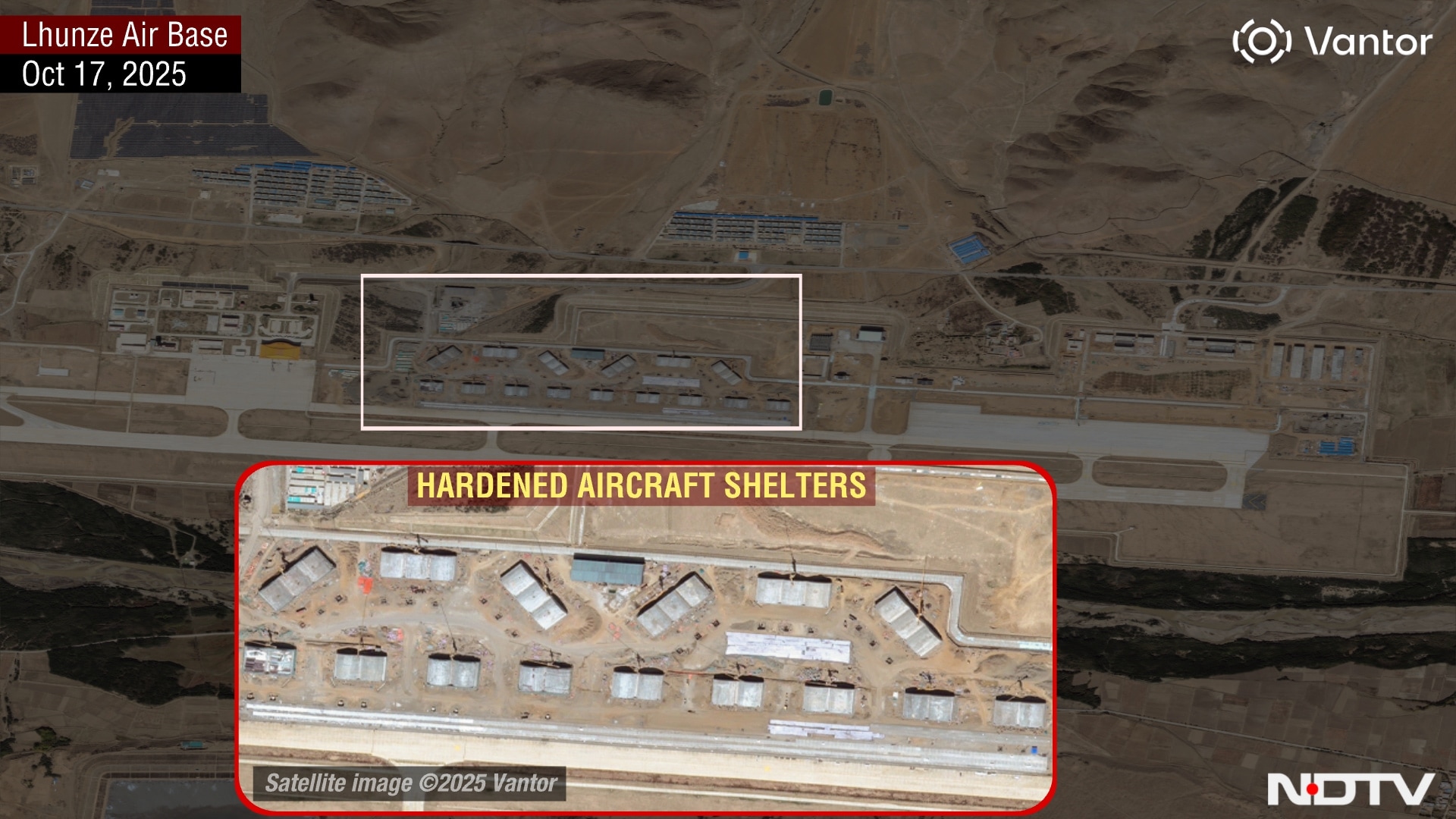
China's Lunze Air Base features 36 hardened aircraft shelters.
New Delhi:
China has completed construction of 36 hardened aircraft shelters, new administrative blocks, and a new apron at its Lhunze airbase in Tibet, approximately 40 kilometres north of the McMahon line - the boundary separating India and China in the Arunachal Pradesh region.
The establishment of these hardened shelters at Lhunze, roughly 107 kilometres from the strategic town of Tawang in Arunachal Pradesh, provides China with the capability to forward-deploy fighter aircraft and various drone systems. This development significantly reduces the response time required for the Indian Air Force to counter any airborne threats from its bases across Arunachal Pradesh and Assam.
Oct 17 image shows 36 completed hardened air shelters. April 2 image shows earthworks were underway.
"Construction of 36 hardened aircraft shelters at Lhunze clearly indicates that during the next incident, their tactical fighters and attack helicopters operating in support of their army would be based in Lhunze," stated Air Chief Marshal BS Dhanoa (retired), former Indian Air Force chief, in an interview with NDTV.
He noted that ammunition and fuel have likely already been prepositioned in underground tunnels in this area.
"I told my staff during the Doklam incident (in 2017) that the PLAAF's (People's Liberation Army Air Force) problem in Tibet is not aircraft but deployment. I had then prophesied that the day they start building hardened aircraft shelters in their airfields in Tibet would mean that they would be preparing for a war with us. Their key vulnerability in Tibet would get removed," he added.
October 17 image of Lhunze air base layout. Lhunze is about 100 km from Arunachal's Tawang.
Air Marshal Anil Khosla, former vice chief of the Indian Air Force, observed that the construction and upgrade of these airfields could support future Chinese military plans and represent a "serious strategic threat" to India, particularly when analyzed alongside recent geopolitical tensions, evolving Chinese military capabilities, and infrastructural developments since the 2020 Galwan clashes.
''The upgrades at Lhunze carry profound implications for regional security, particularly in the context of ongoing India-China border standoffs since 2020 (like the Galwan Valley clash). The 36 hardened aircraft shelters enable the dispersal of assets, reduce vulnerability to concentrated attacks, and allow sustained operations in high-altitude conditions," he said.
Air Marshal Khosla explained that these hardened shelters provide protection against precision-guided munitions, Indian airstrikes, and missile barrages, making it "far more challenging to degrade the base early in a conflict".
"Air Bases like Tingri, Lhunze, and Burang are located close to the Line of Actual Control (LAC), within 50-150 km. This proximity allows for the quick deployment of PLA Air Force assets to forward positions and shorter response times in case of a border escalation. These airfields enable coverage of Indian positions in Arunachal Pradesh, Sikkim, Uttarakhand, and Ladakh," he said.
Recent images from Vantor (formerly Maxar) also indicate the presence of several CH-4 drones on the tarmac at Lhunze.
October 17, 2025 image of Lhunze air base shows three possible CH-4 drones on the tarmac.
The CH-4 Unmanned Aerial Vehicle is designed for high-altitude missions and can deploy short-range air-to-surface missiles from altitudes exceeding 16,000 feet, making it particularly effective as an attack platform in the high-altitude Tibet region. Equipped with an electro-optical sensor turret, the CH-4 drone operates through a datalink with ground controllers.
India's most direct response to this drone threat will begin arriving in 2029 with the first General Atomics-manufactured Sky Guardian drones entering service with the IAF and Indian Army. Each force will receive eight drones.
The Sky Guardian, a variant of the Sea Guardian (15 of which are being acquired by the Indian Navy), is part of an overall deal valued at $3.5 billion.
These US-built drones will significantly enhance India's intelligence, surveillance, and reconnaissance (ISR) capabilities across the Himalayas, with the additional capacity to conduct precision strike missions.
Currently, India's armed forces utilize less advanced Israeli-manufactured Heron and Searcher UAVs.
Air Marshal SP Dharkar, also a former vice chief of the Indian Air Force, noted that the development of hardened aircraft shelters would present significant challenges for India.
"Over the years, we carefully watch development across our northern borders. We have historically taken some solace in the fact that geography, terrain, and the elevations that pertain to those regions gave us some slight advantage as regards the conduct of air operations. However, we now find that the fielding of modern and more capable platforms and the development of a greater number of airfields with larger infrastructure and longer runways is somewhat shrinking that advantage," he said.
"We also now find that increasingly there is the buildup of hardened aircraft shelters and other hardened infrastructure that would now serve to be even more challenging for us in terms of the conduct of appropriate air operations in that zone," Air Marshal Dharkar stated.
Geo-intelligence expert Damien Symon observed that the rapid construction of these aircraft shelters opposite India's Tawang sector demonstrates Beijing's efforts to expand its air power in a historically sensitive region.
"While India maintains strong air infrastructure near this stretch of the Line of Actual Control, the scale of militarisation at Lhunze highlights Beijing's intentions to narrow that gap," said Symon, who contributes to The Intel Lab, a global collective of leading intelligence analysis professionals.
''The purpose of these shelters, whether for rotary or fixed-wing aircraft or both, currently remains unclear, yet their development promises to enhance China's response time and power projection capability across a region of harsh weather and rugged mountain terrain,'' he said.
The upgrade of the Lhunze base occurs as China continues to develop six new air bases positioned against India's defenses along the Himalayan frontier.
Map showing all key Indian and Chinese air bases across the Himalayan frontier.
Details of these developments, documented through satellite imagery by NDTV in April this year, include bases at Tingri, Lhunze, Burang, Yutian, and Yarkant.
Beyond hangars and runway extensions, these air bases feature new apron space, engine test pads, and support structures.
In response to NDTV's April report on Chinese airfield construction, the Indian Air Force stated, ''We have our mechanisms in place, and we keep ourselves aware.''
China's ongoing upgrade of existing air bases and construction of new facilities clearly aims to counterbalance India's traditional advantage along the Himalayas - the IAF has operated 15 major air bases from Leh in the north to Chabua in the east for decades.
The continued air base upgrades by both India and China reflect a new strategic reality in the region, despite attempts to reset relations between Beijing and New Delhi following the Galwan confrontation between Indian and Chinese soldiers on June 15-16, 2020.
In August, Prime Minister Narendra Modi visited Tianjin, his first visit to China in seven years, and held a "fruitful" meeting with Chinese President Xi Jinping.
India and China continue working to stabilize bilateral relations, focusing on renewed direct flights between the two nations, expanded trade, and cooperation in rare earths.
Source: https://www.ndtv.com/world-news/exclusive-china-builds-36-aircraft-shelters-40-km-from-arunachal-border-9523393