
Tragedy Amidst Bureaucracy: How A 4-Month-Old's Death Reveals India's Failed Child Nutrition System
- Date & Time:
- |
- Views: 60
- |
- From: India News Bull
Bhopal:
Daily, the government purportedly allocates significant funds for child nutrition across Madhya Pradesh. Anganwadi registers document spending Rs 8 per day for malnourished children and Rs 12 for severely malnourished ones. Yet amid these financial allocations, four-month-old Hussain Raza became another casualty in a state seemingly incapable of nourishing its youngest citizens.
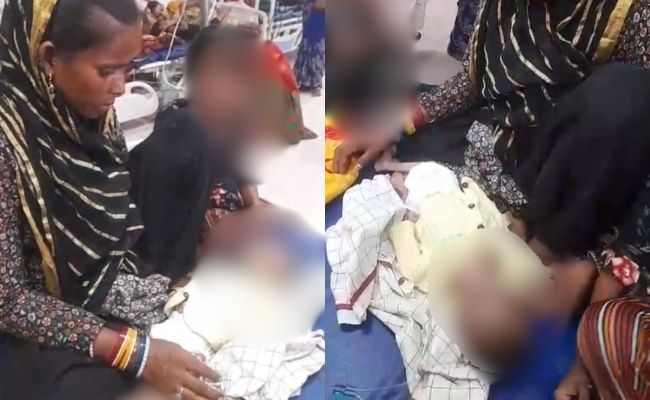
At Satna District Hospital last week, the ICU monitor quietly measured the fading heartbeats of a dying infant. A young mother sat immobile beside a steel cot, her face ashen under the stark lighting. Her baby's skeletal frame was visible through translucent skin, his parched lips too weak even to cry.
"The last moment I had with him, my finger was on his lips," recalls Asma Bano, Hussain's mother. "The nurse told me he was critically weak. They switched machines and inserted various tubes, but my son kept slipping away. My two-and-a-half-pound baby felt weightless, as if he were resting directly on my soul."
For four consecutive nights under the harsh PICU lights, Asma watched her child's life gradually fade. That Tuesday night, the monitor finally fell silent.
In Marwa village within Satna's Majhgawan block—where red dust coats every surface and the closest medical facility is two hours away—Asma and her husband Aamir Khan reside in a simple dwelling of grass, bamboo, and plastic. Rain penetrates their roof; the floor is bare earth. Inside hangs an empty cradle, gently swaying in the afternoon breeze.
"I imagined him growing up here, playing in these fields," Asma whispers, holding her son's photograph. "Now there's no earthy fragrance, only smoke and emptiness."
Aamir, who earns merely Rs 250 daily as a laborer, explains: "We sought help everywhere—Jaitwara, Satna, even private facilities through Ayushman Bharat. We believed he would recover. But there was no follow-up. Anganwadi representatives came just once to record his name. Then they disappeared."
The Anganwadi system, designed to deliver nutrition directly to families, never returned. "We received nothing," Asma says brokenly. "No nutritional packages, no supplements, no visits. Nobody inquired about our child's condition. We only ever received panjiri once. He died in hospital. They diagnosed pneumonia, but he was also starving."
Aamir adds with bitterness, "He never received vaccines after birth. How could he fight pneumonia without any strength?"
Health department records indicate Hussain was born at a healthy three kilograms. By his death, he weighed just 2.5 kilograms. He had only received birth doses of OPV, Hepatitis B, and BCG vaccines, with none thereafter. His name was absent from the Dastak Abhiyan—the very initiative designed to identify malnourished children between 0-5 years.
When questioned, local Anganwadi worker Shakun Gautam claimed the family had left during the survey period. A subsequent inspection by the Child Development Project Officer and supervisor exposed this falsehood. Asma and Hussain had remained in Marwa throughout.
Investigations revealed Hussain was never admitted to a Nutrition Rehabilitation Centre (NRC) nor classified as severely malnourished in official records. Essentially, he remained invisible to the system tasked with protecting him.
Satna district alone has 7,935 malnourished children, with 1,451 severely affected. Between April and September 2025, nine NRCs in Satna and Maihar admitted 1,209 malnourished children, averaging 200 monthly. At Panas Anganwadi Centre in the Nagaud project, seven of nineteen children were severely malnourished—36 percent, nearly six times the acceptable threshold.
Across 125 Anganwadi centres, malnutrition rates far exceed government standards. While the state's official malnutrition rate stands at 7.79 percent compared to the national 5.4 percent, reality reveals entire rural communities surviving on paper nutrition and phantom programs.
Under a neem tree in Marwa, women gather, their faces etched with exhaustion and resignation. "There's an ASHA worker assigned here who never visits," one woman states. "Nobody inquires about our children's health. Pregnant women receive neither iron supplements nor vaccines. Anganwadi workers record names, but no food arrives. When we attempt vaccination, we wait all day until our feet swell, only to be told to return next week."
Their barefoot children play nearby with hunger-distended bellies. "The government promises nutrition for every child," another mother observes. "We've only experienced hunger."
Dr. Rupesh Soni, BMO of Majhgawan, confirms: "He was hospitalized on October 17 and died 2-3 days later. The cause was pneumonia exacerbated by malnutrition."
Show-cause notices have been issued to Khutha Medical Officer Dr. S.P. Srivastava, health worker Lakshmi Rawat, and ASHA worker Urmila Satnami. Yet accountability rarely extends beyond administrative procedures.
Satna alone contains 2,054 Anganwadi centres with thousands of employees and countless reports. Nevertheless, for Hussain, there was no milk, no monitoring, no intervention.
Nirmala Bhuria, Minister of Women and Child Development, characterized it as a broader challenge: "Malnutrition is a global issue. Awareness is equally crucial. Our government works continuously to eliminate malnutrition in both rural and urban regions. We've also requested additional support from the central government."
In Marwa, silence hangs heavy. The Anganwadi register continues recording Rs 8 for "malnourished" children and Rs 12 for "severely malnourished" ones. Asma's once laughter-filled lap remains empty. Government files continue accumulating.
And somewhere between eight and twelve rupees, another life was assessed, processed, and lost.
Source: https://www.ndtv.com/india-news/4-month-olds-death-exposes-madhya-pradeshs-hollow-fight-against-malnutrition-9523013