
Monsoon Exits Delhi Early, Earliest Withdrawal Since 2002
- Date & Time:
- |
- Views: 45
- |
- From: India News Bull
Monsoon Exits Delhi Early, Earliest Withdrawal Since 2002
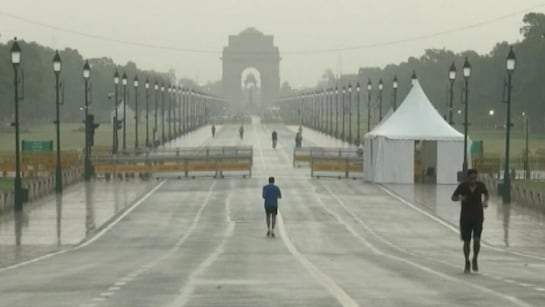
Despite concluding earlier than expected, Delhi experienced an exceptionally rainy monsoon season.
New Delhi:
The India Meteorological Department (IMD) announced Wednesday that the southwest monsoon has officially withdrawn from Delhi and surrounding areas one day before its regular schedule.
This represents the earliest withdrawal from the capital since 2002, when the monsoon season concluded on September 20. In comparison, the 2024 withdrawal occurred on October 2, according to official data.
Though departing ahead of schedule, Delhi recorded remarkably heavy rainfall during this monsoon period.
The seasonal precipitation at Safdarjung, Delhi's primary weather observatory, reached 902.6 mm – approximately 41 percent above normal levels.
Across the entire city, Delhi averaged 736.2 mm of rainfall, exceeding the long-term normal of 536.3 mm by 37 percent. The IMD's monsoon rainfall calculations cover the June through September period.
"As of September 24, the southwest monsoon has further withdrawn from Punjab, Haryana, Chandigarh, Delhi, portions of Gujarat and Rajasthan, and areas of Madhya Pradesh, Uttar Pradesh, Uttarakhand, Himachal Pradesh and Jammu and Kashmir," stated the IMD.
The capital's seasonal total fell short of 2023's measurement of 1,029.9 mm, which ranked as Delhi's seventh wettest monsoon on record.
Previous years' totals include 660.8 mm in 2023, 516.9 mm in 2022, and 1,169.7 mm in 2021. With consistent precipitation since May, Delhi has already exceeded 1,000 mm in annual rainfall this year.
September alone delivered 136.1 mm of rain, surpassing the monthly normal of 123.5 mm. Earlier in the season, the city experienced its wettest May ever recorded, with 186.4 mm against the typical 30.7 mm, followed by an above-normal June (107.1 mm), a rainier-than-usual July (259.3 mm), and an exceptionally wet August (400.1 mm), the highest in 15 years. The city witnessed three days of heavy rainfall: July 29 (68.1 mm), August 9 (79 mm), and August 15 (79.4 mm).
Among districts, Central Delhi recorded the highest rainfall at 950 mm, while South Delhi received the least at 550.3 mm – though still above deficit levels. According to the data, no district experienced a rainfall shortfall.
Since September 20, dry northwesterly winds have dominated the region, causing temperatures to rise.
On Wednesday, Delhi's maximum temperature reached 35.4 degrees Celsius, one notch above normal, while the minimum temperature was 24 degrees Celsius.
Air quality remained in the "moderate" category, with the 24-hour average AQI at 120, slightly better than Tuesday's reading of 126. According to the Central Pollution Control Board (CPCB), an AQI between zero and 50 is considered 'good', 51 and 100 'satisfactory', 101 and 200 'moderate', 201 and 300 'poor', 301 and 400 'very poor', and 401 and 500 'severe'.