
Once Nitish Kumar's Trump Card, This Group Is Now Rahul Gandhi's Bihar Bet
- Date & Time:
- |
- Views: 56
- |
- From: India News Bull
Once Nitish Kumar's Key Constituency, This Group Is Now Rahul Gandhi's Target In Bihar
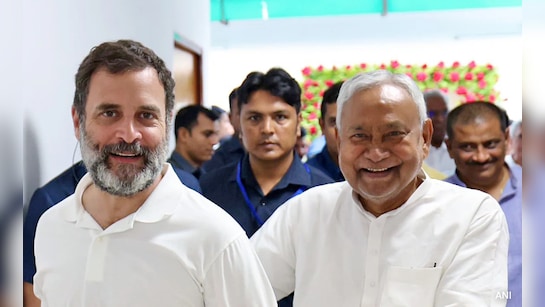
Nitish Kumar with Rahul Gandhi during his brief alliance with INDIA bloc before returning to NDA
New Delhi:
In Bihar's political landscape, caste serves as both guiding principle and constraint: it defines every voter's identity, shapes party strategies, and influences policy promises, while simultaneously reinforcing traditional hierarchies. Within this complex social framework, the Extremely Backward Castes (EBCs) – comprising approximately 36 percent of Bihar's population – have emerged as a critical swing constituency.
Known locally in Mithilanchal as "Panchforna" or sometimes "Panchpaniya," these communities occupy a unique middle position. Unlike the politically dominant Yadavs or the consistently marginalized Dalits, EBCs represent the decisive floating voters who often determine which way power tilts in Bihar.
Nitish Kumar, Champion of the EBCs
For nearly two decades, Nitish Kumar strategically positioned himself as the EBCs' political guardian. His "Ati Pichhda" development initiatives, bicycle programs for schoolgirls, and one-third reservation in panchayats were more than welfare schemes – they represented calculated political outreach to communities like the Nonia, Teli, Mallah, Dhanuk, and Amatya, castes so small they barely register in official census data. By acknowledging their distinct identities while offering meaningful benefits, Nitish built the foundation for his impressive two-decade political dominance.
Electoral data confirms this relationship. According to Lokniti-CSDS surveys, approximately 45-50 percent of EBCs supported the JD(U)-BJP alliance in the 2010 assembly election, helping deliver Nitish's landslide victory. By 2015, when Nitish partnered with Lalu Prasad Yadav in the Mahagathbandhan, EBC support for the alliance rose to around 55 percent, contributing significantly to their sweeping success. However, by 2020, the pattern shifted again, with roughly 45 percent of EBCs backing the NDA while the RJD-led Mahagathbandhan secured only about one-third of their votes. This consistent pattern of shifting allegiances has made EBCs the quintessential swing voters in Bihar's electoral politics.
Political fortunes, like health, inevitably decline over time. Today's Nitish Kumar, oscillating between political alliances, appears more adrift than authoritative, his diminishing political energy reflected in the erosion of his once-solid social base. It is precisely in these emerging gaps that EBC voters have begun exploring new options, their loyalty no longer guaranteed. The votes that once secured Nitish's political future are once again contestable.
Rahul Gandhi's EBC Strategy
Rahul Gandhi has recognized this opportunity. His advocacy for a nationwide caste census and specific references to the "36 percent" represent more than moral positioning – they constitute a direct attempt to attract voters from Nitish's traditional support base. During the significant Congress Working Committee meeting at Patna's Sadaqat Ashram, Rahul Gandhi, alongside his Mahagathbandhan partners, emphasized various EBC-focused initiatives. In the Congress's strategic vision, EBCs represent not peripheral communities but a crucial voting bloc capable of determining electoral outcomes. To these communities, he offers recognition, political representation, and a refreshed narrative where they are portrayed not as "extremely backward" but as centrally important to India's democratic framework.
Karpoori Formula versus Mandal Politics
The historical irony is striking. Karpoori Thakur's reservation formula originally carved political space for EBCs against upper-caste dominance. Later, Lalu Prasad Yadav's Mandal politics effectively subordinated them beneath Yadav leadership. Nitish Kumar subsequently elevated them through targeted policies. Now, as Nitish's influence wanes, Rahul Gandhi proposes to position EBCs as the cornerstone of a national opposition strategy. Each political generation seemingly discovers in these communities the potential for electoral realignment, only to leave them searching for lasting political representation.
For EBCs, Political Leverage Through Independence
Perhaps this is the inevitable position of communities without a unifying identity or prominent leadership: to remain politically fluid, courted by all parties yet consistently disappointed. Yet their very flexibility constitutes their political strength. In 2010, they supported Nitish's victory; in 2015, they backed the Lalu-Nitish alliance; in 2020, they shifted toward the NDA. They can withhold support as effectively as they can grant it, punish as readily as they reward. In contemporary Bihar, where traditional allegiances have weakened and the state increasingly resembles a diverse mosaic rather than a rigid hierarchy, these smaller communities may ultimately carry disproportionate electoral influence.
Thus, Bihar's political narrative, like the rivers flowing through its plains, may ultimately be shaped by communities that remain difficult to categorize. The EBCs, historically marginalized, now find themselves at the center of every political strategist's calculations. They may shift allegiances, but through this very mobility, they effectively determine who secures power in Patna and who, like the aging Nitish Kumar, finds themselves politically adrift.
Source: Lokniti-CSDS post-poll surveys, Bihar Assembly Elections (2010, 2015, 2020)