
Revealed: How BJP First Considered Vajpayee for President Before Nominating Abdul Kalam
- Date & Time:
- |
- Views: 58
- |
- From: India News Bull
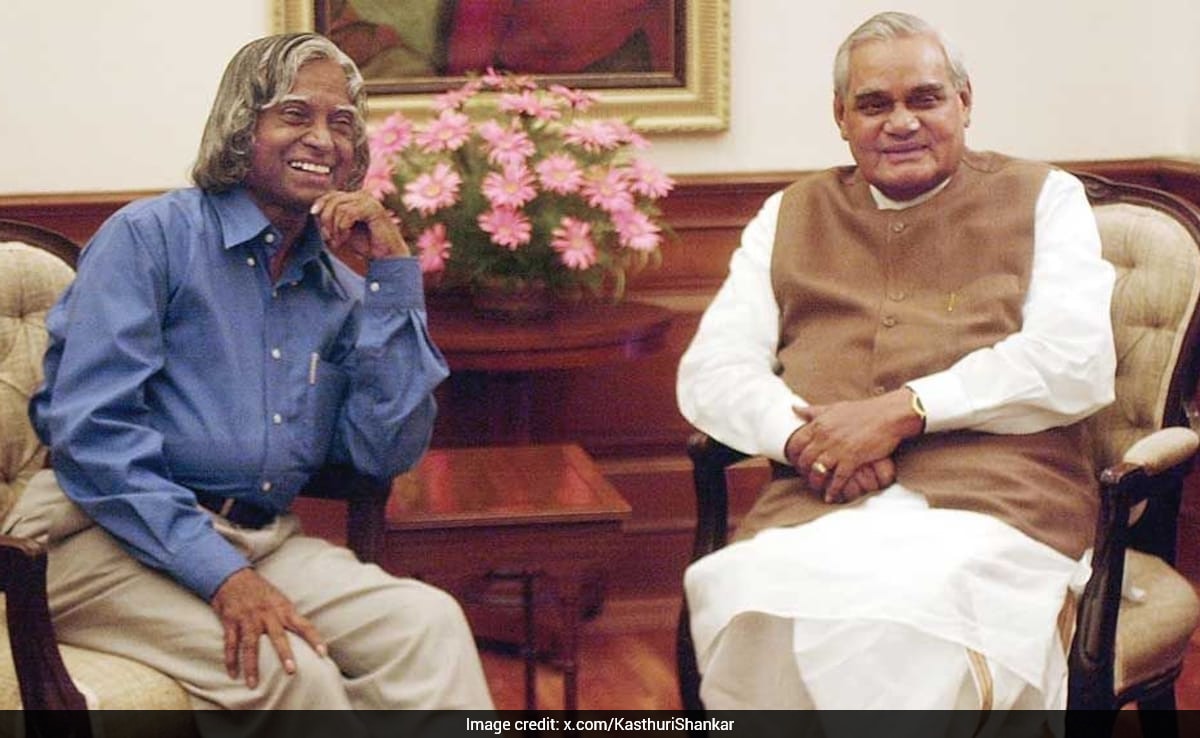
Abdul Kalam was elected the 11th President in 2002.
New Delhi:
Prior to proposing APJ Abdul Kalam as India's eleventh presidential candidate, the Bharatiya Janata Party (BJP) initially suggested that Atal Bihari Vajpayee assume the presidency while transferring the prime ministerial role to Lal Krishna Advani.
However, Vajpayee, who was Prime Minister at the time, declined this proposal, expressing concern that becoming President through his parliamentary majority would establish an inappropriate precedent for Indian democracy.
This revelation comes from Ashok Tandon's book "Atal Smaran," published by Prabhat Prakashan. Tandon served as Vajpayee's media advisor during his administration.
In 2002, Abdul Kalam became India's 11th President with broad support from both the ruling National Democratic Alliance (NDA) and Opposition parties, serving in this position until 2007.
According to Tandon, who worked as the Prime Minister's media advisor from 1998 to 2004, Vajpayee firmly rejected his party's suggestion to move to Rashtrapati Bhavan and transfer leadership to Advani.
Tandon writes that "Vajpayee was not ready for this. He believed that for any popular prime minister, becoming President by virtue of majority would not be a good sign for Indian parliamentary democracy. It would set a very wrong precedent, and he would be the last person to support such a move."
The book describes how Vajpayee invited opposition leaders from Congress to build consensus around the presidential selection. "I remember that Sonia Gandhi, Pranab Mukherjee, and Dr Manmohan Singh came to meet him. Vajpayee officially revealed for the first time that the NDA had decided to nominate Dr APJ Abdul Kalam as their candidate for the presidential election... There was a moment of silence in the meeting. Then Sonia Gandhi broke the silence and said that they were surprised by his choice, and that they had no option but to support him, but they would discuss his proposal and then make a decision."
Tandon's book also chronicles numerous other significant events during Vajpayee's prime ministerial tenure and explores his relationships with various political figures.
Regarding the Atal-Advani partnership, Tandon notes that despite occasional policy disagreements, their relationship remained strong in the public sphere. Advani consistently referred to Vajpayee as "my leader and source of inspiration," while Vajpayee addressed Advani as his "steadfast companion."
Tandon writes, "The partnership of Atal Bihari Vajpayee and Lal Krishna Advani has been a symbol of cooperation and balance in Indian politics. They not only built the BJP but also gave a new direction to both the party and the government."
The book also recounts the terrorist attack on Parliament on December 13, 2001, when a notable exchange occurred between Vajpayee and Sonia Gandhi, then Leader of the Opposition in the Lok Sabha.
During the attack, Vajpayee was at his residence watching security forces respond to the situation on television with colleagues. Tandon describes, "Suddenly, Congress President Sonia Gandhi called. She said, 'I'm worried about you, are you safe?' To this, Atalji replied, 'Sonia ji, I am safe, I was worried that you might be in the Parliament building... Take care of yourself.'"
Source: https://www.ndtv.com/india-news/before-abdul-kalam-bjp-floated-atal-bihari-vajpayees-name-for-president-book-9831446