
Delhi's Air Quality Crisis: AQI Reaches Severe Levels as Thick Smog Engulfs Capital
- Date & Time:
- |
- Views: 42
- |
- From: India News Bull
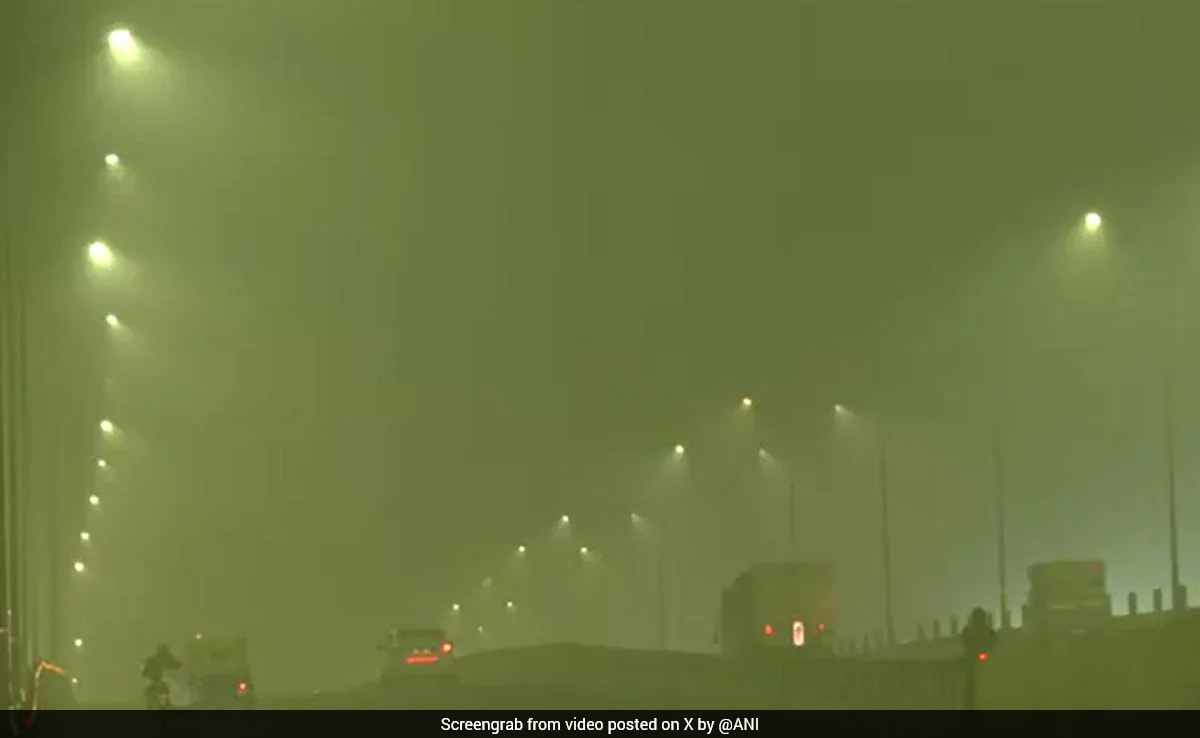
Delhi Pollution: The capital city recorded an alarming Air Quality Index of 462 at 6 am, falling into the 'severe' category.
New Delhi:
On Sunday, Delhi residents awoke to a dense blanket of smog as the city's air quality remained firmly in the 'severe' category. According to the Central Pollution Control Board (CPCB), the Air Quality Index (AQI) measured 462 at 6 am.
All 40 monitoring stations across Delhi displayed 'red' indicators, signifying 'severe' air quality conditions. Rohini in North West Delhi registered a concerning AQI of 499 with PM2.5 as the primary pollutant. Following closely were Jahangirpuri and Vivek Vihar with AQI readings of 495.
Multiple areas in Delhi experienced reduced visibility due to the thick smog. Footage from Patparganj in East Delhi, where the AQI reached 488 by 6 am, showed motorists driving cautiously with headlights illuminated despite daytime hours.
#WATCH | Delhi | Visuals from the Patparganj section of NH-24 as a layer of toxic smog blankets the city. AQI (Air Quality Index) around the area is 488, categorised as 'Severe', as claimed by CPCB (Central Pollution Control Board). CAQM (Commission for Air Quality Management) has implemented restrictions under GRAP-4.
The AQI serves as a public health indicator designed to communicate air pollution levels effectively. Eight pollutants are measured to determine an area's AQI: particulate matter (PM) 10, PM2.5, Ozone (O3), Sulphur dioxide (SO2), nitrogen dioxide (NO2), carbon monoxide (CO), lead (Pb), and ammonia (NH3), according to the CPCB.
The CPCB classifies AQI values within specific ranges: 0-50 is 'good,' 51-100 'satisfactory,' 101-200 'moderate,' 201-300 'poor', 301-400 'very poor,' and 401-500 'severe.' Each category indicates the pollution level and associated health risks. When AQI reaches the 'severe' category, even healthy individuals face health hazards and should avoid outdoor activities or exercise.
India's AQI scale has a maximum value of 500. Any measurements beyond 500 are still classified under the "severe" category, indicating a public health emergency.
Professor Dr. Gufran Beig, Chair Professor at the National Institute of Advanced Studies (NIAS), explains, "AQI above 400 is hazardous. It is assumed that the health impacts are similar at AQI 500 and AQI 900, so why show a higher number and create panic among people."
Sunil Dahiya, Founder and Lead Analyst at Envirocatalysts, notes there is no scientific basis for capping AQI at 500 despite the capability to calculate higher values.
"While it is true that long-term impacts are higher at lower concentration exposures and increase marginally at very high concentrations, but the immediate threats are way higher, leading to hospitalisation and medical emergencies for heart and respiratory patients and sensitive groups whenever pollution levels go way too high as observed during peak stubble burning episodes and around Diwali," Dahiya added.
To combat the escalating air pollution in Delhi-NCR, the Commission for Air Quality Management (CAQM) implemented restrictions under Graded Response Action Plan (GRAP) stage 3 on Saturday, later escalating to GRAP-4.
The CAQM attributed the deteriorating air quality primarily to a feeble Western Disturbance approaching northwest India rather than local emissions.
"This prevailing meteorological condition has caused a marked reduction in wind speed, at times becoming calm, a shift in wind direction from westerly to easterly, and an increase in moisture content in the lower atmosphere. Such conditions during the winter season are conducive to the formation of smog and fog, resulting in poor dispersion and trapping of pollutants near the surface. Owing to these adverse meteorological conditions, a sudden deterioration in air quality has been observed," the CAQM stated.
Under GRAP-4 restrictions, non-essential trucks are banned from entering Delhi except those carrying essential goods or operating on cleaner fuels such as LNG, CNG, electric, or BS-VI diesel.
Delhi-registered medium and heavy diesel vehicles (BS-IV and older) are prohibited except for essential services. Light commercial vehicles from outside Delhi that don't meet EV, CNG, or BS-VI diesel standards are also barred unless providing essential services.
All construction and demolition activities, including public projects like highways, are suspended.
State governments in Delhi-NCR may transition physical classes for students in grades VI to IX and XI to online learning.
Public, municipal, and private offices are advised to implement at least 50% work-from-home arrangements, and staggered work hours are recommended to reduce peak-hour traffic congestion.
Source: https://www.ndtv.com/india-news/delhi-air-pollution-delhi-aqi-thick-smog-blankets-delhi-low-visibility-at-airport-air-quality-severe-9805728