
Satellite Data Reveals Farmers Shifted Stubble Burning to Afternoons, Evading Detection Systems
- Date & Time:
- |
- Views: 58
- |
- From: India News Bull
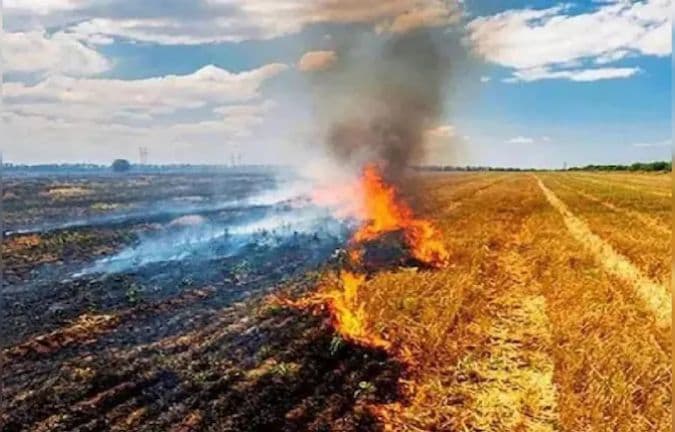
The report has confirmed genuine progress in reducing the total area set on fire.
New Delhi:
Claims of a nearly 90% reduction in stubble burning across Punjab and Haryana - a major contributor to Delhi-NCR pollution - have been challenged by a comprehensive multi-satellite analysis. This new research reveals that the reported decline stems from limitations in India's monitoring system rather than an actual decrease in farm fires.
The Stubble Burning Status Report 2025, published by the International Forum for Environment, Sustainability and Technology (iFOREST), demonstrates that farmers have strategically shifted their burning activities to late afternoon and evening hours - a time period consistently missed by standard monitoring satellites, resulting in significant undercounting.
The government's official monitoring protocol, operated by Indian Agricultural Research Institute's CREAMS (Consortium for Research on Agroecosystem Monitoring and Modeling from Space), relies primarily on polar-orbiting satellites like MODIS/VIIRS that only capture data between 10:30 AM and 1:30 PM as they pass over the region.
iFOREST's analysis employed high-frequency observations from the geostationary SEVIRI satellite, confirming a substantial shift in burning times. In Punjab, over 90% of large fires during 2024 and 2025 occurred after 3 pm, compared to merely 3% in 2021. Haryana's data showed most large fires consistently occurring after 3 pm since 2019, validating that significant undercounting has been ongoing for years.
"Our analysis provides incontrovertible evidence that India's current stubble-burning monitoring system is structurally misaligned with ground realities," stated Chandra Bhushan, CEO of iFOREST. "The result is a massive underestimation of fires, emissions, and their contribution to air pollution in Delhi."
While challenging the claimed 90% decline, the iFOREST report does confirm meaningful progress in reducing the total area subjected to burning. Using burnt-area mapping from the Sentinel-2 satellite, which provides a more reliable measure than active fire counts affected by timing, researchers documented genuine improvements.
Punjab witnessed a 37% reduction in stubble-burnt area since its 2022 peak - decreasing from 31,447 square km to approximately 20,000 square km in 2025. Haryana showed a 25% reduction from its 2019 peak, with burnt area falling to 8,812 square km in 2025.
"Burnt area provides a more reliable picture of stubble burning... a 25-35% reduction is good news and indicates that in-situ and ex-situ stubble-management practices are being adopted," acknowledged Bhushan, while cautioning against complacency as nearly 30,000 square km of paddy fields were still subjected to burning across both states in 2025.
The report emphasizes that flawed monitoring data undermines the evidence foundation for effective air-quality policymaking, leading to underestimation of stubble burning's impact on Delhi's pollution levels.
Among its recommendations, iFOREST suggests that CREAMS should publish burnt-area data alongside active fire counts to provide a more comprehensive and accurate assessment.
The organization also advocates for revising Delhi's air-quality forecasting models to correctly quantify stubble burning's contribution, and expanding policy interventions beyond Punjab and Haryana to address emerging hotspots in states like Uttar Pradesh and Madhya Pradesh.
"We cannot manage what we do not measure accurately," emphasized Ishaan Kochhar, Programme Lead at iFOREST. "To solve the stubble-burning problem, the government must urgently reform the monitoring protocol to integrate burnt-area mapping and geostationary data."
A similar investigation last year had also revealed that farmers were timing their stubble burning activities to avoid detection by NASA satellites, with satellite images exclusively accessed by NDTV appearing to confirm this practice.
Source: https://www.ndtv.com/india-news/delhi-pollution-stubble-burning-punjab-haryana-farm-fires-didnt-end-they-just-moved-to-afternoon-satellite-data-analysis-9779018