
Madras High Court Rejects Tamil Nadu Government's Appeal in Thirupparankundram Temple Lamp Controversy
- Date & Time:
- |
- Views: 57
- |
- From: India News Bull
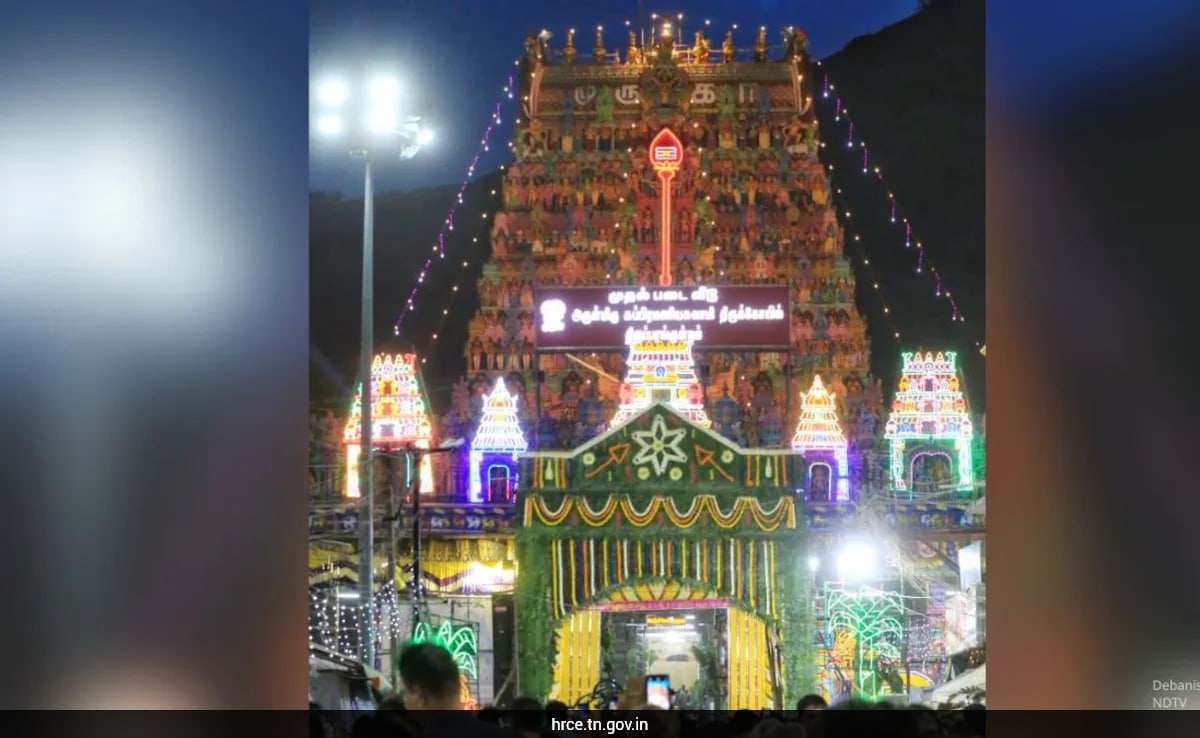
The Madras High Court's Madurai bench rejected an appeal by the Tamil Nadu government and Madurai District Collector on Thursday, challenging a contempt order in the Thirupparankundram Subramaniaswamy temple case. The dispute centers on lighting a festival lamp on one of two ancient pillars situated on a hill that also houses a 14th-century dargah.
Earlier on Monday, a single-judge bench had mandated the lighting of lamps on both the upper pillar and the lower pillar, the latter having been the traditional location for approximately 100 years.
Following non-compliance with this directive, the judge permitted the petitioner and ten others to ascend the hill and light the lamp themselves. In an unusual enforcement measure, the court ordered protection by the Central Industrial Security Force (CISF), noting that this federal deployment was necessary only because state authorities had failed to implement the earlier ruling.
The state subsequently filed an intra-court appeal contesting the Madurai bench's decision.
On December 1, the High Court's Madurai bench determined that the upper stone pillar or 'deepathoon' near the dargah constituted temple property and must be incorporated into the lamp-lighting ceremony. The court stressed the importance of the temple asserting its rightful possession.
The temple administration filed an appeal on December 2, but the court did not schedule it for hearing.
By December 3, the festival day, the petitioner submitted a contempt plea arguing that no arrangements had been made to comply with the court's order. The single-judge bench summoned temple officials and the Madurai police commissioner to appear via video conference at 5 pm.
With the lamp scheduled to be lit at 6 pm, arguments were presented that the petition was premature, prompting the judge to adjourn until 6:05 pm. By that time, however, the lamp had already been lit at the traditional site only. The displeased judge, citing non-compliance, then ordered the lamp to be lit on the upper pillar as well.
Chaotic scenes ensued as hundreds attempted to climb the hill, breaking through barricades and clashing with police forces. Some officers were attacked during the confrontation. District officials subsequently imposed prohibitory orders, preventing both the petitioner and CISF personnel from reaching the upper pillar.
In today's court proceedings, the state argued that both it and the dargah administration should have been granted a 30-day window to file an appeal, and therefore the contempt petition should not have been addressed so hastily.
The state further contended that deploying the CISF constituted judicial overreach, pointing out that the force is intended to secure court premises rather than enforce law. State representatives also claimed the petitioner had mobilized crowds, disrupted public harmony, and triggered the imposition of prohibitory orders.
Additionally, the state maintained that in contempt proceedings, the court's authority is limited to punishing disobedience rather than issuing new operational directives.
The administration reiterated that the lamp had traditionally been lit in one location only, and changing this practice would offend religious sentiments. They also explained that temple officials could not attend the evening hearing due to the volatile situation with the crowds.
Separately, the dargah management questioned whether the responsibility for lighting the lamp could legally be transferred from temple authorities to the petitioner.
The petitioners countered by asserting that police had refused to provide security despite a court order, and that the state government's non-compliance had forced the court to authorize them to light the lamp themselves.
The High Court emphasized that communal harmony must be built through cooperation rather than obstruction, reaffirming the principle that legal orders must be obeyed unless stayed by a higher judicial authority.
Politically, these developments represent a significant setback for the ruling DMK, which already faces allegations of maintaining an 'anti-Hindu' stance to appeal to Muslim voters—a charge the party has consistently denied. BJP leader Tamilisai Soundararajan told NDTV, "It's a slap on the face of the Tamil Nadu government".
For the BJP, which currently has minimal presence in Tamil Nadu, this controversy offers a powerful opportunity to criticize the DMK and expand its political influence, particularly ahead of the 2026 Assembly election. The ruling DMK has yet to issue a formal response, but a party source informed NDTV that the BJP "stands exposed once again, like in the Babri Masjid demolition case. Real devotees are with the government and this won't affect us electorally".
Government sources dismissed allegations of an 'anti-Hindu stance' as unfounded. A senior official stated that the state "is not against Hindus. We are only protecting the interests of Hindus".
Source: https://www.ndtv.com/south/drama-and-setback-for-tamil-nadu-government-in-thirupparankundram-subramaniaswamy-temple-lamp-row-9750930